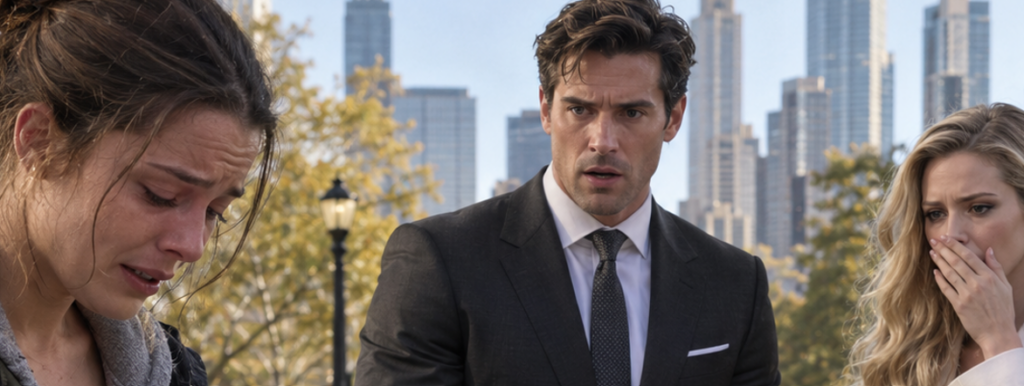
“Four.”
The word left my mouth so softly that the ambient noise of Grant Park swallowed it whole.
Adrian stayed crouched by the stroller. At first, his face didn’t register a thing. Then, something deep inside him seemed to give way.
“Four,” he echoed.
My daughter, Lily, leaned forward with total, innocent curiosity. “Mommy, who is he?”
I gripped the stroller handle until my knuckles turned white.
Adrian looked at me. If this day ever came, I had pictured a dozen different reactions in my head—anger, suspicion, accusations. Grief wasn’t one of them.
“My name is Adrian,” he told Lily softly.
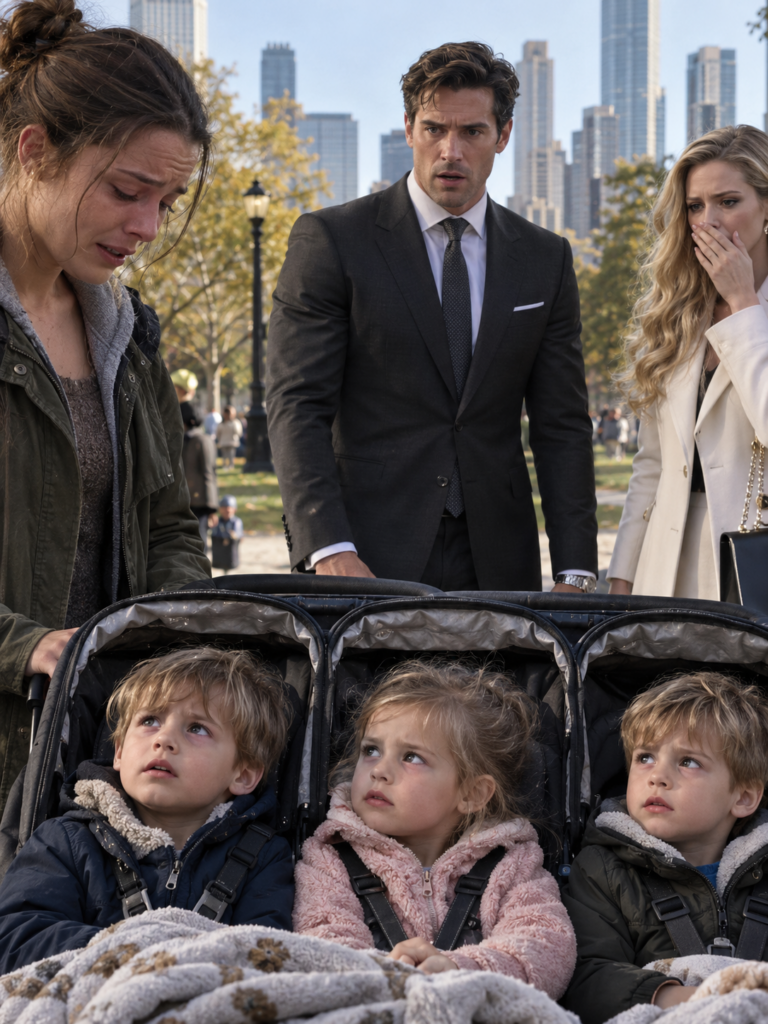
She flashed a smile. “I’m Lily.”
“I know now.” His voice cracked.
My oldest boy, Noah, frowned. “How do you know?”
Adrian gave a small, bewildered laugh. “I suppose that’s something your mother and I need to talk about.”
Right beside him, my youngest, Eli, went back to lining up his plastic cars along the stroller tray, deciding that grown-up drama was way less interesting than proper alignment.
Then a voice piped up from behind Adrian.
“Adrian?”
His fiancée. I had almost completely forgotten she was there.
She walked over slowly, her expression less confused now and more painfully alert.
Adrian stood up. “Claire,” he said.
Her eyes darted from him to me, and then down to the kids. She put the pieces together way faster than I would have liked.
“Oh.”
That single syllable carried the weight of a ruined afternoon.
I swallowed hard. “I should go.”
Instead of blocking my path, Adrian stepped aside. It caught me completely off guard. Four years ago, Adrian Vale commanded every single room he walked into. Today, he just murmured, “Please don’t disappear again.”
My chest seized up. “You’re the one who told me to disappear.”
Claire shot him a sharp look.
Adrian closed his eyes. For a second, nobody said a word.
Then Noah gave my sleeve a tug. “Mom, are we heading home?”
“Yeah.”
I pushed the stroller forward. Adrian didn’t follow. But when I snuck a glance back, he was standing under the trees, staring after us like a man watching his entire world slip away.
He showed up at my apartment the next evening.
I knew it was him before I even touched the lock. Nobody else could make three quiet knocks sound like an absolute command. I opened the door just halfway.
“You shouldn’t be here.”
“I came by myself.”
“That isn’t what I meant.”
His eyes looked exhausted—not that polished, boardroom exhaustion you hear wealthy guys complain about. He looked like he hadn’t slept in days.
“Ten minutes,” he said. “If you want me gone after that, I’ll leave.”
I really should have slammed the door in his face. Instead, I glanced over toward the living room. The kids were fast asleep.
“Ten minutes.”
He stepped inside. Adrian looked completely out of place in my cramped apartment, surrounded by coloring books, grocery store coupons, tiny sneakers, and the half-folded laundry I’d abandoned after dinner. His eyes locked onto three school photos stuck to the fridge. He walked over to them slowly.
“Which one is which?”
I hated how gentle his voice sounded.
“Noah is the oldest by seven minutes. Lily came next. Eli is the baby.”
“Triplets.”
“Yeah.”
He stared at their little faces. “You did all of this by yourself?”
“My mom helped out until she passed away two years ago.”
He turned around. “I didn’t know.”
“There was a whole lot you didn’t know.”
Pain flashed across his face. “I had that coming.”
I crossed my arms. “You deserve a lot worse.”
He nodded. That stopped me dead in my tracks. The old Adrian would have put up a fight, argued his point, or tried to steer the conversation. This man just stood in my kitchen and took the hit.
Finally, he asked, “Why didn’t you tell me?”
I stared at him incredulously. “You seriously have to ask?”
“I need to hear you say it.”
“Because you told me I was a liability.”
His jaw tightened. “You said anyone close to you instantly became a target. You said your dad was starting to poke around about me. You shoved money into an account and told me to get out of Chicago.”
“I was trying to keep you safe.”
“You broke my heart and called it protection.”
“I know.”
“No, Adrian. You really don’t.” My voice dropped to a whisper so we wouldn’t wake the kids. “I found out I was pregnant eight days after you forced me out. I spent three nights staring at your number on my screen. Every single time I almost hit call, I remembered what you told me about the Vale empire.”
He looked down at the floor.
“So I chose them,” I said. “Before I even knew there were three of them, I chose my kids.”
Adrian stayed silent for a long time. Then he asked, “Do they know anything about their dad?”
“They know he and I loved each other once.”
His head shot up. “You told them that?”
“It’s the truth.”
“Was?”
I hated that he caught that. “I am not getting into us.”
“Fine.”
Another surprise. He glanced down the hallway. “Can I meet them?”
“No.”
My answer was instant. His face hardened a fraction—not with anger, but with hurt.
“Maya—”
“You already saw them yesterday.”
“You know what I mean.”
“Yeah, and my answer is still no.”
“Why?”
“Because you’re Adrian Vale.”
His shoulders went rigid. “There it is.”
“It never went away.”
“I’m nothing like my father.”
“You inherited his name, his businesses, and his enemies.”
“My dad is dying.”
I stared at him. “What?”
“Cancer. He has months, maybe less.”
The news shook me up more than I wanted to admit.
Adrian kept going. “I’ve spent the last three years tearing down every illegal operation he ever built.”
I almost let out a cynical laugh. “That sounds impossible.”
“It nearly was.” He reached slowly inside his coat and pulled out a folded packet of papers, laying them flat on my kitchen table. I didn’t touch them.
“What is that?”
“A federal compliance agreement involving Vale Holdings. Asset restructuring, business liquidations, and the names of every shell company I sold off.”
I scanned the top page. It looked entirely legitimate. That scared me way more than if it had looked like a fake.
“Why?”
“Because four years ago, I genuinely believed the only way to keep you safe was to cut you out of my life.” His voice dropped lower. “Then you disappeared so completely that I finally figured out what winning looked like.”
He looked back at the kids’ crayon drawings pinned to the fridge. “It looked completely empty.”
I looked away. “And Claire?”
He flinched. “We called off the wedding.”
My stomach dropped. “When?”
“Last night.”
“Adrian—”
“She said she realized she’d spent two years waiting for me to look at her the way I looked at you in the park.”
“That’s awful.”
“It is.”
“Is she going to be okay?”
“I don’t know yet.”
He actually owned that guilt, and it threw me off. This was what made everything so messy. No cartoon villains, no easy scapegoats—just two adults whose choices had caught up with them.
Two weeks went by.
Adrian started coming over. Not every single day, and not whenever he felt like it—just Tuesdays and Saturdays, because we agreed the kids needed routine.
He learned that Lily hated the crusts on her sandwiches. Noah asked painfully hard questions at the absolute worst times. Eli hated noisy environments, but would sit quietly next to Adrian for an hour straight if they were building something out of blocks.
The kids didn’t magically warm up to him overnight, which made it feel all the more authentic. Lily took to him first; Eli was cautious; and Noah watched his every move.
One evening, Noah piped up out of nowhere, “Are you going to leave us again?”
Adrian’s expression shifted. “I really hope not.”
“That’s not a yes or no.”
“Noah,” I warned softly.
“No, he deserves an answer,” Adrian said. He looked right at his son. “I will never choose to leave you.”
Noah processed that carefully. “What if Mom tells you to?”
Adrian shot a quick look my way. “Then I’ll respect whatever your mom decides about her life. But I’ll still be your dad if she lets me be.”
I stayed quiet.
Later on, after the kids were sound asleep, I found Adrian standing out on the small balcony.
“You handled that well.”
“I was terrified.”
“Good.” I offered a faint smile.
Then his phone buzzed in his hand. He glanced at the screen, and the warmth drained right out of his face.
“What is it?” I asked.
Adrian looked up at me. “My father.”
“You said he was sick.”
“He is.”
“Then answer it.”
“He didn’t call.” He turned the screen toward me.
It was a photo. Taken yesterday at Grant Park. Me, Adrian, and all three kids.
Underneath it was a text: Bring Maya and my grandchildren to the house before someone else finds out what you’ve been hiding from me.
My blood ran cold.
Adrian’s face locked back into that unreadable mask. But this time, I knew what was hiding underneath it. Fear—not for himself, but for us.
By Saturday morning, the photo on Adrian’s phone had turned an uncomfortable secret into a crisis we couldn’t ignore: if his father already knew about the kids, who else was watching?
“I’m not taking them to that house.”
Adrian stood by my kitchen counter while Lily enthusiastically stirred pancake batter with way more confidence than skill.
“I agree.”
I blinked at him. “You agree?”
“Yeah.”
“That was surprisingly easy.”
He looked over at Noah and Eli. “My father doesn’t get to summon my children.”
Hearing him use the word my made my heart skip a beat. Adrian caught it too, looking almost apologetic.
“I’m still getting used to saying that.”
I kept my voice down. “They aren’t possessions.”
“I know.”
“They don’t automatically become Vales just because you found them.”
“I know that, too.”
Noah chimed in from the kitchen table. “Are you guys fighting?”
“No,” we both answered at the exact same time.
He narrowed his eyes. “Sure sounds like it.”
Adrian pulled up a chair next to him. “You’re a very observant kid.”
“Mom says it usually gets me into trouble.”
“I can imagine.”
For the next two hours, Adrian Vale—the guy the tabloids photographed getting into blacked-out SUVs with high-powered politicians—flipped terrible pancakes, let Lily slap three stickers onto his luxury watch, and listened with total seriousness as Eli explained why red toy cars could never share a parking space with blue ones.
I watched from the kitchen sink. Against every defensive instinct I had, my heart softened.
Then I remembered the text message.
Once breakfast wrapped up, Adrian followed me out to the narrow balcony. “I’m going to see my old man.”
“Why?”
“To find out how he found out about them in the first place.”
“And then?”
“Then we decide what we do next.”
I crossed my arms. “You mean we decide.”
He looked right at me. “You’re right.”
That simple acknowledgment meant more than it should have.
The Vale estate used to terrify me.
Adrian told me later that his father looked smaller now. Vittorio Vale sat by the massive library window wrapped in a dark knit cardigan, a thin plastic oxygen tube resting under his nose. But his eyes, according to Adrian, hadn’t changed at all. They were still razor-sharp and calculating.
“You found them,” Vittorio rasped.
“You already knew.”
“For three weeks.”
Adrian froze. “How?”
“Your mother.”
Adrian stared at him. “My mom is dead.”
Vittorio managed a tired, bitter smile. “Which is precisely why you should let me finish before you lose your temper.”
He slid a thick envelope across the desk. Inside was a letter written six years ago, and Adrian recognized the handwriting instantly: his mother, Elena Vale. It was addressed to me, but it had never been mailed.
Adrian read it while standing right beside his father’s desk.
Maya, if my son ever tries to tell you that loving him means leaving him, never let him convince you that cruelty is the same thing as protection.
His hands started to shake.
The letter went on. Elena had known about us all along—and more than that, she supported it. She hoped Adrian might eventually be strong enough to dismantle the family’s criminal legacy, but she knew Vittorio would never let him walk away willingly.
If Maya comes back after I’m gone, Elena had written, tell Adrian I asked him to choose the life he builds with his own hands, rather than the prison he inherited.
Adrian looked up, his voice tight. “You kept this from me?”
Vittorio closed his eyes. “Yes.”
“For six years.”
“Yes.”
“Why?”
“Because your mother knew love would make you walk away.”
“And you figured fear would make me stay.”
His father didn’t bother to deny it.
Then Adrian asked the harder question. “How did you track Maya down?”
Vittorio pointed toward a second envelope. “Your mother hired a private family attorney to check on her after you broke it off. She never reached out; she just wanted to make sure she was safe.”
Adrian opened the second file. The investigator’s notes stopped shortly after Elena’s death—except for one final entry at the very bottom: a hospital record for Maya Bennett, triplets born April 14.
Adrian stared at the date. “You knew four years ago?”
“No.” Vittorio’s voice trailed off weakly. “I only found the old archive while sorting through my estate documents three weeks ago.”
Adrian stepped closer. “Then why send me that picture?”
“Because I had someone check to see if she was still living in Chicago.”
“You had my kids followed?”
“Observed once.”
“Once is too many times.”
Vittorio studied his son closely. “You sound just like your mother.”
“Good.”
That ended the conversation.
Adrian came straight back to my apartment with the letters in hand. I read Elena’s words slowly, tears blurring my vision by the time I finished. I’d only met his mother twice—she was elegant, quiet, and nearly impossible to read. I had no idea she saw right through the armor of the entire family.
“She wanted us together,” I whispered.
“She wanted me to be free.”
“Those aren’t the same thing.”
“No,” he agreed, looking at me. “Maybe they could have been, though.”
I folded the letter carefully and set it down. “Don’t use your mother as a shortcut to something we haven’t earned yet.”
His face fell. “I’m not.”
“You hurt me badly, Adrian.”
“I know.”
“I loved you so much that walking away almost broke me in half.”
“I know.”
“And now you’re standing in my kitchen looking at me like four years can just be wiped away.”
“They can’t.” His voice was barely a murmur. “And honestly, I don’t want them to.”
That caught me off guard. He stepped forward, keeping a respectful distance.
“If those years didn’t exist, Noah, Lily, and Eli would just be collateral damage from our past.” He glanced toward the living room, where the kids were engrossed in a cartoon. “They aren’t collateral. They’re real people.”
My eyes stung with sudden heat.
Adrian went on. “And you became someone entirely on your own. Stronger in ways I never had to be.”
I shook my head. “Don’t romanticize the struggle.”
“I’m not. I’m just deeply ashamed you had to go through it alone.”
The absolute honesty in his voice left me nowhere to direct my anger. So I asked the question hanging heavily between us.
“What about Claire?”
“She called off the wedding.”
I froze. “When?”
“Last night.”
“Adrian—”
“She said she realized she’d spent two years waiting for me to look at her the way I looked at you in the park.”
“That’s devastating.”
“It is.”
“Is she going to be okay?”
“I don’t know yet.”
He didn’t make excuses, and that accountability complicated everything. No villains, no easy outs—just two adults trying to pick up the pieces.
Two weeks later, Adrian was still showing up on Tuesdays and Saturdays.
He learned that Lily hated the crusts on her sandwiches, Noah asked impossible questions, and Eli liked quiet company. The kids weren’t fawning over him, but they trusted him more each week.
One evening after the children went to bed, I found Adrian standing out on the balcony again.
“You’ve been good with them.”
“I was terrified every second.”
“Good.” I gave him a small smile.
Right then, his phone rang. His expression shifted the second he saw the caller ID. “It’s the hospital.”
He picked up, and I watched the color drain completely from his face. “What happened?”
He hung up the phone slowly. “My father collapsed.”
I expected him to rush out the door right then and there. Instead, he just stood there, paralyzed.
“Go,” I urged.
His eyes met mine. “I honestly don’t know if I want to.”
That was the deepest cut of all, I realized. It wasn’t anger—it was pure ambivalence. His father was dying, and Adrian didn’t even know if he had the right to grieve after everything that had passed between them.
I grabbed my coat off the hook. “I’m coming with you.”
Vittorio was unconscious when we got to the private hospital wing. Hours ticked by. Just before dawn, he finally opened his eyes.
Adrian went into the room alone first. Ten minutes later, he came back out.
“He wants to see you.”
“Me?”
“He said there’s something you need to hear.”
I walked into the dim room. Vittorio Vale looked frail enough to drift away with a stiff breeze beneath the heavy hospital blankets.
“You look just like your mother,” he rasped.
“My mother?”
He gave a slow nod. “I knew her.”
Every muscle in my body seized up. “What?”
“Before Adrian was ever born. Before you were.” He struggled for a breath. “Your mother worked for Elena.”
I stared at him, my mind spinning. “That’s impossible.”
“She was her closest confidante.”
The room seemed to tilt sideways. “My mother never once mentioned the Vales.”
“She made a promise to Elena that she wouldn’t.”
“Why?”
Vittorio’s weary gaze drifted toward the doorway, where Adrian stood watching us.
“Because Elena once helped your mother escape this family.”
Adrian stopped breathing.
I looked back down at Vittorio. He closed his eyes for a moment, then opened them again.
“And that,” he whispered, “is why Elena always believed the two of you finding each other was either the most tragic coincidence in this family’s history…”
He paused, catching his breath.
“…or the one chance we had to finally set things right.”
Would you like to explore what happens next with Vittorio’s secret or focus on a specific character’s perspective?