At my brother Ethan’s wedding, I expected to feel emotional. I just didn’t expect to become the main event.
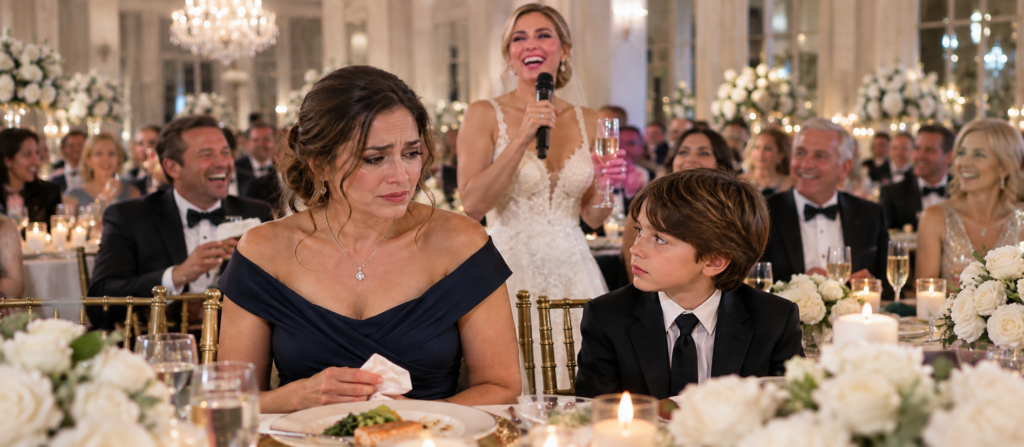
The Fairmont ballroom in downtown Chicago looked flawless beneath crystal chandeliers, adorned with white roses, neat rows of gold chairs, and hundreds of guests gathered to celebrate Ethan and his new bride, Vanessa Whitmore. I sat beside my nine-year-old son, Noah, trying to enjoy the night and telling myself whatever complicated history shadowed our family could stay outside for a few hours.
Then Vanessa stood up to give her toast and zeroed in on me. Instead of celebrating her marriage, she turned my divorce, my small apartment, and my receptionist job into punchlines for the crowd. Laughter rippled across the tables almost instantly. I kept my eyes locked on the untouched salmon in front of me, gripping the cloth napkin in my lap because reacting would only give her what she wanted: a front-row seat to me breaking down.

The humiliation stung even worse when my own mother, Diane, chimed in. She dropped another cutting remark about my life, and the room erupted all over again. People who had hugged me when I first walked in were suddenly covering their mouths to hide grins. None of them hurt as much as Ethan, though. My little brother sat beside his bride, red-faced with laughter, never even looking my way.
After our father died, I had helped raise him. Years later, I contributed toward his first car, and I even arranged discounted flowers through an old college friend so his wedding day would be gorgeous. Now he was laughing while his wife and our mother turned my life into entertainment.
Beneath the table, a small hand found mine. Noah looked at me with confusion rather than amusement. “Mom,” he whispered, “why are they laughing at you?”
I couldn’t answer. Vanessa kept going, taking shots at my failed marriage and quiet life. I pushed my chair back, trying to stand, but my knees wouldn’t cooperate, and my ears buzzed with the noise of the room. Noah released my hand, stood up, and began walking directly toward the stage.
“Noah,” I called out, but my voice barely carried.
He climbed the steps and stopped beside Vanessa. She looked down at him, her smile tightening. “Well,” she said into the microphone, “looks like someone wants attention.”
Noah didn’t smile. He stepped up to the second microphone on its stand. The DJ lowered the music, Ethan finally stopped laughing, and hundreds of eyes settled on the nine-year-old boy. Noah looked directly at his uncle.
“Uncle Ethan,” he said, his voice ringing out clearly through the speakers, “why is making my mom sad funny?”
The laughter vanished instantly. Ethan’s face went pale, the red in his cheeks fading fast. Noah swallowed and kept going. “Mom said today was supposed to be about you. She made me practice being polite. She told me not to complain about my shoes because she wanted your wedding to be perfect.”
Vanessa tried to step in. “Sweetheart, grown-ups were only joking.”
Noah stepped back, keeping the mic. “She wasn’t laughing.”
He didn’t have a secret recording or a grand speech; he just pointed out the ugly truth everyone else had chosen to ignore. My mother sat rigid. Vanessa’s smile disappeared.
Noah looked back at Ethan. “Mom helped you when Grandpa died. She told me you were her little brother and that family takes care of each other. So why didn’t you take care of her?”
Ethan opened his mouth, but no words came out.
I finally found my strength, walked up the steps, and held out my hand. “Come here, Noah.” He set down the microphone and rushed into my arms, burying his face against my dress.
Vanessa tried to recover, claiming it was just playful and that I was making a scene out of a child. I looked straight at her. “I didn’t bring him into this. You did when you decided humiliating his mother was entertainment.”
Ethan stood up so fast his chair crashed behind him. “Vanessa. Stop.”
He looked at her, then at my mother, telling them both he was done with the cruelty. I took Noah’s hand and started walking toward the exit. Ethan hurried after us, begging us to stay, but I couldn’t. I had heard him laugh.
Outside, downtown Chicago was cold and bright. We ordered a ride home, and Noah leaned against my arm.
“Are you mad at me?” he asked softly as we waited.
I crouched in front of him. “No. You were braver than every adult in that room, including me. But you should never have had to be.”
“I just wanted them to stop,” he whispered, his lower lip trembling.
I pulled him tight. “They stopped.”
The next days brought a flood of apologies, missed calls, and messages from relatives realizing how badly they had misbehaved. I turned my phone facedown and focused on my son. Ethan’s marriage didn’t survive the year—the wedding exposed a pattern of toxic behavior he was finally forced to confront. Slowly, through actual accountability and changed actions, Ethan and my mother began earning back trust, starting with small steps and genuine apologies.
A year later, an old friend invited me back to the Fairmont for coffee. She led me to a hallway near the old ballroom, where a tall planter of white roses stood. They were the exact variety our father used to grow by the garage. She handed me an envelope containing a photograph taken right before the reception: Noah standing beside me, calm and trusting, while I adjusted his tie.
I framed that picture and put it on our living room shelf. It reminded me of the truth: I wasn’t defined by the cruel measurements other people chose for me. I was a mother who loved her son, and nothing in that ballroom could ever change that.