My parents slept on the exact same mattress at their country house for thirty-one years.
Last Saturday, I finally hired a couple of guys to haul it away. I thought I was doing my aging parents a favor, completely unaware that before the afternoon was over, I’d stumble upon a long-kept secret that had quietly shaped their marriage for over three decades—or that my mother would panic the moment she realized someone had finally lifted that mattress.
To understand why, you first have to understand the bed.
My parents bought their modest country home when I was young. It sat about an hour and a half outside the city, tucked up a winding hill road. It wasn’t fancy—just a simple weekend escape where we spent summers, holidays, and quiet getaways.

My parents were in their seventies now. Dad, Arthur, had retired from teaching, and Mom, Eleanor, had spent most of her career as a librarian. They were practical, budget-conscious people with zero sentimentality for material goods. They firmly believed that if something still worked, replacing it was a waste of money.
Unfortunately, their definition of “still worked” was extremely flexible.
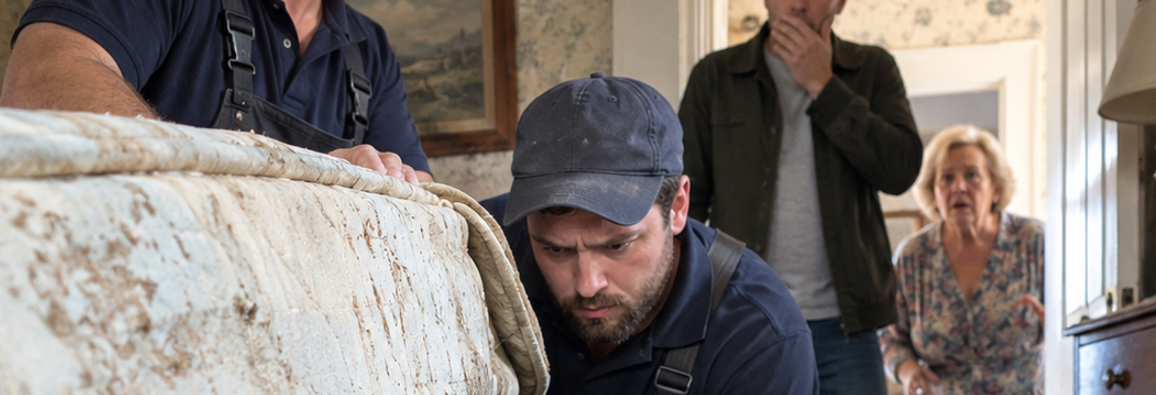
That mattress had been there for thirty-one years. It sagged so severely in the middle that both sides featured permanent, body-shaped hollows. The fabric had faded into a grimy, uniform gray, marred by dark, ancient stains near one corner. The entire thing looked like it had recorded every single summer, night, and year my parents had spent there.
I had tried to talk them into replacing it for years. Whenever I brought it up, Mom gave me the exact same line:
“It’s fine.”
“Mom, that mattress is older than my marriage.”
She’d just offer a faint smile. “So is your father.”
Discussion over.
What always baffled me was how fiercely they resisted. Money wasn’t an issue—they could easily afford an upgrade. Nor were they hoarders; Dad tossed junk without blinking, and Mom had donated half my childhood belongings years ago. They had no emotional attachment to furniture whatsoever.
Except for that mattress. They protected it with a stubbornness I could never wrap my head around.
Eventually, I stopped arguing and took matters into my own hands. That spring, I ordered a brand-new mattress—a good one—with delivery, installation, and haul-away service included so they couldn’t salvage the old relic.
The plan was simple: take Mom and Dad out to the beach for the day, let the movers do their job while we were out, and return to a fresh, modern bed. My parents could grumble for a few days, and hopefully, their backs would thank me.
Saturday morning started out gorgeous. I texted the gate code to the moving company, and the three of us headed down to the coast. Dad promptly fell asleep in a folding chair with the Sunday paper draped over his face, while Mom and I took a long walk along the shoreline. Around 1:30 PM, we stopped at a quiet seafood restaurant—one of those peaceful family afternoons you never realize is a turning point until it’s already gone.
Then my phone rang.
I didn’t recognize the number at first, then remembered. It was the driver.
I picked up. “Hello?”
His voice sounded off—not panicked, just careful.
“We had to stop the job.”
I frowned. “What happened?”
“The old mattress is still in the bedroom.”
“Did something break?”
“No.” A pause. “How far away are you?”
“About forty minutes. Why?”
Another hesitation. “It’s what we found underneath it.”
A cold chill washed over me. “Underneath the mattress?”
“Between the mattress and the box spring.”
I could hear the crunch of gravel as he moved around on the other end, followed by the muffled thud of a closing door. His voice dropped lower.
“Sir, how long have your parents had this bed?”
“Thirty-one years.”
Silence hung on the line.
“What did you find?” I asked.
“I’d rather not explain it over the phone.”
He wasn’t trying to play games or sound mysterious, which is what really unsettled me. He sounded like a guy who had accidentally stumbled onto something intensely personal and was terrified of crossing a line.
“We haven’t touched anything,” he assured me. “We left it exactly where it was.”
“What is it?”
“I think you need to see it yourself.”
Across the table, my mother had frozen. Her iced tea glass hovered halfway to her mouth, and she was staring right at me, the expression on her face entirely drained.
I looked away from her. “It’ll take us forty minutes to get back.”
“I’ll wait.”
Then he added something I’ll never forget: “When you get here, come into the bedroom alone first.”
“What?”
“Don’t bring your mother in until you’ve seen it.”
That was the moment I knew this wasn’t just some forgotten box or old love letter. I hung up the phone and looked at Mom.
“The movers found something under the mattress.”
The color completely vanished from her face. Not out of confusion, but sheer terror.
“Between the mattress and the box spring,” I added.
Mom shoved her chair back so hard it scraped loudly against the patio. “We have to go.”
“Mom—”
“Now.”
I had never heard her voice sound like that. “What is under the bed?”
“Get your father.” Her hands were trembling. “Please. We need to go home immediately.”
Dad woke up disoriented when I yanked the newspaper off his face, while Mom was already marching toward the car. In seconds, our peaceful afternoon evaporated.
On the drive back up the mountain, she sat rigidly in the passenger seat, her fingers locked tightly together in her lap.
“Mom, what did they find?” I kept pressing. “Just tell me.”
Absolute silence.
From the back seat, Dad asked, “What’s going on?”
Mom finally turned around slightly. “Arthur.” Her voice cracked. “They found it.”
Dad went completely still.
“Under the mattress,” she whispered. “They found it.”
I glanced in the rearview mirror and saw that all the color had drained from my father’s face, too.
That was when it hit me. Both of them knew. Whatever was hidden in that bedroom wasn’t just Mom’s secret—it belonged to their marriage. And somehow, it was just as old as the mattress itself. Thirty-one years.
The drive felt endless. Mom cried quietly beside me, at one point murmuring, “I always thought I would get to it first.”
“What do you mean?” I glanced at her.
She just shook her head. “I thought I’d have more time.”
Dad leaned forward from the back seat and placed a heavy hand on her shoulder. She covered his hand with hers, and they stayed like that for the rest of the trip—silent, deeply connected, and afraid.
When we pulled up to the house, the moving truck was still parked outside, and the two guys were sitting on the tailgate. They stood up as soon as we got out. The older one walked over to me.
“Are those your parents?”
“Yes.”
He glanced toward the house. “You should go inside first. Nobody is in danger, and nothing terrible happened as far as we can tell. It’s just… very private.”
“We’ll wait out here,” he added.
I went inside alone. The house smelled familiarly of old wood, dust, and closed-up rooms. I walked down the hall toward my parents’ bedroom. The brand-new mattress leaned against the wall, still wrapped in plastic, while the old one had been propped up against the footboard, exposing the box spring.
And covering nearly the entire surface was something I never could have expected.
Letters. Hundreds of them. Photographs, drawings, tiny keepsakes, and small objects arranged carefully across the box spring—an entire secret world hidden beneath the place where my parents had slept for three decades.
I froze in the doorway, then stepped closer. The letters featured two distinct styles of handwriting: my mother’s, and another I didn’t recognize at first. Then I noticed the photos. A younger version of my mom, a younger version of Dad, and a little girl.
I picked up a photograph, my hands instantly shaking. The child couldn’t have been more than four years old, and for reasons I couldn’t yet explain, her face looked hauntingly familiar.
Then I heard footsteps behind me. I turned to see Mom standing in the doorway, Dad right behind her.

She looked at the memories spread across the bed, and she began to cry. But the panic was gone; in its place was a heavy wave of grief, tenderness, and—strangely—relief.
Mom looked down at the photo in my hand. “Her name was Grace.”
I stared at her. She walked slowly into the room, sat down on the floor beside the bed, and finally told me the truth.
Before I was born, my parents had another child. A daughter. Grace, my older sister.
When Grace was four, she fell sick. It happened fast—a high fever, followed by something worse. Modern medicine at the time couldn’t save her, and within a week, she was gone.
The room seemed to tilt beneath me. I was forty years old, and I had never known I once had a sister. My parents had buried a child before I was ever born, and somehow built an entire family afterward without ever uttering a word about it.
“We couldn’t talk about her,” Mom said, her fingers grazing one of the old letters. “Not after she died.”
She explained that she and Dad had grieved in completely different ways. They stopped understanding each other, stopped knowing what to say, and for a long while, they almost lost their marriage entirely. Eventually, they made a desperate choice—maybe not a healthy one, but the only one they thought would help them survive.
They stopped speaking Grace’s name. They packed away the heartbreak and tried to force a forward-moving life. Then I came along.
Mom looked up at me, tears streaming down her face. “You were such a gift. We didn’t want you growing up feeling like you were living in the shadow of a child who died before you were born.”
They wanted me to have an ordinary, happy childhood, free from comparisons or the burden of healing a wound I couldn’t understand. So they told me nothing.
I looked back down at the bed. “But all of this?”
Mom nodded. She had agreed to stop talking about Grace, but she had never been able to throw away what remained of her. The photographs, drawings, tiny shoes, little toys, and especially the letters. After Grace passed, Mom had started writing to her—pouring out all the things she couldn’t say aloud, the things she wished she could still tell her daughter.
Eventually, she hid everything beneath the country house mattress. It became her one sacred, private space where Grace was allowed to exist. Every year when they visited the house, Mom would go into the bedroom alone, lift the mattress, look at the photos, read the old letters, sometimes write a new one, and then place everything back exactly as it was.
Thirty-one years of quietly visiting the daughter she had lost.
I looked at Dad. He was standing near the door, crying quietly. I had rarely seen my father cry in my entire life.
“I knew she had kept something,” he said, wiping his face. “I didn’t know exactly what, but I knew she needed somewhere to put the grief.”
He had never once looked under the mattress himself. He knew that whatever Mom had hidden there belonged to her, and he respected it. “I just knew Grace was there somehow.”
Suddenly, every argument about that bed, every excuse, every intense reaction whenever I suggested replacing it—it all made terrifying sense. The mattress itself meant nothing. Grace was underneath it. And I had accidentally hired two strangers to uncover the deepest, most private grief my mother had carried for decades.
I sat down on the floor beside her and wrapped my arms around her shoulders. “Tell me about her.”
Mom looked at me.
“My sister,” I said softly. “Tell me about Grace.”
And for the first time in thirty-one years, my mother was able to speak openly about the daughter she lost. She picked up the photos one by one: Grace at the beach, Grace laughing, Grace holding a stuffed rabbit, Grace drawing, Grace singing to herself, being stubborn, being funny—just being a little girl.
The stories poured out of her. Three decades of locked-away memories. At first, we cried, but then, unexpectedly, we laughed, because some of her antics were genuinely funny. Slowly, the little girl who had been treated like a forbidden memory became part of the family again.
By late afternoon, I understood something profound. The silence had probably saved my parents once. In those unbearable first years after Grace died, withholding words might have been the only way they knew how to wake up the next morning. I couldn’t judge them for that; young parents losing a four-year-old child will do whatever it takes to survive.
But somewhere along the way, survival had turned into a prison. The silence lingered long after it stopped helping. Mom carried her grief alone, Dad carried his separately, and I grew up entirely unaware that a piece of our family was missing—all because breaking the silence eventually felt harder than keeping it up.
And without meaning to, I had shattered it.
We didn’t let the movers throw away the mattress that day. Those two guys had handled the situation with an incredible amount of class and compassion. They brought the new mattress inside, set it up in the guest room, left the old bed untouched, and quietly went on their way. (Later, I realized they hadn’t even charged me for the extra time.)
That afternoon, Mom, Dad, and I gathered everything together: the letters, pictures, drawings, and the stuffed rabbit—every small piece of Grace that had spent thirty-one years hidden in the dark.
Then Mom made a choice.
“I don’t want to put her back.”
I looked at her.
She shook her head, her voice breaking. “I’m tired of carrying her by myself. I want to be able to say her name.”
So we brought Grace out of hiding. Mom framed several photographs, and for the first time in my life, pictures of my sister hung in my parents’ home. Grace went back into the family albums, back into casual conversation, back into our stories.
As the weeks passed, I watched both of my parents grow lighter. The grief didn’t vanish—of course it didn’t—but grief spoken aloud turned out to be entirely different from grief locked in the dark. My mother had spent thirty-one years believing silence was protecting her, when in reality, it had only forced her to mourn in isolation. The pain hadn’t gone away just because she refused to say Grace’s name; it had simply stayed trapped beneath a mattress, waiting.
I think about that constantly now. We often hide the things that hurt us most because we believe secrecy keeps us safe. Sometimes it does, at least for a while. But eventually, what once protected us can become the very thing keeping us trapped.
My parents hid Grace because they were trying to survive, then kept hiding her to protect me, and eventually continued simply because thirty-one years of silence felt impossible to break. But the cost was immense: my mother lost decades of remembering her daughter openly, my father lost the chance to grieve side-by-side with his wife, and I lost the chance to know I had a sister.
Today, my mother sleeps on a new mattress in the country house. She says she sleeps better now. I don’t think it has much to do with the mattress itself; I think she sleeps better because there is nothing left hidden beneath her.
Grace is up on the wall now. She’s in the family albums, in our conversations, and in the light.
I have a sister. Well, I had a sister.
Her name was Grace. She was four years old. She loved the beach, she carried a stuffed rabbit everywhere, she sang to herself, and she died before I was born. My parents loved her so deeply that for thirty-one years, saying her name hurt too much.
Now, we say it all the time.
Mom used to defend that old mattress by saying, “We only sleep here.” But now I understand they were doing so much more than sleeping. For thirty-one years, they were standing guard over the little girl they lost, holding onto her in the only way they knew how—hidden away, silent, and in the dark.
Now, they hold her differently. They remember her openly, speak her name, cry when they need to, and laugh at her silly stories. And Grace is finally where she should have been all along: not trapped beneath a mattress, but safely inside the family that never stopped loving her.