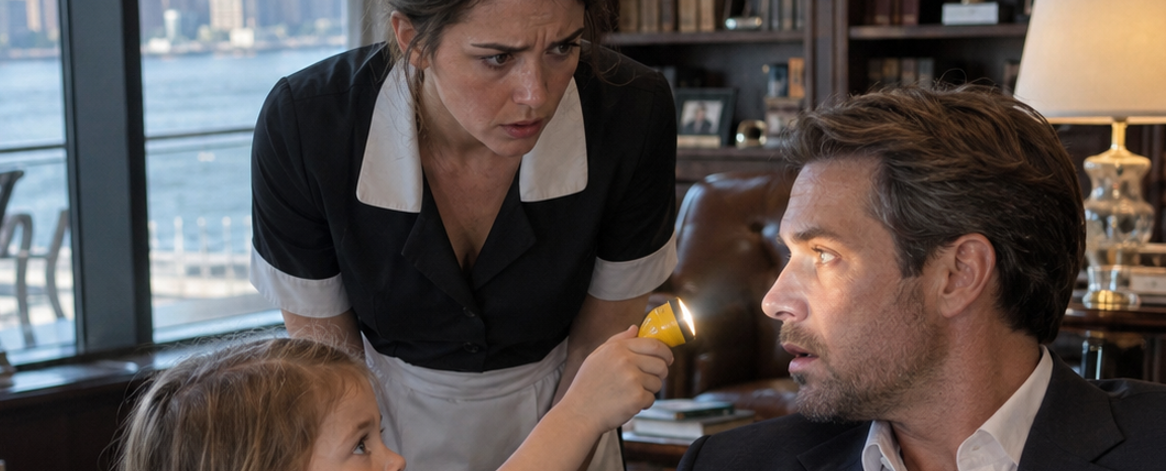
The Sound of Light
The Sound was the first thing I noticed. Not the waves themselves—I had heard those for five years—but the way Hannah described them.
“Today the water is calm,” she said from the terrace railing. “The surface is almost silver. There are small boats passing near the harbor, and every few seconds the sunlight catches the windows.”
I smiled faintly. “Interesting choice of words.”
“What do you mean?”
“You said sunlight catches the windows.”
She hesitated. “Yes.”
“How do you know that?”
“Because I can see it.”
I turned my face toward her voice. “And what does sunlight look like?”
The question caught her off guard. No one had ever asked her something so simple. Leaning against the railing, she thought it over.
“When I was younger, I thought light was just brightness. But after my mother got sick, I started noticing little things. Morning light feels different from afternoon light. Winter light feels colder even when the room is warm. Sunset makes everything look like it’s remembering something.”
I listened quietly.
“Light isn’t just something you see, Mr. Mercer. It changes the way you feel.”
For five years, people had described my blindness like a locked door. Hannah described sight like a window.
I wanted to believe her. That frightened me.
“Tomorrow,” I said, “I want an appointment.”
She knew exactly what I meant. “With an eye specialist?”
“Yes.”
“Not Dr. Hale?”
“No.”
The silence that followed was heavy—not because she disagreed, but because she understood.
“You don’t trust him anymore,” she said.
I looked out toward the sound of the ocean. “I trusted him more than anyone.”
“That makes this harder.”
“Yes.”
She didn’t say anything else. That was one thing I had grown to appreciate about Hannah Reed: she never rushed to fill the quiet. Most people were uncomfortable with silence; they wanted to fix it, explain it, or cover it up. Hannah let it exist. Maybe that was why little Lucy was so comfortable around her, and maybe that was why I was finally beginning to trust her.
Uncovering the Past
The following morning, I arranged a private appointment with a specialist in Manhattan, having Daniel Cross set everything up. Daniel had been my closest friend for twenty years. Before the explosion, he managed security for my shipping company; afterward, he became something far more important—the person who kept me afloat.
When he arrived at the study, he sat across from me and crossed his arms. “You’re hiding something.”
I offered a slight smile. “You always say that.”
“Because you always are.” Daniel had always been direct, which was why I kept him close.
“I’m getting a second opinion.”
“About your eyes?”
“Yes.”
A long silence stretched between us before he asked quietly, “Why now?”
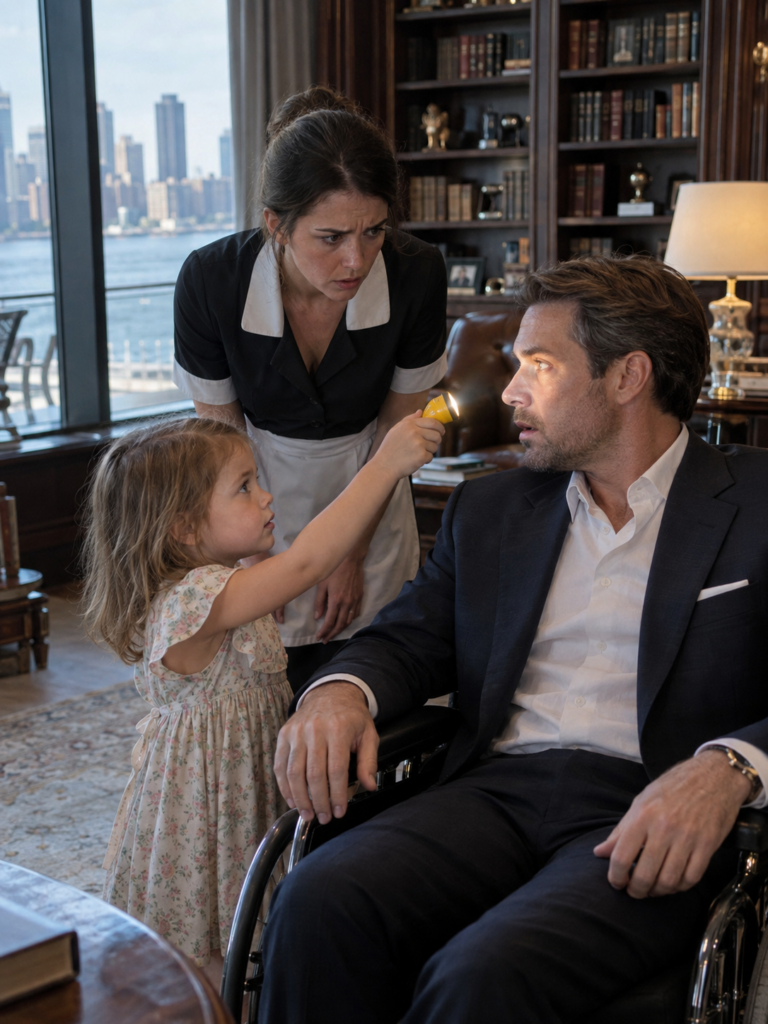
I could have lied. Instead, I told him about Lucy, the flashlight, and the pupil reaction. Daniel listened without interrupting. When I finished, he rubbed a hand across his jaw.
“Grant—”
“I know.”
“No, you don’t,” his voice softened. “You’ve spent five years believing the worst day of your life was the day you lost your family.”
I said nothing.
“Maybe the worst day was the day you stopped looking for answers.”
The words lingered. I had spent years building walls around my house, my company, and myself, thinking they protected me. Perhaps they had only trapped me.
The appointment took place three days later. Dr. Elena Marquez was patient, explaining every test before performing it. For five years, doctors had spoken around me, never to me. After several hours of evaluation, she sat down across from me.
“I want to be careful with my words.”
I waited.
“That is a good sign.”
My hands tightened on the armrests. “What does that mean?”
“It means there are responses in your visual system that I didn’t expect.”
My heart hammered against my ribs. “But?”
“There is still significant damage. Don’t imagine you’ll walk outside tomorrow and see the city skyline.”
“I understand.”
“However, your original diagnosis may have been incomplete.”
“Why?”
She studied the reports. “Because your eyes aren’t behaving like someone whose entire visual pathway has shut down.”
I remembered Hannah’s words: Some pathways may still be working.
“What happened to me?”
Dr. Marquez looked over the old records. “The explosion caused severe trauma. That part is clear. But recovery depends on many factors. The brain adapts, and the visual system can sometimes preserve unusual functions.”
“Could someone have known?”
She looked at me carefully. “Known what?”
“That I might recover.”
“I can’t answer that.”
“But someone might have?”
She didn’t respond. And somehow, that silence was answer enough.
The Missing File
Back home, I sat alone in my office. Five years of darkness. Five years of believing my life ended at Pier 17. Then a little girl with a flashlight opened a door I thought was welded shut.
That evening, I asked Hannah to come to the library. She entered quietly.
“You went.”
“Yes.”
She waited. “And?”
I took a steady breath. “They found activity.”
Her eyes filled with emotion—not celebration, but something far more careful. Hope. “That’s wonderful.”
“I’m afraid.”
She looked surprised. “Afraid?”
“Yes.” I touched the edge of my desk. “If I start hoping and nothing changes… I don’t know if I can survive losing everything a second time.”
Hannah sat across from me. “You already lost everything once. Don’t you think you deserve to find out what remains?”
The simple words reached deep inside me. Over the next month, my life shifted in small, incremental ways. Dr. Marquez started therapy designed to bridge the gap between my remaining vision and my brain. At first, it was deeply frustrating—I could detect light, basic shapes, and movement, but nothing more. A shadow near a window. A stark contrast between dark and slightly less dark. Yet every small improvement felt miraculous.
One afternoon, Hannah placed a photograph in my hand.
“What is it?”
“Your family.”
I froze. “I don’t have photographs.”
“You do.” She guided my fingers along the wooden frame. “I found a box in storage.”
My throat tightened. “Why didn’t anyone tell me?”
“I think people were afraid of reminding you.”
I traced the edges. “What do I look like?”
She smiled sadly. “You.”
“That’s not an answer.”
“It is.”
I almost laughed. “Very helpful.”
She sat beside me. “Your daughter is holding your hand.”
My fingers stopped moving. “Emma?”
“Yes.”
“Tell me about her.”
Hannah looked down at the picture. “She looks curious.”
“That sounds right.”
“She has your expression.”
I smiled faintly. “What expression?”
“Like she’s trying to figure out something everyone else missed.”
For the first time in years, remembering Emma didn’t feel like drowning. It felt like breathing.
Unraveling the Truth
A week later, Dr. Marquez called. “Mr. Mercer, I reviewed additional records.”
My body stiffened. “What records?”
“Your hospital files.”
“And?”
“There’s something unusual. Your final retinal imaging from the month after the explosion is missing.”
A cold chill ran down my spine. “Missing?”
“Yes. Files get misplaced, but this is strange because your initial scans are here, and your later follow-ups are present. The specific scan used to establish your permanent prognosis is gone.”
“Who had access?”

“I don’t know.”
That night, Daniel helped me search through old archives. Near midnight, he found a billing record for a specialized retinal analysis ordered six months after the explosion.
“Who ordered it?” I asked.
Daniel hesitated, then answered: “Dr. Vernon Hale.”
The room went dead silent. If Hale knew about a later examination, why had he never told me?
Two days later, Daniel tracked down the doctor who had performed the scan—Dr. Samuel Whitmore, now retired and living in a quiet mountain town in Vermont. We drove out to see him.
Dr. Whitmore opened his front door, looked at me, and sighed softly. “I wondered if this day would come.”
“You remember me?”
“Yes. Come inside.”
We sat at a wooden kitchen table smelling of old books and coffee.
“After your accident, I was brought in to review your case,” Dr. Whitmore explained. “Your injuries were severe, but your scans showed unexpected signs. Your brain was still receiving visual information.”
“Then why was I told I was permanently blind?”
He looked away, guilt washing over his face. “I sent my report, but it disappeared. I kept copies because something felt wrong.”
He pulled an old folder from a drawer and handed me a report. It detailed a possibility of rehabilitation.
“Why didn’t you contact me?” I asked.
“I tried. But Dr. Hale told me your family requested privacy.”
“My family? Caroline and Emma were gone. Who spoke for them?”
I thought of my lawyers, my board—people who believed they were protecting me.
“Was he trying to hurt me?” I whispered.
Dr. Whitmore shook his head. “No. I believe he was afraid you would push yourself too hard, that giving you false hope without certainty would completely destroy you.”
The Confrontation and Recovery
The next Thursday morning, when Vernon Hale arrived for my routine checkup, I was waiting.
“Grant,” he said warmly. “How are you feeling today?”
“Better than I have in years.”
He stopped in his tracks. He knew. “I see.”
“No,” I said quietly. “You don’t. I know about the scan.”
Hale pulled out a chair and sat down slowly, looking exhausted. “I wondered when you’d find out.”
“You knew, and you said nothing.”
He removed his glasses. “After the explosion, you weren’t just blind. You were broken. You woke up asking for Caroline, then Emma. When we told you the truth, you stopped speaking for three days.”
“I remember.”
“I thought giving you a possibility would help, but it terrified you. I made a mistake.”
For years, I had imagined this confrontation filled with fiery anger and accusations. Instead, there was only an old friend carrying a heavy burden of regret.
“I trusted you,” I said.
“I know.”
“That’s why it hurt.”
“I know.”
Neither of us spoke for a long time. Then I asked, “If you had told me the truth, what would have happened?”
Hale looked toward the window. “Maybe you would have fought harder, healed faster. Or maybe you would have spent five years blaming yourself for not improving.”
I had no answer, because he was right about one thing: I had been fragile. But fragile didn’t mean powerless.
Moving Forward
The months that followed were far from easy. Recovery moved in inches, not miles. There were days when I wanted to quit, days when I grew furious that my progress was so agonizingly slow. But little Lucy kept me grounded, sitting nearby during my exercises and asking what shapes I could see. Children have a magical way of making the impossible feel completely ordinary.
One afternoon, I sat by the garden as Hannah walked toward me. Usually, I recognized her solely by her footsteps. But this time, I looked up and actually saw something—a human shape, a familiar outline of a face.
“Hannah?”
She stopped in her tracks. “Yes?”
“Your hair.”
She reached up, touching it in surprise. “What about it?”
“It’s different.”
She laughed, her voice bright. “You can see?”
I shook my head, smiling broadly. “Not completely. Not yet.”
She sat beside me on the bench. For the first time in five years, the darkness didn’t feel permanent anymore. It felt temporary—just a chapter, not the entire book.
A year later, my vision wasn’t perfect, and it never would be. But it was enough. Enough to read large-print letters, to make out faces in photographs, and to recognize the people who had chosen to stay by my side.
One evening, I held the old picture of Caroline and Emma near the window. The image remained blurry, but I saw them clearly—not as ghosts or painful memories, but as people who had loved me, whose story didn’t end just because they left. Love wasn’t just about holding onto what was gone; sometimes, it was about allowing what remained to grow.
Hannah stayed, too—not because I needed a constant guide, but because we discovered that two people who had lost pieces of their lives could still build something entirely new.
Years after the disaster, I finally returned to Pier 17 with Daniel by my side. The city bustled around us, people walked by, and boats drifted across the harbor. The world had kept moving.
I stood there quietly, taking it all in. “I used to think this was where my life ended.”
Daniel looked over at me. “And now?”
I smiled, feeling the warmth of the afternoon sun against my face. “Now I think it was just where my life changed.”