“Who is their father?”
For several seconds, Claire didn’t move.
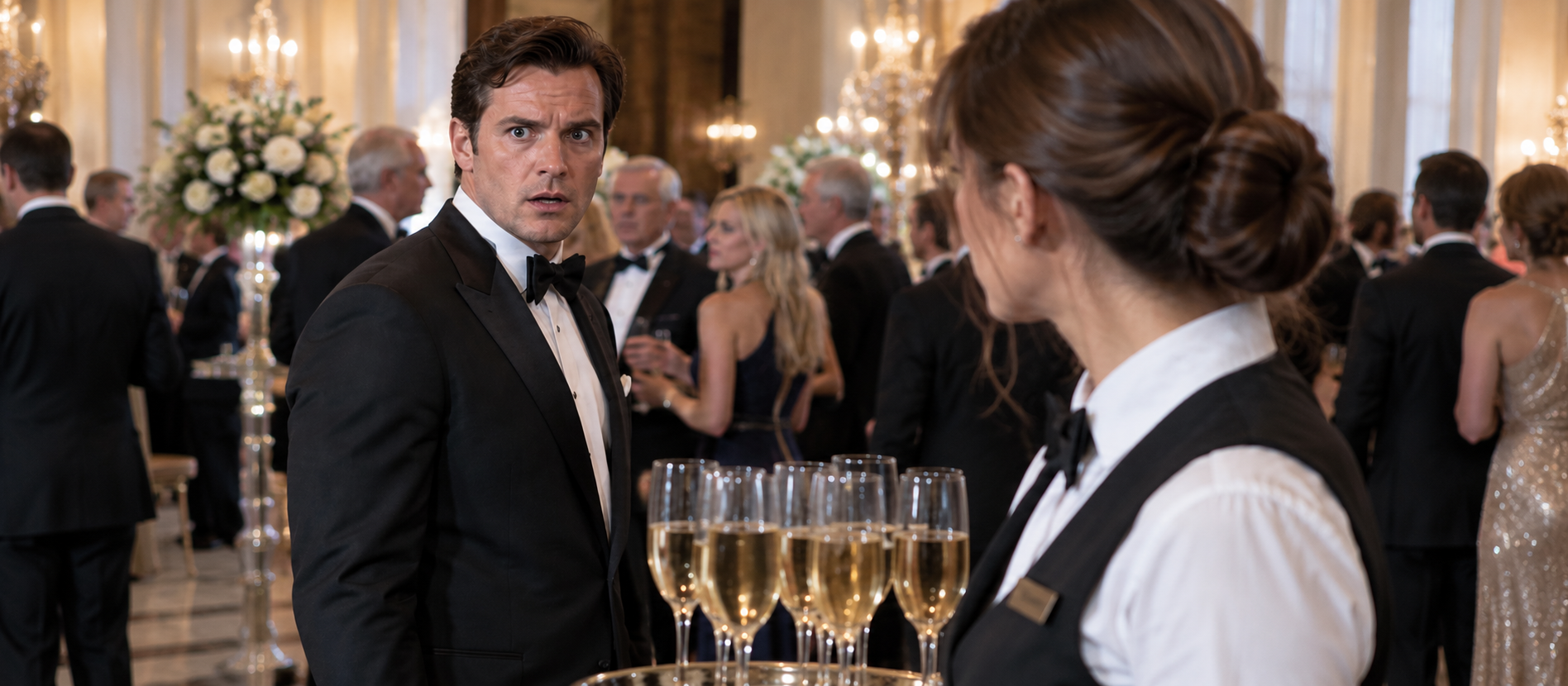
The ballroom hummed along as if nothing had happened. Crystal glasses chimed against one another. A string quartet played softly near the stage. Tuxedoed men leaned across tables, chatting about charitable donations and tax write-offs. Through the soaring windows, Chicago’s skyline glittered against the dark expanse of the lake.
Yet the space between Claire and me had turned dead quiet.
One of the boys tugged lightly on her sleeve.
“Mom?”
Claire glanced down. The panic I had caught on her features a moment ago vanished completely.

“Everything’s fine, Oliver.”
The boy who shared my childhood frown shifted his gaze between us.
“You know him?”
Claire swallowed hard.
“Yes.”
A beat passed. Then she offered them a reassuring smile.
“Why don’t you three head back over to Ms. Ramirez? I’ll be right there.”
“We’re supposed to help carry the music stands,” another of the boys piped up.
“I know, Noah.”
“And there are cookies,” the third chimed in.
Claire nearly cracked a smile.
“I know that, too, Miles.”
That tiny, mundane exchange nearly brought me to my knees.
Oliver.
Noah.
Miles.
Real names.
Until that exact second, they were just three impossible faces standing at the edge of a ballroom. Now they were living, breathing kids.
Children with backpacks, chores, and cookies waiting down some hotel hallway.
And potentially—
I cut the thought off.
Claire watched the boys walk toward a woman standing by the side doors. She wore a dark blue evening gown with a conference badge clipped to her lapel, greeting them warmly and handing one of them a folded music stand.
Only once they were safely out of earshot did Claire turn back to me.
“You shouldn’t be asking me this here.”
“Then tell me where.”
“Ethan—”
“Please.”
She held my gaze.
Nine years ago, I would have talked right over her. I would have demanded we settle things on the spot, convinced that brute-force urgency was the same thing as taking responsibility.
Slowly and painfully, I had finally learned that sometimes being responsible meant giving someone else the space to catch their breath.
So I lowered my voice.
“I’m not asking for a scene in front of them. I’m just asking for a chance to listen.”
Claire glanced toward the event coordinator.
“I’m on the clock.”
“I can wait.”
“You have a room full of donors.”
“They’ll manage without me.”
For a flicker of a second, I saw something familiar flash across her face. A ghost of the Claire who used to tell me I suffered from an overinflated sense of corporate importance.
Then it was gone.
“My break is in twenty minutes,” she said. “There’s a staff lounge behind the west ballroom.”
“I’ll be there.”
She picked up her champagne tray once more. Before turning away, she added quietly, “Don’t say anything to the boys.”
“I won’t.”
She searched my eyes, testing whether my word still held any weight.
Then she melted into the crowd.
I stood frozen long after she vanished.
“Ethan?”
My chief financial officer, Marcus Hale, materialized at my elbow. Marcus had been by my side for eleven years, blessed with the rare talent of knowing when to keep his mouth shut.
Tonight, though, even he looked unsettled.
“You look like you just saw a ghost.”
“Something like that.”
He followed my line of sight to where Claire was circulating with champagne flutes. Marcus frowned.
“Do you know her?”
“Yes.”
He waited.
“My ex-wife.”
His eyebrows shot up. Marcus knew I had been married once before, but practically nobody at Whitmore knew any details beyond that.
“I see.”
“No,” I told him. “I don’t think either of us sees the whole picture yet.”
He glanced toward the side doors where the three boys had disappeared, then back at me. Whatever he concluded, he kept to himself.
“The foundation chair wants you back on stage in five minutes.”
Of course she did.
For the next twenty minutes, I stood under glaring stage lights, talking about early childhood education initiatives while my mind was trapped behind the ballroom doors.
I had delivered keynotes to thousands. I had negotiated hostile takeovers. I had sat through eleven straight hours of federal regulatory depositions.
Nothing had ever required more sheer willpower than reading three paragraphs off a teleprompter that night.
When the applause rolled in, I barely registered it.
I stepped off the stage, handed my notes to Marcus, and headed straight for the west corridor.
The staff lounge was small and starkly ordinary compared to the gala—harsh fluorescent lights, gray vinyl chairs, a humming corner fridge, and a coffee maker bearing a handwritten sign that read: OUT OF ORDER AGAIN.
Claire was already there, having shed her vest.
For a second, seeing her in a simple white button-down with her sleeves rolled up to her elbows transported me right back to our cramped Evanston apartment.
She used to cook like that.
Hair pinned up. Sleeves caked in flour. Bare feet on cold kitchen tiles.
We had owned a grand total of four matching plates back then. I had always assumed those lean years were just a temporary stepping stone. Now I realized they were the closest thing to a real home I’d ever known.
Claire motioned toward the chair across from her.
“Sit down.”
I did.
Neither of us spoke for a long moment.
Finally, she broke the silence. “What do you want to know?”
My throat tightened.
“The truth.”
“That’s a broad umbrella.”
“Are they mine?”
Claire squeezed her eyes shut. Just for a second.
When she opened them, she looked straight at me.
“Yes.”
The word was heartbreakingly gentle.
I stared at her. No dramatic sound effects, no earthquakes, no shattering reality.
Just a single syllable.
Yes.
My hands went ice-cold.
“All three?”
A sad, fleeting smile touched her lips.
“They’re triplets, Ethan.”
“I know. I just—” I choked on the words.
She waited.
“How old are they?”
“They turned eight in June.”
I ran the math in my head anyway, even though it was already painfully clear.
Eight years old.
Born roughly eight months after our marriage imploded.
I stared down at the scuffed linoleum.
“I have sons.”
Claire remained silent.
“Three sons.”
“Yes.”
I laced my fingers together, my mind instantly flooding with everything I had missed.
First steps. First words. Birthdays. High fevers. School portraits. Wobbly teeth. Christmas mornings.
Eight solid years of ordinary, beautiful days I had no idea existed.
The grief hit so hard and fast that I couldn’t tell where it ended and the anger began.
“When did you find out?”
Claire’s jaw tightened.
“About six weeks after you signed the paperwork.”
I snapped my head up.
“You were pregnant while we were getting divorced?”
“I was pregnant before the decree was finalized. I didn’t know it yet when I signed.”
“Why didn’t you tell me?”
She looked away.
There it was. The question that had hung in the air for nine years, waiting for a room quiet enough to hold it.
“When I found out,” she said softly, “I was terrified.”
“Of me?”
“No.”
That caught me off guard.
“Then of what?”
“Everything.”
She folded her hands neatly on the table.
“I had just walked away from my marriage. I was living in a studio apartment with a mattress that practically touched the refrigerator. My research fellowship had six months left on it. My widowed mother was scheduled for heart surgery. And then a doctor told me I was expecting.”
She let out a dry, humorless breath.
“And three weeks later, a different doctor told me there were three.”
I tried to picture it—Claire sitting alone in a cold medical office, absorbing that kind of seismic news. The mental image made me sick.
“I would have stepped up.”
“I know that now.”
“Claire—”
“I said now.”
Her tone wasn’t sharp, which made it sting all the worse. She met my eyes steadily.
“You remember the final months of our marriage very differently than I do, Ethan.”
I kept quiet.
“You remember being busy. You remember your mother being a nightmare. You remember promising you’d sort things out.”
She paused.
“I remember calling you seven times one weekend while you were stuck in Houston and only getting two text messages back.”
I dropped my gaze.
“I remember your mother letting herself into our apartment with a spare key you never bothered to take back. I remember being told I was an embarrassment to your high-society family. And when I finally broke and left, I remember you showing up at my studio saying you could fix it all.”
“I meant every word.”
“I know you did.”
“Then why—”
“Because you always meant it.”
That completely silenced me.
Claire leaned back in her chair.
“That was the root of the problem, Ethan. Your promises weren’t intentional lies—lies would have been so much easier to deal with. You genuinely believed every single promise in the exact moment you made it. You believed you’d finally stand up to your mother. You believed you’d slow down after the next big merger. You believed we’d get our life back after the fiscal quarter.”
Her gaze softened.
“But there was always another quarter.”
I stared past her at the vending machine because looking at her hurt too much.
“So you decided I had no right to know I had children.”
“No.”
I looked back at her. She took her time before speaking.
“I decided I couldn’t tell you yet.”
“Which turned into eight years.”
“Yes.”
The brutal honesty of it hit harder than any defensive excuse could have.
“I’m not proud of it.”
“Did you ever plan on telling me?”
“Plenty of times.”
“When?”
“When they were infants.” She looked down at her hands. “Then Oliver had trouble putting on weight. Nothing critical in hindsight, but it meant constant doctor visits. My mother came up from Carbondale to help. My friend Elena practically moved in with us. I was sleeping in forty-minute increments.”
A faint, tired smile touched the corner of her mouth.
“Three newborns don’t give a damn about anyone’s grand life plan.”
Despite everything, I could vividly imagine it. Three tiny bassinets. Claire running on fumes. Her mother folding laundry in the corner. Someone heating up bottles at 3:00 AM.
An entire family unit taking shape while I sat in VIP airport lounges.
“I actually wrote you a letter,” she continued.
My head snapped up.
“What?”
“A real, physical letter. Four pages long.”
“What did it say?”
“That you had three healthy sons. That I wasn’t looking for a handout or child support. That I didn’t know what co-parenting would look like, but you deserved to know they existed.”
“Did you send it?”
“No.”
I stared at her in disbelief.
“Why?”
“Because the exact day I planned to drop it in the mail, I caught a rerun of an interview you did.”
I remembered doing dozens of press hits back then. Whitmore had just closed the biggest acquisition in its history. I was thirty-two, utterly convinced that chronic exhaustion was the ultimate badge of honor.
“What interview?”
“Business Chronicle. You were talking about relocating part of your core executive team to New York.”
A hazy memory surfaced. A reporter had asked if I had any regrets about sacrificing my personal life for the business.
My stomach churned.
“What did I say?”
“You said there are seasons in life for building a family, and seasons for building an empire that lasts.”
I squeezed my eyes shut. I remembered it now.
At the time, I meant that I wasn’t dating anyone—that work was all I had left. But to Claire…
“You thought I meant I never wanted kids.”
“I thought you were just reiterating everything you’d shown me all through our marriage: that family was always going to take a backseat.”
I rubbed a hand over my face.
“That wasn’t what I meant at all.”
“I know that now.”
“Now.”
“Yes.”
That word again. Now.
The cruelest trick of hindsight is how crystal clear everything looks when it’s entirely too late to fix. We could both read each other like an open book, nine years after the ink had dried.
“Where’s the letter?” I asked.
“Stashed in a box back at my apartment.”
“You still have it?”
“I tend to hold onto too many things.”
“I remember.”
“You used to yell at me for it.”
“I was an idiot.”
“You alphabetized our spice cabinet, Ethan.”
“That was just efficient.”
“It was just paprika, Ethan.”
For one absurd, fleeting second, we both smiled.
Then Claire’s expression hardened again.
“I almost tried telling you again when they turned two.”
“What stopped you?”
“Nothing dramatic. I just dialed Whitmore’s main line.”
My chest tightened.
“And?”
“The receptionist transferred me twice. Then some corporate assistant told me you were overseas for a month and coldly asked what the inquiry was regarding.”
“And so—”
“And so I hung up.”
“Claire—”
“I know.”
“No, I mean…” I let out a long breath. “I genuinely wish you’d tried harder.”
“So do I.”
There was zero defensiveness in her voice. Just hollow regret.
And that shifted something fundamental inside me. Up until this exact moment, a bitter part of me had desperately wanted a scapegoat.
My mother. Claire. A slick divorce lawyer. A gatekeeping assistant.
Anyone I could pin eight lost years on.
Instead, the reality sitting between us was painfully mundane. Claire had been terrified and overwhelmed. I had been completely checked out and absent.
Time had simply done what time always does when nobody steps in to stop it: it kept marching forward.
“Do they know anything about me?”
“No.”
The answer cut deep, even though I expected it.
“What have you told them about me?”
“That their father and I split up before I even realized I was pregnant.”
“Do they ever ask questions?”
“Sometimes.”
“And what do you tell them?”
“That when they’re old enough to understand, I’ll fill in the blanks.”
“How much older?”
“I never really set a timeline.”
I stood up, paced to the mini-fridge, and turned back around.
“I need to ask you something, and I need you to hear me out completely before you answer.”
Claire gave a slight nod.
“I want to be in their lives.”
Her eyes flickered.
“I’m not talking about bringing in high-priced divorce lawyers or filing emergency custody motions tomorrow morning. I’m not talking about blowing up their entire world because I just realized mine has been missing three people.”
I swallowed hard.
“I just want a fighting chance to know them.”
Claire studied me for a long, agonizing beat.
“You watched them for thirty seconds out there.”
“I know.”
“They have an established life.”
“I know.”
“They have school, soccer practice, weird quirks. Noah detests tomatoes. Miles needs every clock in our apartment set four minutes fast because he thinks it makes him punctual. Oliver reads encyclopedias for fun and corrects his teachers when they mess up historical dates.”
I almost smiled.
“Which one gave me the death glare?”
“Oliver.”
Of course.
“What are the other two like?”
The question slipped out before I could censor myself.
Something shifted in Claire’s expression. She had been braced for a fight. She clearly hadn’t expected genuine paternal curiosity.
She glanced toward the door.
“My break is almost over.”
“Just tell me one thing about them.”
She hesitated.
“Miles tells terrible jokes whenever he’s nervous. Really bad ones.”
“How bad?”
“Last week he asked me why the math textbook looked so depressed.”
I waited.
Claire sighed.
“Because it had too many problems.”
I let out a genuine laugh. I couldn’t help it.
Claire cracked a smile, too. For a few brief seconds, we were just two normal people in a dreary breakroom, laughing at a terrible dad joke told by an eight-year-old neither of us had even known existed five minutes prior.
Then the door swung open.
The woman in the blue evening dress peered inside.
“Claire? Sorry to interrupt—”
“It’s fine, Elena.”
Elena’s gaze shifted to me. Recognition hit her instantly—not celebrity recognition, but personal, loaded recognition.
“So,” she said quietly. “It finally happened.”
Claire stood up.
“Elena—”
“I’m not saying a word.” She looked at me. “I’m Elena Ramirez.”
I stood to shake her hand.
“Ethan Whitmore.”
“I know who you are.”
There was no active hostility in her voice, just a protective layer of history.
“You helped Claire out after the boys were born.”
Elena glanced over at Claire. “You told him?”
“Parts of it.”
Elena nodded. “Well, the boys are helping tear down the youth orchestra stands with the director. They’re safe, they’re occupied, and they’re currently lobbying for a second round of cookies.”
Claire checked her watch.
“I’ve got another hour left on my shift.”
“Go home, Claire,” Elena said. “I’ve got the rest of the night covered.”
“I need the paycheck.”
The flat simplicity of the statement gutted me far more than a complaint would have.
I looked down at her catering uniform.
“Are you still at the university?”
Claire narrowed her eyes slightly.
“Yes.”
“Doing research?”
“I manage a biomedical imaging lab.”
“And you’re working second jobs on top of that?”
“Occasionally a third one, yes.”
“Why?”
She gave me a look that was equal parts exasperated and amused.
“Because three growing boys consume groceries like a medium-sized agricultural enterprise.”
I opened my mouth to say something about financial support. Then I shut it.
Nine years ago, I would have instinctively reached for my checkbook, because throwing money at a problem was the only form of assistance I knew how to execute efficiently.
Claire noticed my hesitation, and her expression softened a fraction.
“My base salary is decent,” she conceded. “But private magnet school tuition isn’t cheap, my mother’s medical bills add up, and I’m trying to squirrel away a down payment for a larger place. The catering gig lets me pick up flexible weekend hours.”
“Are you guys struggling?”
“We’re surviving just fine.”
“That wasn’t my question.”
“We have everything we actually need.”
The message was loud and clear.
Elena looked back and forth between us. “I’m heading back to check on the kids.”
Claire nodded. “Elena?”
“Yeah?”
“Don’t say anything to them.”
Elena’s expression warmed. “Of course not.”
Once the door clicked shut behind her, I turned back to Claire. “Does she know the whole story?”
“She knows enough.”
“Does your mother know?”
“Yes.”
I closed my eyes for a second. Claire’s mother had known for eight years that she had grandsons who also happened to be mine.
“Does anyone on my side of the family know?”
“No.”
That brought my mother straight to the forefront of my mind. Margaret.
I had spent the last nine years carefully constructing a relationship with her that was strictly polite and heavily cordoned off. After the divorce papers were signed, I had finally confronted her—far too late.
I had moved out of every family-owned property, stripped her of any informal advisory role in my business affairs, and spent years enforcing boundaries I should have established while Claire was still my wife.
Margaret had eventually apologized. Not gracefully at first—she didn’t exactly possess a native fluency with the word sorry. But old age, or perhaps sheer loneliness, had mellowed her out somewhat.
Still, there were truths Claire would never know, because I had never anticipated crossing paths with her again.
“I won’t tell my mother,” I said.
Claire looked genuinely surprised.
“Not unless you’re completely okay with it.”
“Thank you.”
Just then, her manager poked her head into the breakroom.
“Claire?”
“I’m coming.”
She slipped her black vest back on. Panic immediately flared in my chest.
“Can I see you again?”
She paused.
“Not the boys yet. Just you and me. We need to talk this through.”
“I know.”
She reached into her pocket, pulled out a catering receipt, and scribbled a string of numbers across the back.
A phone number.
“My cell changed,” she said.
“Mine did too.”
“I figured.”
She handed the slip of paper to me. I took it, holding that scrap of thermal receipt paper more carefully than I’d ever held a multi-million-dollar acquisition contract.
“When can I call?”
“Tomorrow. After seven.”
“I’ll call at seven-oh-five.”
“Still incapable of being casual?”
“Worse than ever.”
That ghost of a smile returned to her lips.
Then she turned and walked out.
I lingered in the empty staff room for a long time. For the first time in eight years, I actually knew the names of my sons.
I skipped the rest of the gala that night. Marcus absorbed my remaining hosting duties without a single complaint.
I drove back up to my penthouse overlooking Lake Michigan. I had bought the place primarily because the architect promised the floor-to-ceiling windows offered the best residential views in the city.
Tonight, those massive panes of glass just looked like walls enclosing an empty, hollow museum.
I sat down at the kitchen island and searched the boys’ names online—then felt a wave of immediate shame and slammed the laptop shut.
Claire had trusted me with a direct phone number. She hadn’t invited me to cyber-stalk her children.
At 11:30 PM, I picked up my phone and called my older sister.
Rebecca picked up on the fourth ring.
“Somebody better be in the hospital.”
“Nobody’s in the hospital.”
“Then why are you calling me at half-past midnight?”
“I ran into Claire tonight.”
Dead silence on the line.
Rebecca had been the sole voice in our family who had openly, fiercely condemned the way Margaret treated Claire. When I was twenty-seven, I had called her over-dramatic. At thirty-six, I had finally called her to apologize.
“You saw Claire?”
“Yes.”
“Where?”
“At a charity gala.”
“Did you talk?”
“We did.”
Another heavy pause.
Then my sister asked carefully, “Ethan, are you okay?”
“No.”
I looked down at the receipt slip sitting next to me on the marble counter.
“She has three sons.”
Rebecca didn’t say a word.
“They’re mine.”
Still nothing.
Then I heard her take a sharp breath.
“What?”
“Triplets. Eight years old.”
“Oh, sweet mother of God.”
I pressed the heel of my hand against my eyes. “I have kids, Becca.”
Her voice shifted instantly. No excitement, no panic—just profound caution.
“Does Claire want you in their lives?”
“I don’t know yet.”
“Then that’s the only thing that matters right now.”
I almost laughed. Nine years ago, I would have bristled at that answer, viewing it as an obstacle.
Now, it just sounded like basic common sense.
“I told her I want to know them.”
“And?”
“She didn’t slam the door in my face.”
“That’s a far cry from an engraved invitation.”
“I know.”
“Good.”
I leaned back against the counter. “I lost eight years of their lives.”
“Yes, you did.”
Her tone was gentle. Rebecca had never had much patience for sugarcoating hard truths.
“What am I supposed to do?”
“You don’t try to buy back eight lost years in eight days.”
“I know that.”
“Do you really?”
“Yes.”
“Then prove it.”
The next evening, I dialed Claire’s number at precisely seven-oh-five.
She picked up on the second ring.
“You actually waited the full five minutes?”
“Didn’t want to look desperate.”
“You failed.”
It was the first time she had genuinely teased me since the bitter end of our marriage.
We talked for forty-seven minutes straight. Mostly about the boys.
Noah loved drawing blueprints and was currently obsessed with civil engineering and bridges. Miles played the violin appallingly badly but with unmatched enthusiasm. Oliver devoured astronomy books and kept a running log of complex questions he planned to ask an actual astronaut one day.
They went to a small public magnet school. They willingly shared a bedroom despite their apartment having two. They bickered over cereal brands. They built sprawling, elaborate cities out of discarded Amazon boxes.
They had recently launched a relentless campaign to adopt a dog, while Claire had launched an equally firm counter-campaign declaring absolutely not.
I listened. I asked follow-up questions. And slowly, a strange transformation took place.
The boys stopped feeling like abstract symbols of everything I had missed out on. They became real, distinct little humans.
As we were wrapping up the call, Claire’s voice dropped an octave. “There’s one more thing.”
My grip on the phone tightened.
“What is it?”
“If we’re going to do this—if I’m going to let you step into their world—we take it slow.”
“Agreed.”
“No grand gestures.”
“Understood.”
“No expensive shopping sprees.”
I glanced around my minimalist, high-end penthouse.
“Define expensive.”
“Ethan.”
“Right. No expensive gifts.”
“No showing up at their school, no ambushing us at their activities, no corporate fixers poking around, and absolutely nobody from Whitmore getting involved.”
“Done.”
“And when you meet them, they meet you as Ethan first.”
Not Dad.
The word didn’t even need to be spoken out loud.
I swallowed hard. “Okay.”
“They deserve the time to figure out what you actually mean to them on their own terms.”
“I agree completely.”
Another pause stretched across the line.
“There’s a children’s astronomy program at the museum this Saturday morning.”
My chest stopped working for a second.
“They’ve been dying to see the new space exhibit.”
I stood up from the kitchen island, even though I had nowhere to walk.
“Are you inviting me to come along?”
“I’m considering allowing it.”
“That sounds suspiciously like an invitation.”
“It isn’t.”
“Understood.”
“They know I bumped into an old acquaintance from the past.”
“Me.”
“Yes.”
“And what are you going to tell them?”
“That you were my husband before they were born.”
My throat constricted.
“And if they ask why I wasn’t around?”
“I’ll tell them the truth in a way an eight-year-old can digest.”
“Which is?”
“That adults sometimes make terrible choices they deeply regret, and sometimes they wait far too long to try and make things right.”
There was enough raw accountability in that single sentence to carry us both forward.
Saturday morning arrived with a cold, driving rain.
I pulled up outside the Museum of Science and Industry twenty minutes early, standing under an umbrella while wondering if a billionaire CEO could genuinely suffer a stress-induced cardiac arrest before meeting three eight-year-olds.
Apparently, my heart held up.
Claire arrived right at ten on the dot.
The boys spotted me first.
Oliver narrowed his eyes in that familiar skeptical frown. Noah whispered something to his brother. Miles grinned brightly.
“Hey, it’s the champagne guy.”
Claire closed her eyes.
“Miles.”
“What? He was literally at the champagne party.”
I couldn’t help the dry laugh that slipped out.
“Ethan,” Claire said, keeping her voice even, “you remember Oliver, Noah, and Miles.”
“I do.”
Oliver studied me up and down.
“You used to be married to Mom.”
There is zero training in the corporate world that prepares you to hear your own flesh and blood state that fact.
“Yes, I did.”
“How come you guys aren’t married anymore?”
Before Claire could jump in, I answered.
“Because I didn’t listen nearly as well as I should have.”
Oliver weighed that answer carefully.
“That happens to Miles all the time.”
“Does not!” Miles protested instantly.
“Does too.”
Noah pointed eagerly toward the grand entrance doors. “Can we go look at the rockets now?”
And just like that, the heavy interrogation was adjourned.
For the next four hours, I trailed behind them through the exhibits. I quickly learned that Miles reached out to touch every single artifact posted with a DO NOT TOUCH sign. Noah methodically read every single informational plaque from start to finish. Oliver peppered me with complex astrophysics questions that no sane adult should be expected to answer off the top of their head.
At the cafeteria lunch, they fought over who got the last French fry.
Claire sat across the table, quietly watching us.
Once, our eyes locked across the noise of the room. Neither of us smiled. But I saw something in her eyes that hadn’t been there in nine years.
Not total forgiveness.
Not yet.
Just a glimmer of possibility.
Over the weeks that followed, that fragile possibility slowly hardened into a routine.
Saturday morning breakfasts. Strolls along the freezing lakefront. Attending a school science fair where Noah’s bridge design actually held more weight than mine did.
Always with Claire present at first.
Then, one Tuesday afternoon, she asked if I could watch the boys for forty minutes in her apartment while she ran down the block to meet with a teacher.
Forty minutes.
I had negotiated multi-million-dollar corporate buyouts in less time. Nothing in my life had ever terrified me quite as much.
We attempted to build a cardboard model bridge. It collapsed twice. Noah bluntly informed me my structural engineering instincts were deeply disappointing. I reminded him I ran a massive manufacturing concern. He replied that made my failure even more pathetic.
By December, they knew I was their father.
Claire and I broke the news to them together, sitting on their living room rug. No dramatic speeches, no forced tears. Just the unvarnished truth.
Oliver listened quietly.
Noah fired off three rapid-fire practical questions.
Miles tilted his head. “Wait, does this mean Grandma Morgan has been hiding a massive secret this whole time?”
Claire said yes.
Miles considered it for a second. “She’s pretty good at secrets, then.”
Then he immediately asked if we could have brownies.
Children, I quickly discovered, possess a miraculous capacity to absorb life-altering information and still remain entirely focused on dessert.
Even so, Oliver watched me a bit differently after that day. More cautiously.
One snowy evening, after I drove them back from the public library with Claire, he lingered near the coat rack while his brothers bolted upstairs.
“Ethan?”
“Yeah, buddy?”
“Did you actually not know about us before that champagne party?”
“I really didn’t.”
“You’re telling the truth?”
“On my life.”
He scrutinized my face for a long second, then gave a sharp nod.
“Okay.”
He turned toward the stairs.
“Oliver?”
He looked back over his shoulder.
“I’m sorry I wasn’t there.”
His expression softened into something remarkably mature.
“You didn’t know.”
“I know. But I’m still sorry.”
He thought about that for a beat.
“Mom says you can still be sorry about something even if you can’t wave a magic wand and change it.”
“She’s right.”
“She usually is.”
Then he scrambled up the steps to join his brothers.
Claire was standing quietly in the kitchen doorway. I hadn’t even heard her walk up behind me.
“That was handled well,” she said softly.
“I honestly didn’t know what to say to him.”
“Which is probably why it went well.”
Christmas arrived.
I didn’t buy them high-end tablets, dirt bikes, or the ridiculously oversized electric go-kart I had nearly ordered off the internet at two in the morning.
Instead, I gave each boy a single, carefully chosen book.
For Oliver, a comprehensive children’s atlas of deep space. For Noah, an illustrated history of monumental bridge architecture. For Miles, a thick anthology of terrible dad jokes.
Miles surprised me by throwing his arms around my waist in a quick, impulsive hug. He had no clue what that simple gesture did to my chest.
Claire saw it happen. She looked away, blinking rapidly.
Later that evening, while the boys were sprawled out on the carpet assembling a cardboard telescope kit, she handed me a small, heavy envelope.
“I found this while going through some old boxes.”
My name was scrawled across the front in Claire’s familiar handwriting.
The letter. The one she had never mailed.
“I figured you should finally have it.”
I stared down at the sealed envelope.
“You never broke the seal and read it yourself?”
“Never.”
“Do you remember what you wrote?”
“Most of it.”
“Should I read it?”
“That’s entirely up to you.”
I waited until I got back to the penthouse that night.
Sitting alone at my kitchen island, I opened a letter written eight years ago by the woman I had once loved and so easily lost.
The first page matched everything Claire had described to me in the lounge. She detailed the birth of the triplets, their birth weights, how Oliver sneezed whenever sunlight caught his face, how Noah slept with his small fist pressed against his cheek, how Miles cried until someone hummed to him.
Then I turned to the third page.
And the ground fell out from under me.
Claire had written:
There is one thing I couldn’t bring myself to tell you during the divorce because I was too humiliated and angry. The day your mother came to our apartment to clear me out, she told me that you had already agreed I needed to go. She told me you wanted the separation handled quietly and that you were simply too busy with your career to ever come home again.
I read the lines once.
Then a second time.
Then a third.
My mother had always maintained she acted entirely on her own accord. Claire had always believed I had signed off on my own absence.
And I—I had never actually bothered to ask my mother what, precisely, she had said to drive my wife away.
Nine years ago, Claire hadn’t walked out simply believing I had failed to protect her from my family.
She had walked out believing I had actively given my mother permission to throw her out into the cold.
I stared at the letter until the ink blurred into a dark smudge.
For all these years, Claire and I had been carrying entirely different versions of the exact same tragedy.
And in that quiet kitchen, I finally understood something vital: before we could ever figure out what kind of family we might still become, we had to have the one conversation neither of us had ever dared to finish about the day our marriage died.