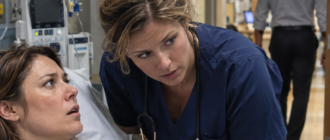
The first time Elias Whitfield walked into the neonatal intensive care unit at Ridgeview Children’s Hospital in Cedar Falls, Iowa, I figured someone had sent him to the wrong floor.
I’d worked there as a neonatal respiratory therapist for thirteen years, long enough to know how most visitors carried themselves at our doors. New parents entered with wide, frightened eyes and short steps. Grandparents showed up clutching coffee cups and crocheted blankets, as if softness could be carried through a doorway. Even our trained cuddler volunteers usually hesitated at the threshold, almost like the air itself might bruise.
Elias didn’t hesitate.

He stood six-foot-five, built like a man who’d spent thirty years taking orders and giving them. He was fifty-three, though the creases around his eyes made him look closer to sixty-five. A pale rope of scar tissue ran from beneath his collar up the side of his neck, and more of it wrapped around both forearms—skin healed thick and uneven from a vehicle fire somewhere I never asked about directly.
It was his hands I noticed most. They were big enough to palm a dinner plate, and they shook. Constantly. It was a fine, involuntary tremor that never fully stopped, the kind caused by nerve damage that doesn’t heal on any timeline a doctor can promise.
Nothing about him looked like he belonged three feet from an incubator holding a baby small enough to fit inside a winter hat. But his volunteer badge was real. He’d finished our six-week Comfort Care training, passed his background check and two psychological screenings, and been cleared for our infant-holding program—the one built for babies whose parents couldn’t be there around the clock.
I was still double-checking his paperwork at the desk when the baby in Room 9 started crying. We only had a placeholder on her chart: Baby Girl Hollis.
She’d been born ten weeks early, weighing one pound fourteen ounces, after her mother, twenty-two-year-old Melissa Hollis, delivered in an ER bathroom and left the building within eleven hours—before the hospital social worker could get a single form signed. No father listed. No grandparents who’d called. No name chosen by anyone who loved her enough to pick one.
Other babies in our unit had construction-paper hearts taped above their incubators and stuffed animals waiting for the day they’d go home. Baby Girl Hollis had a printed ID bracelet and a state-issued gray blanket.
She was also in withdrawal. Her mother’s chart flagged opioid use during pregnancy, and the first ten days of this baby’s life had been one long fight against her own nervous system. Every sound was too loud. Every bit of light was too sharp. Every touch, even a gentle one, made her tiny fists shake and sent her heart rate climbing past 180.
That morning, we’d dimmed the lights, repositioned her, and checked every line twice. She was still crying—thin, furious, and making a sound far too big for a body that small.
Elias turned toward Room 9 like he’d heard his name called.

«Is that the baby who needs a holding volunteer?» he asked.
«She needs someone calm,» I said. «She startles at almost everything. We go slow.»
He nodded, then his eyes dropped to his own shaking hands. So did mine.
I’m not proud of what went through my head. I wondered if hands that unsteady could safely support a skull smaller than a softball. I wondered if the monitor alarms—sharp, sudden, and medical—might drag him somewhere he wasn’t ready to go back to.
«If you don’t think I’m ready, say so,» Elias said, before I could. «I won’t take it personal.»
There was no defensiveness in his voice. Just plain honesty, the kind that made refusing him feel almost like an insult to both of us.
«Let’s try,» I said. «I’ll stay right here.»
He scrubbed in at the sink, water scattering off his unsteady knuckles, then pulled on a fresh gown and waited while I opened the incubator’s side port. The second his fingertip touched the edge of the mattress, Baby Girl Hollis screamed harder. Her monitor alarm went off, and her heart rate spiked to 194.
Elias went rigid, like something invisible had landed across his shoulders. For three, four, five seconds, he didn’t move at all. His eyes had gone somewhere else—somewhere with a different kind of alarm, a different kind of heat.
I’ve worked with enough veterans’ families to recognize that particular stillness.
«Mr. Whitfield, step back a second,» I said, reaching for his arm.
«Give me ten seconds,» he said, eyes shut, breathing slow through his nose. «Please.»