Until the day the chain disappeared.
«Miss?»
Daniel Bennett’s voice pulled me back.
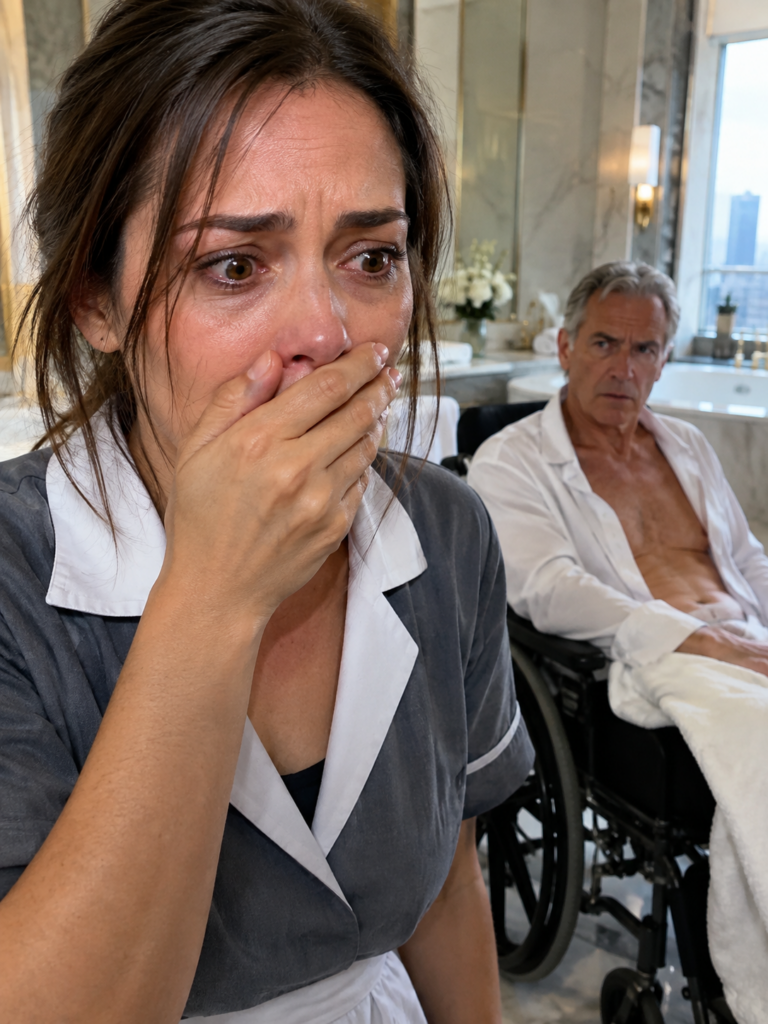
He was still sitting in the transfer chair beside the bathtub, his shirt half-open.
The chill was gone from his demeanor. He looked genuinely concerned.
Not angry.
Not embarrassed.
Just concerned.
«What happened?»
I tried to stand. My legs wouldn’t cooperate.
«I’m sorry.»
«Don’t apologize. Are you hurt?»
«No.»
«Then sit tight for a second.»
The irony of a paralyzed man telling me not to move almost made me laugh. Instead, I clapped a hand over my mouth.
Daniel watched me intently. «What did you see?»
I looked down at the chain again. Then at the crescent-shaped scar just below his collarbone.
«You need to get someone else.»
His expression tightened. «For the bath?»
«For tonight.»
«If this is about modesty—»
«It’s not.»
«Then what is it?»
I used the marble vanity to hoist myself up. My hands were shaking so violently that I knocked a folded towel onto the floor.
«I said I need to go.»
Daniel’s face snapped shut.
There it was again—that guarded mask the housekeeper had warned me about. The look that said he was used to people walking out on him.
«Of course,» he said.
Those two words hit harder than any outburst would have.
I froze. Something in his face broke my heart. It wasn’t pride; it was total resignation. He assumed this was about him, about his body, about the harsh, intimate reality of needing another human being just to get through the day.
I knew that misunderstanding would haunt him long after I walked out the door. So, I forced myself to speak up.
«This has nothing to do with your injury.»
Daniel looked straight at me. «Then what is it?»
I pointed at the chain. «Where did you get that?»
His gaze dropped. For the first time since I’d met him, his cool composure cracked.
His hand couldn’t quite reach it—his paralysis took away almost all movement below his shoulders, though he still had some mobility in his right hand and arm. He flexed his fingers against the armrest controls.
«My father.»
My stomach flipped.
«Your father gave it to you?»
«No.» His eyes rose to meet mine. «He died with it.»
Everything inside me ground to a halt. I grabbed the edge of the counter.
«What was his name?»
Daniel stared at me. It was a normal question, but something in my voice made it sound like a loaded gun.
«Thomas Bennett.»
The words no, that’s not right hovered in my throat.
Because the man I remembered wasn’t Thomas Bennett. His name was David.
David Mercer.
He was twenty-eight when we met. I was nineteen. He worked the night shift loading trucks behind a wholesale market near the crappy apartment I shared with my mother.
He drank terrible coffee. Loved old Motown tracks. Could fix pretty much anything with an engine.
And he had a distinct, crescent-shaped birthmark right below his left collarbone—the exact twin of the one Daniel had.
«Thomas Bennett,» I repeated.
Daniel nodded. «Why?»
I swallowed hard. «Did he ever go by another name?»
His eyes narrowed. «That’s a pretty strange question.»
«Please.»
He studied me for a long moment, then his tone shifted. «You should probably get whatever is wrong with you sorted out before you start interrogating me about my old man.»
«I’m trying.»
«Try faster.»
The sharp edge was back, but now I could hear what was hiding underneath it: fear.
Not fear of me, but fear of where this conversation was heading. I knew that kind of fear inside and out. I’d lived with it for twenty years.
«I knew someone,» I whispered.
Daniel didn’t say a word.
«Someone who wore that chain.»
His gaze dropped back down. «That’s impossible.»
«It’s not.»
«My father owned it for thirty years.»
«No.»
«You don’t know what you’re talking about.»
«I know about the little dent near the clasp.»
Daniel froze.
«And the scratch shaped like a straight line across the back of the pendant.»
He stared at me like I was a ghost.
I stepped closer. «It happened when he dropped it while working on a motorcycle in an alley off Madison Street.»
The bathroom became suffocatingly quiet. Daniel’s face shifted—not dramatically, but all the blood seemed to drain right out of it.
«How do you know that?»
My voice cracked. «Because I was there.»
Another caregiver, Rosa, finished up Daniel’s evening routine.
I sat down in the downstairs staff kitchen, staring at a mug of tea I had no intention of drinking. Mrs. Whitmore, the house manager, came in twice. The second time, she leaned against the counter.
«You don’t have to explain yourself to me,» she said.
«I think I do.»
«Not to me, you don’t.»
She was the same woman from the café. Her name, I’d learned, was Margaret Whitmore. She had run Daniel’s household for eleven years, and she didn’t seem like the type who was easily impressed—or easily spooked.
«Am I fired?» I asked.
«Do you want to be?»
I thought of Brandon, running a fever under a thin blanket. Emma, brushing her broken doll. The barren pantry back home.
«No.»
«Then I suggest you wait.»
«For what?»
«For Mr. Bennett to decide if he wants to see you again.»
«He probably doesn’t.»
Margaret gave me a knowing look. «Mr. Bennett isn’t a fan of mysteries.»
«Neither am I.»
«Yet you seem to have brought one right to his doorstep.»
She walked out.
Twenty minutes later, she was back. «He wants you in the library.»
Daniel was sitting by the fireplace when I walked in. Someone had dressed him in a charcoal sweater, and the chain was hidden beneath it now. I noticed. He noticed me noticing.
«Shut the door.»
I did.
The library was massive, lined with dark wood shelving and rows of heavy books. But unlike the rest of the mansion, it didn’t feel like a museum meant to show off; it felt lived-in. A stack of novels sat next to Daniel’s chair. A half-played game of chess was set up by the window.
A single shelf held framed photos: a younger Daniel on skis, Daniel getting some kind of award, and Daniel standing next to an older man with silver hair.
Thomas Bennett.
Next to the photos sat a stack of bank statements, official records, and dozens of old letters tied together with a faded blue ribbon.
The top envelope was addressed to Thomas Bennett.
Just the handwriting alone made my breath catch in my chest.
David’s handwriting.
Michael’s handwriting.
Daniel caught my reaction. «Is that him?»
«Yes.»
I untied the ribbon. The earliest letter was dated three weeks after David vanished. I read the first line out loud:
Tom, I need you to understand why I left Chicago.
My hands started trembling.
Daniel wheeled himself a fraction closer. «Keep going.»
I kept reading aloud:
Father found out about Laura.
The room went dead still.
He found out she was pregnant before she even knew.
I stopped cold.
«What?» Daniel frowned. «How would your grandfather even know that?»
«I don’t know.» I forced myself to keep reading:
He told me if I stayed, he’d make sure she lost her apartment, her mother lost her job, and every employer in the city knew I’d stolen from the company.
My breath hitched.
The story I had carried around like a heavy anchor for twenty years instantly fractured. Michael hadn’t abandoned us because he wanted to; he’d been forced out.
I kept reading:
I know what you’re going to say—that I should’ve stayed, that Father makes threats he can’t always back up. But Laura’s mother begged me to leave.
I closed my eyes. My mother. Again.
She told me Laura deserved a clean slate. I believed her. I was twenty-eight and stupid enough to think skipping town for a week would protect everybody.
Daniel spoke softly. «He planned to come back.»
«Yes.»
I flipped the page.
I’m up in Milwaukee. I’ll head back as soon as Father cools off.
The next letter was dated six days later:
Tom, something’s wrong. Laura isn’t answering her phone. Her mother told me she had a miscarriage.
I threw a hand over my mouth. Daniel stared down at the page. I kept going:
I don’t believe her. Please go find out.
Another letter: Tom, Father says the baby didn’t make it.
Another: Tom, I need the truth.
Another: Please.
The letters got shorter and shorter. More desperate.
Then, one dated three months later:
I saw the adoption papers.
I couldn’t draw a breath.
Father showed me just enough to prove I have no legal right to interfere. Laura signed them.
Tears burned my eyes. I had signed them. I had believed the guardianship was just temporary. Michael had seen my signature and assumed I gave our son away by choice.
Daniel closed his eyes.
The final letter in the bundle was dated almost a year later:
Tom, I’m heading out for good. Father says Laura has built a new life now. If that’s true, I won’t disrupt it. But if the boy is still alive, promise me one thing—
The next line blurred. I wiped my eyes.
—make sure he knows someday that I didn’t walk out on him.
Daniel looked away. The room suddenly felt suffocatingly small.
I found one last envelope tucked beneath the stack. It had never been opened.
It was addressed to:
LAURA.
My name.
My old address.
No stamp. No postmark. Just my name written in Michael’s hand.
I looked at Daniel. He looked just as shell-shocked as I felt.
«Your father never mailed it.»
«No.»
«Why?»
«I don’t know.»
The envelope had sat sealed for twenty years. My fingers hovered over the flap.
«Open it,» Daniel murmured.
I did. Inside was a single piece of paper:
Laura,
If your mother told me the truth, then I’m sorry for writing. If she lied, then I’m sorry for walking away. I thought I was protecting you. Maybe that was just a cowardly excuse.
I swallowed hard.
I heard you lost the baby. I can’t even begin to tell you how sorry I am. I wanted that child.
My vision blurred.
I wanted you.
I pressed the paper against the table. There was more at the bottom:
My brother Thomas knows where I am. If you ever want the truth, ask him.
And signed simply:
David.
Not Michael. David. The name he’d used with me.
I stared at the signature, then back up at Daniel. «Where did he go?»
Daniel shook his head. «I don’t know.»
«He said Thomas knew.»
«My father took that secret to his grave.»
«Maybe it’s in another box.»
We searched. For two hours straight, we tore through records, old address books, cancelled checks, a postcard from Vancouver, a photo from Oregon. Nothing definitive.
Then Margaret pulled a thin folder out from the very bottom of the box.
Inside was a bank receipt. A wire transfer from Thomas Bennett to Michael Mercer.
Monthly payments. For nine straight years.
The last payment had gone out eleven years ago.
Not twenty years ago. Michael hadn’t died two decades ago; he had been alive and kicking for at least nine years after he vanished. Maybe even longer.
My knees felt like water.
Daniel scanned the bank details. «Portland.»
«Oregon?»
«Yeah.»
A final document was paperclipped to the back of the transfer receipts: an address, with a note jotted down in Thomas Bennett’s handwriting right beside it:
Michael does not want Nathan contacted until the boy is old enough to make his own choice.
Daniel stared at the note. «So my father did know where he was.»
«Yes.»
«At least up until eleven years ago.»
«Yes.»
The mystery that had defined half my life wasn’t about a man who had simply vanished off the face of the earth. It was about a man who had been deliberately kept at arm’s length.
By parents. By brothers. By fear. By a mountain of lies.
I looked at Daniel. «What happened eleven years ago?»
He frowned. «What do you mean?»
«The payments stopped.»
His expression shifted. «I honestly don’t know.»
Margaret, standing quietly behind us, had gone completely still. Too still.
Daniel caught it. «Margaret?»
She looked up at him. For the first time since I met her, the unflappable house manager looked genuinely rattled.
«What is it?» Daniel asked.
«You know something,» I said.
She closed her eyes for a brief second. «I know why the payments stopped.»
I stared at her.
Daniel’s voice dropped to a whisper. «How?»
Margaret looked between the two of us. «Because Thomas asked me to process that final transfer.»
The room went dead silent.
«Why was it the final one?» Daniel asked.
Margaret hesitated, then said, «Because Michael wrote to your father and told him not to send any more money.»
«Why?»
Margaret’s eyes shifted to me. «He said he had finally built a life of his own.»
My heart hammered against my ribs. «With who?»
«I don’t know.»
«Where?»
She reached into the folder and pulled out a second sheet we had completely overlooked. A forwarding address.
Not Portland.
Chicago.
My city. The city I’d lived in for twenty years.
I read the street name, and my breath caught in my throat. It was only twelve blocks away from the run-down apartment where Brandon and Emma were sleeping right now.
Michael Bennett had come back to Chicago.
And according to the date on the page, he had been back here for eleven years.
I looked at Daniel. «If he came back… why didn’t he ever find me?»
Daniel didn’t have an answer. Because right there at the bottom of the page was one final handwritten note from Thomas:
Michael believes Laura married and moved on. He asked that we leave her alone.
I stared at the words.
A lie had built a wall between us from both sides. Michael believed I had chosen a different life without him, and I believed he had walked away without looking back.
And somewhere in the crossfire of those two misunderstandings, our son had grown up poor, struggling in a broken-down apartment just blocks away.
Daniel spoke softly. «Laura.»
I looked over at him. He was holding another piece of paper.
«What?»
His face had gone completely white.

«This isn’t the last page.»
He turned it around so I could see. It was a recent property deed, dated just six months ago, for that exact same Chicago address.
And the owner’s name listed on the line was:
MICHAEL D. MERCER.
The air rushed out of my lungs.
Daniel met my eyes. «He might still be here.»
And for the first time in twenty years, the question wasn’t what had happened to David.
It was whether I had the courage to go knock on his door.
I didn’t go to Michael’s address that afternoon.
Every single part of me wanted to.
For twenty years, I had replayed what I would do if I ever finally tracked him down.
Demand answers.
Break down in tears.
Walk right back out.
Forgive him.
Refuse to give him the time of day.
Tell him about our son.
Keep my mouth shut.
I’d had so many imaginary conversations with a ghost that none of them felt real anymore. But now, there was an actual address. A real house on a real street. And a very real man living behind that front door.
Daniel watched me stand by the east-wing window holding the property deed in my hand.
«You’re not going.» It wasn’t a question.
«Not today.»
«Why?»
«Because I’ve got two kids waiting for me at home.»
He stared at me. «That’s your reason?»
«It’s one of them.»
«What are the others?»
I folded the paper up. «I don’t even know who Michael is anymore.»
«You knew him once.»
«Twenty years ago.»
«So?»
«So twenty years is a lifetime.»
Daniel didn’t say anything to that.
«I’ve spent two decades pretending that finding him would magically fix everything,» I continued.
«And now?»
«Now, I’m starting to think the past isn’t some broken vase you’re supposed to glue back together.»
Daniel’s expression softened a fraction. «What is it, then?»
«Something you just learn how to carry differently.»
He glanced over at the stack of old boxes. «That sounds entirely too mature.»
«I have kids.»
«You mentioned.»
«And I haven’t slept in three days.»
«Well, that explains the sudden philosophy.»
I almost smiled, but the heavy weight in my chest settled right back in.
«Nathan is coming next month.»
«Yeah.»
«Before I do a single thing about Michael, I need to understand what Nathan actually knows.»
Daniel frowned. «You’re putting him first.»
«He’s my son.»
The words slipped out naturally. Then they caught in my throat.
My son.
I hadn’t said those words out loud in twenty years.
Daniel heard the sudden shift in my voice and looked away, giving me a quiet moment of privacy in the middle of the room.
«I’ll call him tonight,» he said quietly.
«You don’t have to do that.»
«Yes, I do.»
«Because of me?»
«No.» He looked over at the framed photo of himself and Nathan on the shelf. «Because I’ve been avoiding him.»
That was the first choice the past changed. Not mine—Daniel’s.
The next three weeks didn’t feel like some sweeping cinematic montage. That honestly surprised me. I kept expecting every morning to dawn with some earth-shattering revelation.
Instead, life just kept moving.
Brandon complained about his nasty-tasting medicine. Emma figured out that mixing ketchup with mashed potatoes created a color she described as «gorgeous.» The ceiling still leaked every time it rained. The rent was still breathing down my neck. And I still rode two buses to the Bennett estate every morning.
Mysteries, it turned out, didn’t excuse you from doing your laundry.
Daniel kept me on the payroll. Better than that, he actually started trusting me—slowly, but surely.
He had his quirks. He liked his bathwater a bit warmer than what the hospital guidelines suggested, but not scalding. He couldn’t stand scented lotions. He wanted classical music in the morning and total silence after three o’clock. He hated when people asked if he was comfortable every five minutes.
And he could still freeze anyone in the room with a single look.
Except Margaret. And, increasingly, me.
One morning, while I was helping him button up his shirt, he said, «You’re doing that wrong.»
I looked down. «I’m buttoning a shirt, Daniel.»
«The cuff.»
«The cuff is buttoned.»
«Unevenly.»
I stared at him. «Has your paralysis somehow granted you superhuman cuff awareness?»
The corner of his mouth twitched. Not quite a smile, but close. «You’re getting entirely too lippy.»
«I learned it from Emma.»
«Your daughter?»
«Mm-hmm.»
«The master doll surgeon?»
«She fixed a broken arm with scotch tape yesterday.»
«Promising career path.»
We were figuring each other out. We weren’t just a wealthy billionaire and his hired help anymore. Not really. We were just two people whose families had left them with a mess of complicated questions. And that mattered.
One Friday, Daniel asked, «How much are you paying for rent?»
I stiffened up immediately. «Why do you ask?»
«Because Margaret mentioned your landlord still hasn’t fixed your roof.»
I turned to glare at him. «Margaret talks too much.»
«She talks just the right amount.»
«I don’t need charity.»
«I didn’t offer you charity.»
«You were about to.»
«No,» he said, looking mildly offended. «I was going to ask why you haven’t reported the building.»
«To who?»
«The city.»
I let out a dry laugh.
Daniel frowned. «What?»
«People with money always think a bunch of paperwork fixes everything.»
«Paperwork solves plenty of problems.»
«Not when your slumlord knows you’re too broke to pack up and leave.»
Daniel went quiet. Then he murmured, «Fair point.»
That caught me off guard. Most wealthy people I’d crossed paths with treated poverty like it was just a bad budgeting choice. But Daniel, for all his sharp edges, actually listened.
«I know someone at a tenant’s legal clinic,» Margaret told me later that afternoon.
«I don’t want—»
«It’s not Daniel’s lawyer,» she said, giving me a look. «It’s a nonprofit.»
That made a difference. I took the phone number.
Within two weeks, the landlord had patched the ceiling, fixed the broken heater, and wiped out the ridiculous late fees he’d been tacking onto my balance.
Daniel never brought it up. I didn’t either. But something shifted. Help didn’t always have to feel like a trap or a debt you couldn’t pay back. Sometimes, it just came in a form you were finally strong enough to accept.
Daniel called Nathan twice before Nathan flew out to Chicago.
The first call lasted seven minutes. The second one went on for forty-three. I only knew because Daniel mentioned it afterward—not the details, just the clock time.
«Progress,» I said.
«You sound like Margaret.»
«She’s contagious.»
«Nathan asked about you, by the way.»
My hands froze over the stack of folded towels. «What did you tell him?»
«That you’re my caregiver.»
«Anything else?»
«Nope.»
I looked up at him. Daniel was watching me closely. «Should I have told him more?»
«No.»
Relief and disappointment wrestled inside my chest.
«You mentioned he has documents about Michael,» I said.
«He does.»
«Do you know when he’s going to open them?»
«On his birthday.»
«When’s that?»
«Tuesday.»
I gave a slow nod. Nathan was arriving on Monday.
I had four days. Four days before I might find myself standing in the same room as the son I’d spent twenty years looking for.
I went home that night and cried in the kitchen while Brandon and Emma slept. Not because I was sad, exactly—just because love, when it doesn’t have anywhere to land, turns into pure pressure. And suddenly, after twenty long years, there might actually be somewhere for it to go.
Michael’s house was still twelve blocks away.
I passed his street twice that weekend. Never on purpose—at least, that’s what I kept telling myself. The first time, I stayed glued to the bus seat as we drove right past the corner. The second time, I walked right by the iron gate, my heart hammering against my ribs like a trapped bird, before walking briskly in the opposite direction.
I wasn’t ready.
Nathan arrived on a brisk Monday afternoon.
He looked so much like David around the eyes that it nearly took my breath away. He was taller than I expected, with the same quiet, careful way of moving.
We didn’t talk about the past on his first day. We just worked. I helped him settle into the guest suite down the hall from his father, showing him where the extra linens were and making sure he had everything he needed.
By Tuesday afternoon, the air in the house felt charged, like a thunderstorm was rolling in.
I was wiping down the mahogany table in the library when Nathan walked in, holding a worn manila folder.
«You’re working on your birthday?» I asked softly.
«Needed a change of scenery,» he said, pulling out a chair. He sat down and stared at the manila folder for a long, quiet moment.
«Are you going to open it?» I asked.
He looked up at me, his eyes searching my face. «Did my dad talk to you about what’s in here?»
«He told me it was about Michael.»
Nathan opened the flap and pulled out a thick stack of papers. A few old photographs slid out onto the polished wood. I caught a glimpse of a young man with laughing eyes leaning against an old motorcycle.
David.
My breath caught.
Nathan slid one of the photos toward me. «He didn’t hate you, you know.»
My eyes stung with sudden tears. «Who?»
«Michael. According to these letters… he spent a long time trying to find out what happened to us.»
«Your grandfather made sure we stayed separated,» I choked out, pulling up a chair and sitting across from him.
«I know.» Nathan looked down at the documents. «Thomas kept them apart on purpose. He built a whole cage out of money and threats.»
«And we lived inside the ruins of it,» I whispered.
Nathan reached across the table and pushed a final letter toward me. It was the one Michael had written right before he left for good.
Make sure he knows someday that I did not abandon him.
I traced the familiar handwriting with my fingertip, a tear finally spilling over and splashing onto the paper.
«You look like him,» Nathan said quietly, studying my face. «When you cry, I mean. I used to think I didn’t look like anyone. Just an adopted kid from a good family with a bunch of unanswered questions.»
«You were always so much more than that, Nathan.»
He looked up, a bittersweet smile touching his lips. «I think I’m finally starting to believe that.»
«Are you going to go see him?» I asked, holding my breath.
Nathan looked out the tall library window, watching the afternoon sun stretch across the lawn. «I don’t know. Finding out your dad is alive is one thing. Knocking on his front door when he’s lived twelve blocks away for a decade… that’s heavy.»
«I know the feeling,» I murmured.
We sat there in the quiet library for a long time, neither of us rushing to fill the silence. For twenty years, I had believed that uncovering the truth would blow my whole life apart. But sitting here across from my son, surrounded by old letters and ghosts of the past, it didn’t feel like destruction.
It felt like breathing out after holding my breath for two decades.
Two days later, Daniel called me into the library.
The morning sunlight cut sharply across the wooden floorboards. The old silver chain lay resting on the table right beside his wheelchair.
I stopped in my tracks. «You took it off.»
«Yeah.»
I stared at the silver links. For two years, he had worn that chain like armor. «What changed?»
«Nathan asked if Michael should have it.»
I swallowed hard. «And what did you tell him?»
«I told him it belonged to my grandmother first.» Daniel looked down at the metal. «Then my father. Then Michael. And then, somehow, it wound up back with my father.»
I walked over and sat across from him. «What are you going to do with it?»
Daniel pushed the chain across the table toward me.
I didn’t touch it. «No.»
«I didn’t say it was for you.»
«Then why are you giving it to me?»
«Take it to Nathan.»
My chest tightened up. «Why?»
«Because everyone else in my family used that chain to keep score. To remember who owned what and who owed who.» He looked up, meeting my eyes. «Maybe he should be the one to decide what it means next.»
It sounded so different from the guarded, bitter man I’d first met that a genuine smile pulled at my lips. «You’re getting awfully philosophical in your old age.»
«Blame my terrible influences.»
I reached out and picked up the chain. The silver felt cool and heavy against my palm. The exact same chain David had placed in my hands twenty years ago.
Back then, he had told me: Keep this safe.
I used to think he meant protecting the physical object. Now I understood what he was really saying. People were never meant to keep the past safe by locking it away in the dark. Sometimes, the only safe thing left to do was to let the truth out into the light.
I curled my fingers around the silver links. «I’ll give it to him.»
Daniel gave a single nod. Then he added, «Right after my bath, of course.»
I raised an eyebrow. «Still bossing me around?»
«You remain gainfully employed.»
I stood up, shaking my head. «Keep telling yourself that.»
As I walked around to grab the handles of his chair and pushed him toward the hallway, a beam of morning sunlight caught the empty space at his collarbone where the chain used to rest. For the first time since I’d walked through the doors of this mansion, Daniel didn’t look like a man weighed down by someone else’s history.
He just looked like himself.
That afternoon, I handed the chain to Nathan.
He turned the heavy silver over and over in his palm. «What am I supposed to do with this?»
«Whatever you want.»
«Keep it?»
«If you want.»
«Give it to Michael?»
«If that’s what you choose.»
«Throw it in a drawer and forget about it?»
«Yes.»
He let out a soft laugh. «You’re not giving me much guidance here.»
«I’m trying out a new strategy.»
«Which is?»
«Not making everyone else’s decisions for them.»
Nathan smiled, slipping the chain safely into his pocket. «Maybe I’ll hold onto it for a little while.»
«For how long?»
«I don’t know yet.»
I smiled back. «That sounds like a healthy start.»
He rolled his eyes affectionately. And just like that, the object that had once made my knees buckle and my world collapse became ordinary again.
Just a chain.
Just a memory.
Just a choice waiting to be made.
Nothing more.
Nothing less.