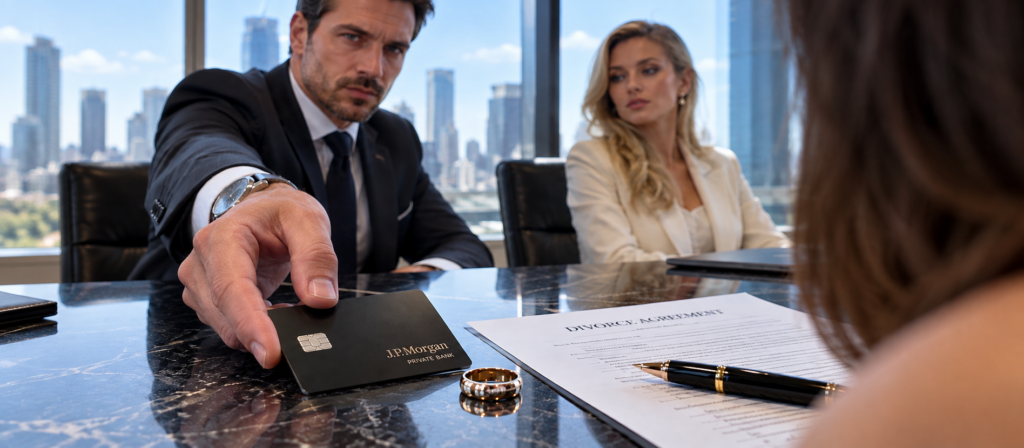
The black private-banking card landed beside my wedding ring just before my husband announced he intended to marry his secretary.
It slid across the polished conference table and stopped inches from my hand. Beneath it lay a certified document confirming that $120 million had already been transferred into an escrow account under my name.
Grant Caldwell didn’t look ashamed.
He looked relieved.
«This is more than fair, Claire,» he said. «Sign the divorce agreement tonight, resign from Meridian Medical Technologies, and the money becomes yours permanently.»
Vanessa Hale sat in the chair I had occupied during every major board meeting for seven years.

She wore a cream suit, diamond earrings, and the quiet smile of a woman convinced she had already won. Grant’s favorite coffee mug rested beside her hand, a faint red lipstick mark staining the rim.
My husband’s mother, Evelyn, stood near the windows with her arms crossed.
«Grant has been extremely generous,» she said. «Most women would be grateful.»
Most women had not built a four-billion-dollar medical technology company beside the man now paying them to disappear.
Most women had not spent eight years sleeping on laboratory floors, negotiating emergency supplier contracts at two in the morning, and personally calling hospitals when a product failed.
And most women did not discover their husband’s affair three days after warning him that one of their medical devices could kill someone.
Grant pushed the agreement closer.
«The properties remain yours,» he said. «You receive the full settlement, but you surrender all future claims to my shares, resign as chief operating officer, and leave the board immediately.»
«And then?» I asked.
His expression hardened.
«After the legal waiting period, Vanessa and I will marry.»
Vanessa lowered her eyes as if the conversation pained her.
«I never wanted to hurt you, Claire.»
I looked at her.
«You’re wearing my wedding ring.»
Her left hand froze.
The platinum band was slightly too large. She had wrapped a thin transparent strip around the inside to make it fit.
Grant finally glanced at her hand, but instead of embarrassment, irritation crossed his face.
«Claire, don’t make this uglier than it needs to be.»
I nearly laughed.
The affair was ugly.
The ring was ugly.
But neither explained why I had already packed a suitcase.
That reason sat inside a gray notebook in my handbag.
Two days earlier, I had presented a safety report on Meridian’s newest product, the Aegis One—a motorized hospital bed designed for elderly and post-surgical patients.
During prolonged elevation tests, the control module overheated. When thermal protection activated, the braking mechanism sometimes responded three seconds late.
Three seconds sounded insignificant in a boardroom.
Three seconds could send a seventy-year-old patient onto a concrete floor.
I had demanded an immediate production halt.
Grant closed my report in front of the entire executive team.
«You treat every problem like a catastrophe,» he said.
Vanessa leaned toward him.
«The replacement supplier passed its initial review. Delaying now could damage the financing round.»
I asked who had approved the supplier.
Grant smiled.
«It’s an executive matter, Claire. You don’t need to interrogate every decision.»
That was when I understood.
They were not removing me only because Grant wanted Vanessa.
They needed me gone before the Aegis One entered mass production.
I picked up the fountain pen.
Vanessa’s smile widened.
Grant seemed almost disappointed by my calm.
«You aren’t going to reread it?»
«No.»
I signed the divorce agreement.
Then I signed my resignation as chief operating officer and board member.
The pen made a faint scratching sound—the sound of seven years ending without tears, shouting, or another chance.
I removed my wedding ring and placed it beside the black banking card.
Vanessa stared at it.
«You can keep that one too,» I said. «Apparently, you’re comfortable wearing things that belonged to someone else.»
Her face tightened.
Grant leaned forward.
«The corporate legal team will supervise the removal of your belongings. Company materials cannot leave this building.»
I opened my handbag and pulled out the gray notebook.
Its corners were worn from years of use.
Grant’s eyes narrowed.
«What is that?»
«My personal journal.»
«If it contains technical information—»
«It contains dates, names, decisions, and the reasons I disagreed with them.»
I opened the first page.
Grant himself had written the sentence during Meridian’s earliest days, when we worked from a converted warehouse outside Denver.
Every decision that forces another person to carry responsibility must preserve the name of the person who made it.
He believed those words when we were poor.
Money had not changed him.
It had simply made pretending unnecessary.
I left my security badge on the table, removed Grant from my emergency contacts, disabled location sharing, and lifted my suitcase.
As I reached the door, he spoke.
«When you calm down, perhaps we can still be friends.»
I turned.
«The moment I signed those papers, we became strangers connected by a contract.»
The door closed behind me.
A ninety-day restriction from a judge barred me from offering jobs to former Meridian employees. Three colleagues who had planned to start a consulting firm with me backed out to protect themselves legally.
I sat alone on the floor of my empty rented office, surrounded by unopened boxes and blank white walls.
Grant had struck at the one thing he knew mattered more to me than money: my ability to rebuild.
The door opened. Thomas Walker, Meridian’s former chief financial officer, walked in holding a public securities filing.
«That settlement wasn’t generosity,» he said. «Grant didn’t have $120 million in liquid cash.»
To fund the divorce, Grant had pledged a massive block of his Meridian stock to a private investment fund called Northstar Capital. One of Northstar’s primary backers was Titan Motion Systems—the exact supplier Vanessa had forced into the Aegis One project. The five-year exclusive supply contract had been signed just twenty-four hours before Northstar approved Grant’s personal loan. Breaking that agreement could cost Meridian nearly $150 million in penalties.
«Titan essentially financed your divorce settlement,» Thomas explained. «And in exchange, Meridian locked them in for years of guaranteed revenue.»
I scanned the documents. «Who negotiated this?»
«Vanessa.»
«She didn’t have procurement clearance.»
«She used Grant’s office.» Thomas flipped a page. «The COO of Titan Motion Systems is Owen Hale.»
Vanessa’s cousin. When we first vetted suppliers, I had questioned the matching last name. She had just laughed and called Hale a common name, and Grant had accused me of being jealous.
Now the puzzle pieces fell into place. I never would have signed off on that contract. Grant needed $120 million fast to buy his freedom, and Vanessa delivered it by shackling Meridian to a backdoor deal.
What Grant liked to call true love was just a debt-financed business transaction. But we still lacked smoking-gun proof that Vanessa stood to profit personally.
Then Thomas dropped the final piece: a shell company controlled by Vanessa held a hidden equity stake in Titan. If the five-year contract held up, her cut could top thirty million dollars.
I looked around the empty office. The affair wasn’t the real betrayal. Grant had mortgaged the company, put patients in danger, and paid me off with borrowed funds just to clear out the only person standing in the way of his scheme.
My phone buzzed in my hand. Another Aegis One bed had failed—this time in Arizona.
The Second Fall
A Phoenix assisted-living facility had installed thirty Aegis One units. During a routine adjustment, a control module overheated, the brakes engaged late, and the platform tilted violently. An elderly patient was thrown against the metal rail, suffering a severe fracture.
Unlike the first hospital, the Arizona facility had security footage. The video clearly showed the warning lights flashing while the bed moved entirely on its own, with no nurse near the controls.
The family went straight to the police, the FDA, and national news outlets. By nightfall, federal regulators ordered an immediate freeze on all Aegis One units nationwide.
Grant called me, his usual swagger entirely gone. «Do you have the lab results yet?»
After the first lab caved to pressure from Meridian, I had bought a retail unit through an authorized dealer and sent it to an independent safety lab.
«The preliminary data is in,» I told him.
«Send it to me.»
«It confirms severe overheating and a three-second brake delay under continuous load.»
He fell silent for a long moment. «I can push a voluntary patch.»
«It’s a recall, Grant.»
«Calling it a recall will kill our upcoming funding round.»
«It’s a defective medical device.»
«If the financing falls through, Meridian goes under.»
«That doesn’t justify keeping dangerous equipment in hospitals.»
«We have two thousand employees, Claire.»
There it was again—his favorite shield.
I closed my eyes. «You pushed a hundred more units through after the first accident. You knew the risk.»
«I need you to come back and run crisis management.»
«No.»
«You designed our entire quality assurance framework.»
«I already gave you the playbook: halt sales, recall everything, preserve the data, compensate the victims, and submit to independent testing.»
«You just want to watch Meridian burn.»
«I want you to stop driving the car into a brick wall and asking me to pull you from the wreckage.»
I hung up.
Meridian scrambled to put out a press release blaming the incident on a «software integration glitch.» When Vanessa ordered staff to push that narrative, someone leaked her emails.
Journalists quickly pieced together the timeline. My FDA report predated their lawsuit. The forged digital signatures were logged after my resignation. Six different department heads had flagged the supplier months prior.
Public sentiment flipped overnight. This wasn’t a bitter ex-wife drama anymore; it looked like a massive corporate cover-up of a deadly medical defect.
Hospital networks began canceling pending orders en masse. Northstar Capital pulled the plug on the $400 million funding round. Meridian’s board demanded an immediate forensic audit of Grant’s personal loan and the Titan deal.
Cornered, Grant finally ordered his IT team to scrub through Vanessa’s archived inbox. They found the paper trail proving her shell company owned a slice of Titan.
Grant cornered her in his office. According to his assistant, the shouting match lasted over an hour.
«You used my loan to strong-arm Titan into Meridian,» Grant yelled.
«You needed the cash,» Vanessa shot back. «Without Northstar, how else were you going to pay off Claire fast enough to make her disappear?»
«You swore Titan was independent.»
«You wanted to believe it.»
«I trusted you.»
Vanessa laughed. «No, Grant. You just loved the reflection you saw of yourself in me.» She reminded him how he used to complain that the industry viewed me as the real brains behind the company. She had played to his ego, validated his shortcuts, and convinced him my caution was just an attempt to cage him. «You didn’t divorce Claire because you loved me. You divorced her because you were sick of everyone knowing she was the only reason your company stayed afloat.»
Grant couldn’t fire her on the spot; Vanessa had recordings tying his personal loan directly to Meridian’s supplier terms. If Northstar demanded immediate repayment, Grant would lose his shares, and Titan could sue for a $150 million breach penalty.
They had locked themselves in a mutual destruction pact.
Their wedding, set for the following week, suddenly became a high-stakes PR stunt. Canceling it would signal panic to investors. Vanessa needed the ring for legal immunity, and Grant needed the illusion of stability.
Out of six hundred invitations, only twenty-three people RSVP’d yes. None of the founding engineers showed up. None of the exiled executives came. The silence spoke volumes.
Grant showed up at my apartment two nights before the ceremony. «I’ll cut ties with Titan,» he said. «I’ll announce the recall and settle with the victims. Just give me time to restructure.»
«Then do it.»
«Just hold off on filing your lab report.»
«No.»
«If you drop that before we secure bridge loans, Meridian goes into Chapter 11.»
«That report belongs in federal hands.»
His shoulders slumped. «Come back as COO. Take the board seat. Name your title.»
«You still think this is a turf war.»
«I know the company is dying without you.»
«That’s not an apology.»
«I was wrong about how much you carried.»
«You’re wrong again.» He stared at me blankly. «You don’t miss me. You miss the safety net that caught every disaster you caused.» His voice cracked. «Seven years, Claire. Was nothing real?»
«It was,» I said quietly. «That’s why it took me seven years to finally walk away.»
The next morning, a federal judge tossed out the rest of Meridian’s restrictive injunctions against me. They had zero proof I stole data or poached staff, and my settlement funds were finally unfrozen.
More importantly, the SEC and FDA announced a joint inquiry. Thomas handed over verified server logs proving my electronic signature had been stamped on three separate documents after I left the building—all originating from Vanessa’s IP address, complete with two-factor authentication codes sent straight to her phone.
The evidence landed on Grant’s desk the night before the wedding. He confronted her in the bridal suite while her dress hung by the window.
She didn’t even try to deny it. «If the beds worked, nobody would have looked twice,» she said coolly. «If they failed, Meridian needed a scapegoat.»
«You tried to frame Claire.»
Vanessa looked at him in the mirror. «You approved the PR hit. You signed off on the lawsuit. You handed her $120 million so everyone would assume she bought her own silence.» She turned to face him. «We played the same game, Grant. The only difference is I’m not lying to myself about it.»
Grant ordered her out, but Vanessa just held up her phone. «Cancel the wedding, and Northstar gets every audio file where you guaranteed Titan’s contract in exchange for your personal cash.»
Realizing he was completely trapped by the secretary he thought he controlled, Grant called me late that night from the lobby of my building. «I know everything,» he said. «I’m firing her tomorrow.»
«Tomorrow is the federal hearing.»
«If you come back, I’ll call off the wedding.»
«Will you admit corporate negligence?»
«We have to manage the messaging—»
«Will you issue a public recall?»
«You need to step back in first.»
I hung up.
The Hearing
The federal hearing kicked off at nine sharp. Meridian’s legal team tried to pin the Aegis One design flaws on my past administration, with Vanessa testifying smoothly in a sharp black suit.
When my turn came, I didn’t open with the forged signatures. I pulled up an internal email from four months prior with the subject line: CRITICAL SAFETY WARNING — AEGIS ONE MOTOR CONTROLLER.
Grant, Vanessa, and the head of quality had all been copied. It demanded full thermal and load testing before greenlighting production.
Next, I played an audio transcript from a board meeting where I explicitly warned against using Titan Motion Systems without proper vetting. Grant’s voice followed mine on the recording: “We can manage the risk post-launch. The market window won’t wait.”
The room went dead silent.
I looked toward the families of the injured patients. «I share some blame,» I told the panel. «When I saw executives systematically gutting safety protocols, I stayed because I thought I could fix it from the inside.»
Grant raised his head.
«I overestimated my influence and underestimated their willingness to trade human safety for stock valuation,» I continued. «But I never approved Titan, and I never signed that risk waiver.»
The forensic tech put the server logs up on the big screen. Three documents. Three timestamps post-resignation. Three two-factor security pings to Vanessa’s cell.
When security footage proved Vanessa had walked into Grant’s private office at those exact timestamps, her icy composure finally cracked. «I was following executive directives,» she stammered.
Grant whipped around. «I never told you to forge signatures!»
Vanessa glared at him. «You authorized everything else.»
Before they could tear each other apart, I dropped the independent lab results on the record. Under standard hospital operating loads, Titan’s cheap motor controllers overheated past legal thresholds, triggering the thermal failsafes and causing a three-second brake delay. It matched both accidents down to the millisecond.
Thomas followed up by laying out the financial paper trail: Meridian guarantees Titan a contract on day one; Northstar funds Grant’s $120 million loan on day two; the money hits my escrow account on day three—all tied to Vanessa’s hidden equity stake in Titan.
A venture capital rep leaned over the table. «Did you mortgage corporate revenue to fund your divorce?»
Grant had no answer.
One by one, the six resigned directors took the stand to back up the timeline. Marcus detailed how R&D was sidelined; Daniel exposed the forged quality sign-offs; the logistics head confirmed Vanessa ordered them to bury customer complaints.
Even Samuel Trent, the supply chain exec who had briefly walked back his resignation, took the stand. He couldn’t look me in the eye. «Vanessa offered me a retention bonus and a promotion,» he whispered. «She said Meridian would blacklist me if I backed Claire.»
By the end of the day, the fallout was absolute. The FDA ordered a nationwide recall of every Aegis One unit. The Titan contract was voided. The DOJ stepped in to launch a full criminal probe into the forged signatures, insider fraud, and gross negligence.
Meridian’s board held an emergency vote right there in the building. Grant was stripped of his CEO title, and Vanessa was fired for cause.
Grant sat alone at the head of the long mahogany table, completely stripped of the power that had given the seat its weight. His laptop was confiscated; his keycard deactivated. Northstar immediately demanded more collateral on his personal loan, while Titan slapped him with a $150 million breach lawsuit.
He looked across the room at me one last time. «If you come back, we can save the company.»
«Meridian has a fighting chance if it owns up to its mistakes, pays out the victims, and puts people in charge who actually care about safety,» I said, closing my briefcase. «The only thing Meridian lost today was a CEO who thought he mattered more than the truth.»
His face drained of color. «Did I ever mean anything to you?»
«You meant enough for me to spend seven years cleaning up your messes.» I paused at the door. «Never again.»
The wedding was called off by sunrise. Photographers caught Vanessa sneaking out of the hotel through the service entrance while crew members hauled away thousands of dollars worth of white floral arrangements. She didn’t waste time crying; she immediately filed a wrongful termination suit against Meridian, claiming she was just following Grant’s orders.
Natalie Brooks received a full, unredacted settlement for her injuries, and the Arizona patient’s family won a substantial payout. Meridian publicly retracted every statement blaming them, and my own countersuit was dropped with prejudice.
My $120 million remained safely untouched—legally mine, secured under a valid agreement.
Grant, however, was financially cornered. To stave off total bankruptcy and satisfy Northstar, he had to dump the bulk of his Meridian shares. He kept enough to live comfortably, but he lost control of the empire he had built his entire identity around.
When the mandatory legal waiting period finally lapsed, we met at our lawyers’ office to sign the final divorce decree.
Grant slid my old platinum wedding ring across the table. «When did you actually check out?» he asked quietly.
«Long before I found out about the hotel room.»
He frowned. «You knew?»
«I knew.»
«Then why didn’t you say anything?»
» Because the affair wasn’t the moment I lost respect for you.» I pulled the papers toward me. «It happened in that boardroom. You knew those brakes were death traps, but you pushed production anyway because Vanessa whispered that Wall Street would love the Q3 numbers.»
Grant stared down at the ring. «If the beds hadn’t failed… would you have stayed?»
«Yes.»
«Why?»
«Because being lucky isn’t the same as making the right call.»
Before I signed, Grant laid a hand over the documents. «I can sign over my remaining shares. The company belongs in your hands.»
«I don’t want your shares.»
«Then what do you want?»
«For you to listen when I told you the house was on fire.» I pushed his hand aside. «And now you’re handing me the ashes just because I proved I could walk through the flames.»
We signed.
Outside on the courthouse steps, Grant looked utterly hollowed out. «I didn’t just lose my wife,» he muttered. «I lost the only person who always had my back.»
«I never had your back,» I said, sliding the decree into my bag. «I had the back of the life we were building. For too long, I couldn’t tell the difference between protecting our future and cleaning up your recklessness.»
He held out the ring. I didn’t take it.
«Sell it. Toss it in the river. Give it to Vanessa.»
I walked away without looking back. For the first time in eight years, Grant Caldwell had engineered a disaster I wasn’t coming back to fix.
The Company That Could Say No
Two months after the ink dried on the divorce, Marcus and Thomas dropped by my new office space. They didn’t pitch a rescue mission for Meridian; instead, they laid the draft charter for a brand-new firm on my desk.
It was called Northline Integrity—a specialized consulting outfit focused entirely on medical device compliance, strict supply-chain auditing, and airtight risk management.
Under our bylaws, no executive could ever override a quality control veto when patient safety was on the line. Engineers, auditors, and investors held equal voting power, and every single safety dissent required an immutable timestamp. We even set aside a dedicated profit pool to legally protect whistleblowers.
«We want you at the helm,» Thomas said.
I read through every line. «If I sign on, this company can’t rely on me to be its permanent conscience.»
Marcus grinned. «That’s why article one states that everyone is replaceable—including the CEO.»
I opened my worn gray notebook. On the first page, Grant’s old handwritten rule still stood: Every decision that forces another person to carry responsibility must preserve the name of the person who made it.
Beneath it, I added one more line: No organization should ever outsource its moral compass to a single individual.
I signed the charter.
We started small in a modest Boulder office with just seven people. I seeded it with a fraction of my settlement, but the company belonged to all of us. Marcus ran audits, Thomas handled the books, and an independent ethics board could overrule us all.
Six months in, my old habits flared up during a crunch time. I stayed late, pulling up half a dozen project files to fix a client assessment myself.
At 10:45 PM, Marcus walked into my office and physically closed my laptop lid.
«What are you doing?» I asked.
«Our charter explicitly bars execs from signing off on critical files after twelve straight hours on the clock.»
«I wrote that rule.»
«Then you should respect the author.»
For years, I had operated under the delusion that if I just suffered enough, everyone else could coast. Now I understood that no healthy enterprise could survive on the burnout of one person.
A year after the federal hearings, Meridian staggered through its restructuring. A seasoned compliance expert took over as CEO, two bleeding hardware divisions were axed, and independent oversight was finally baked into their DNA. Their stock price was a fraction of what it once was, but their devices were safe.
Grant had no board seat, no office, and no influence. Occasionally, trade blogs would snap a photo of him at a conference—still wearing bespoke suits, but sitting quietly in the back row, forgotten by the industry he used to own.
Vanessa’s legal fallout dragged on for years. Heavy civil penalties, a permanent industry ban, and mounting civil suits destroyed the carefully curated image she had spent a lifetime building. Her ultimate nightmare wasn’t being exposed as the other person; it was being exposed as someone whose sweetness was just a corporate acquisition strategy.
Natalie Brooks received every cent of her medical and emotional damages, and Meridian publicly cleared her name.
As for me, I kept my routine quiet. On Northline’s first anniversary, as the team prepped to expand into a larger lab space, Thomas asked how I planned to celebrate.
«I’m heading out at six.»
«That’s it?»
«I bought a movie ticket for seven.»
«Going solo?»
I smiled. «Watch me.»
At six sharp, the office lights clicked off. For once, I wasn’t the last soul in the building. Our receptionist called out a mock warning about unauthorized overtime as I grabbed my coat.
My old gray notebook sat upright on an open shelf. It wasn’t locked away like a state secret, nor was it displayed like a trophy of my past trauma. New hires read it sometimes—its pages filled with red flags ignored, hard lessons learned, and the reminder of how close a multi-billion-dollar machine came to collapsing because everyone involved kept insisting the view from the edge was beautiful.
Grant sent one final email six months down the line: When I sent those wedding invitations and everyone ghosted, I thought they were scared of you. Now I realize they just stopped believing in me.
I read it once, archived it, and didn’t reply.
Silence wasn’t a punishment anymore. It was just peace.
Most of the $120 million sat safely in diversified bonds and a managed trust, funding Northline’s growth and backing a legal defense fund for whistleblowers in the medical field. I hadn’t given the money back to prove some holier-than-thou point, nor did I view it as dirty cash. It was simply the payout for seven years of invisible, back-breaking labor and an eight-year partnership gone wrong. How I chose to spend it belonged entirely to me.
The Light That Belonged to Me
The theater was just two blocks down from the Northline office. At the crosswalk, the pedestrian signal glowed red.
In my old life, every red light was an excuse to check my inbox, redline a contract, or put out a fire before anyone else even smelled smoke.
This time, I just stood there on the pavement, watching the evening breeze move through the trees. Across the street, a corner flower shop was rolling in its displays, a clerk carrying out a bucket of unsold white lisianthus.
When the light changed, I walked over and bought the whole bunch.
«Want me to wrap those up?» the clerk asked.
«No, thank you. They’re fine like this.»
I walked into the theater holding the loose stems. The seat directly beside mine was empty, so I propped the flowers gently on the armrest.
My phone stayed silent in my bag. No missed calls. No frantic pings from an executive suite. No husband assuming that no matter how thoroughly he trashed our lives, I’d still be sitting among the rubble waiting to clean it up.
When the house lights dimmed, I didn’t think about Grant. I didn’t wonder if he finally grasped what he’d thrown away. His remorse wasn’t the yardstick for my worth anymore.
For the longest time, I had gauged my value by how many crises I could juggle. I thought love meant being irreplaceable, loyalty meant taking the hits without complaining, and strength meant carrying the weight for people who refused to carry their own.
But being needed isn’t the same as being cherished. Being useful isn’t the same as being respected. And playing the savior on an endless loop doesn’t inspire gratitude—it just teaches people that accountability is someone else’s problem.
When the credits rolled, a light Colorado mist was falling outside.
I carried my flowers home up the steps of a porch with a motion-sensor light that clicked on the second I approached. A year ago, I would have walked into a cavernous, sterile mansion filled with designer furniture and unspoken resentments.
Instead, I unlocked a modest, warm home that belonged completely to me.
I dropped the lisianthus into a simple glass vase by the window. No framed executive profiles. No corporate trophies from Meridian. No wedding ring rattling around in a drawer.
Pouring a glass of water, I watched the rain streak against the glass. Somewhere out there, Meridian was limping along without me. Somewhere out there, Grant was learning that the woman he tried to trade in for an upgrade was never the dead weight holding him back—she was the foundation holding the whole ceiling up.
That truth didn’t sting anymore, because I had finally built something where my survival didn’t depend on my suffering.
The next morning at Northline, our ethics board shot down one of my project proposals. A high-paying client wanted us to fast-track an audit timeline, and I genuinely believed we could safely compress the schedule.
The committee disagreed unanimously.
For a split second, my old COO instincts flared up—the urge to argue engineering metrics until everyone fell in line with my verdict.
Then I glanced up at our framed charter on the wall: No organization should ever outsource its moral compass to a single individual.
I closed my folder, nodded, and dropped the push. The audit stayed on its original, unhurried track.
Three weeks later, that exact pacing caught a subtle battery insulation flaw that standard automated tests would have missed. The catch kept thousands of potentially compromised diagnostic units out of hospitals.
Marcus dropped the final incident report on my desk. «You were wrong on this timeline.»
«I was.»
He paused, bracing for a defense that didn’t come. I just signed off on the preventative fix. «Make sure my name goes right beside the error on the review.»
He smiled.
That was the house I wanted to live in. Not a place where I had to be infallible, but a place where nobody was important enough to bury a mistake.
That evening, I logged off at six on the dot.
The receptionist locked up the main lobby right behind me as we walked out together. For years, Grant used to introduce me at dinners as the woman who always stayed behind to turn out the lights, as if that endless devotion was proof of his charm.
It never was.
It was just the habit of someone terrified of the dark.
I wasn’t scared of the dark anymore. Crossing the parking lot under the wide Colorado sky with just my car keys and my own thoughts, I looked back as Northline’s windows darkened one by one.
The company was solid. The people were protected. The work would still be there tomorrow.
And this time, when the last light went out, I was already gone.