Sitting in a hospital bed with an injured arm and fresh stitches, I called my parents to ask if they could watch my four-week-old baby. My dad picked up and immediately said, «It’s Whitney’s nig…»
I stared at my phone and told him to say it again.
Dad sighed heavily, acting as though I were the one making his evening difficult. «We’re not coming. Whitney needs us tonight.»
«I’m in the hospital,» I replied. «I’m not asking you to entertain. I need someone who can safely pick up a four-week-old while my arm is like this.»
He told me they had already made plans.

That sentence hurt worse than I expected. I needed someone to carry the diaper bag and car seat without pulling my stitches. I just needed one night where asking my own parents for help didn’t feel like submitting an application they were free to reject.
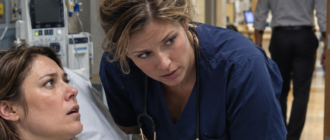
The nurse beside my bed adjusted the rail and quietly asked, «Do you have another person you can call?»
I almost said no. Then I thought about Whitney.
For years, whenever something involved her, my parents acted as if her needs came with a hard deadline and mine came with an optional checkbox. Birthdays, rides, last-minute favors, and holidays were always brushed off as bad timing. I had gotten so used to it that I rarely challenged them anymore. But this time, a newborn was involved.
Instead of arguing with Dad, I hung up and sent Whitney one message: Dad says you need them tonight. I’m in the hospital and asked them to take the baby. Is everything okay?
Her answer came less than a minute later. What are you talking about?
Before I could process that, another message appeared: They told me you already had someone helping you.
I felt something inside me go completely still. I called her immediately.
«Where are you?» Whitney asked.
«At the hospital.»
«With the baby?»
«Yes.»
«And they know that?»
«Yes.»
Whitney didn’t defend them. She didn’t tell me I was overreacting or that Dad must have misunderstood. She simply said, «I never asked them to choose me over you.»
It wasn’t a misunderstanding or competing emergencies. My parents had told each of us a completely different version of the same night. Whitney explained that Mom had called earlier to offer help, and Whitney had assumed they were just being supportive because, according to them, I was doing fine and already had plenty of backup.
«I didn’t know you were hurt,» she said. «I didn’t even know you were at the hospital.»
The nurse quietly busied herself with supplies, giving me enough privacy to breathe through what I was hearing. I looked at the baby’s carrier beside the chair, then at the diaper bag I couldn’t comfortably lift with one arm. For the first time, I wasn’t angry at Whitney. I was angry at the system my parents had built between us—a system where they kept us separated with half-truths and let resentment do the heavy lifting.
Whitney asked one question: «Do you need me to come?»

No speeches, no pride, and no pretending I could manage because asking twice felt humiliating. About half an hour later, footsteps stopped outside my room. The door opened, and Whitney walked in wearing jeans and a sweatshirt, her face tight with worry.
She looked at my stitched-up arm, then at the baby, and back at me. Neither of us mentioned Dad. Whitney crossed the room, reached down, and took the diaper bag from my hand, setting it beside the carrier.
«I need to tell you something,» she said quietly.
It turned out this dynamic hadn’t started tonight. After the baby was born, Whitney had asked Mom twice whether she should visit, and both times Mom claimed I wanted space and that visitors were overwhelming me. Whitney had believed her, leaving me wondering all those weeks why she never checked in. When she pulled out her phone, there was the text from Mom: Don’t bother them right now. They have plenty of help.
My phone lit up with Dad’s name. Before I could stop her, Whitney reached over and hit speakerphone.
«What is going on?» Dad demanded.
I asked him straight out if he told Whitney I was already taken care of.
There was a pause, just long enough. Dad said, «I didn’t want her worrying about you.»
I looked at Whitney standing by the baby carrier, the exact same realization dawning on her face. Neither of us had been given the full story. Dad’s voice hardened when I challenged him further. «You’re making this bigger than it needs to be.»
«No,» I said, looking at my stitches and my baby. «I’m finally making it clear.»
I ended the call. Whitney didn’t try to dictate my next move or defend Dad; she just stayed. As she picked up the car seat and prepared to head out, she looked back at me and asked, «Do you want me to come back tomorrow?»
I nodded. «Yes.»
«Then I will.»
For the first time, I realized the person I had spent years quietly resenting wasn’t my enemy at all. The hardest part wasn’t discovering my parents had chosen Whitney—it was realizing how easily they had convinced both of us that the other sister had pushed us away.