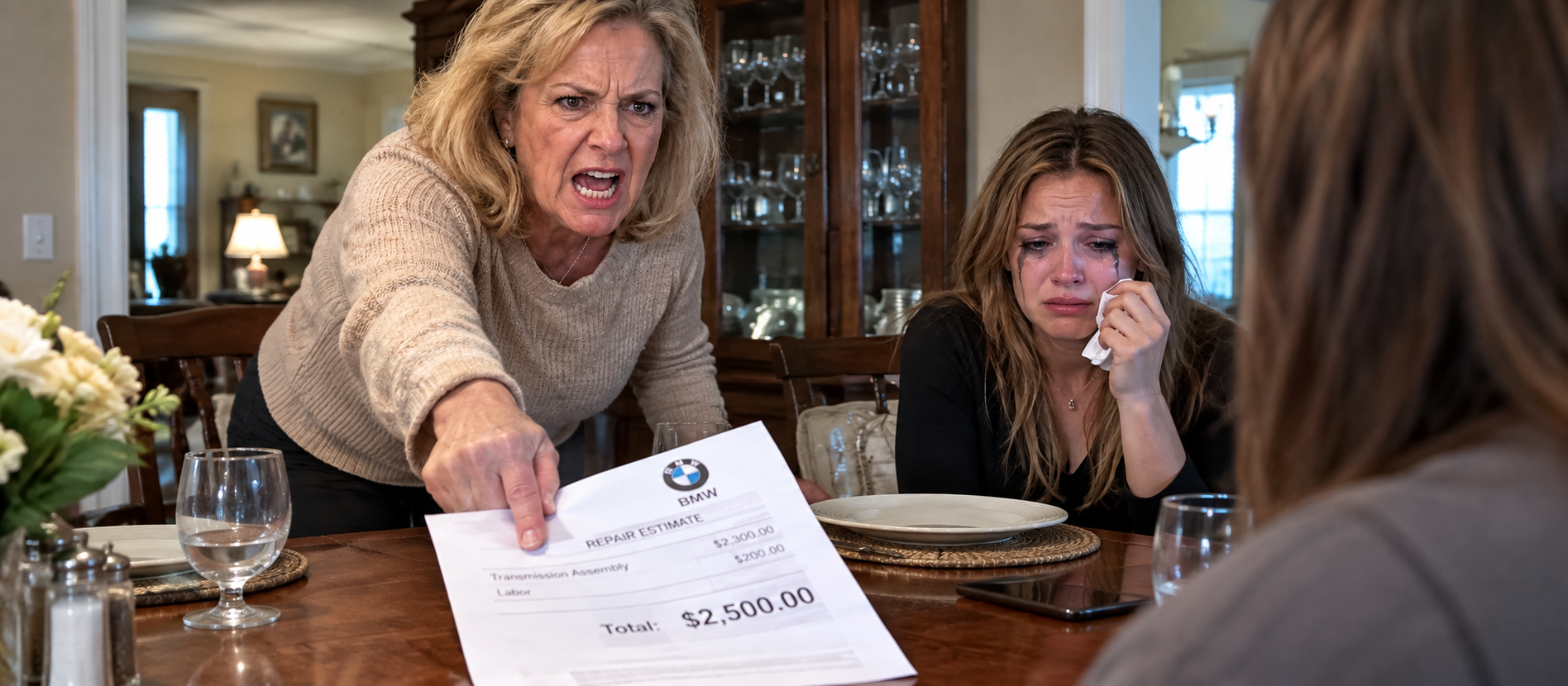
The moment my mother told me I was “dead to the family” over a $2,500 BMW repair bill, something inside me didn’t break.
It became quiet.
That was worse.
For years, I had imagined that if my family ever pushed me too far, I would scream, cry, and finally unleash every resentment I had swallowed since childhood. Instead, I sat at the dining room table staring at the invoice between us and felt something colder than anger: clarity.
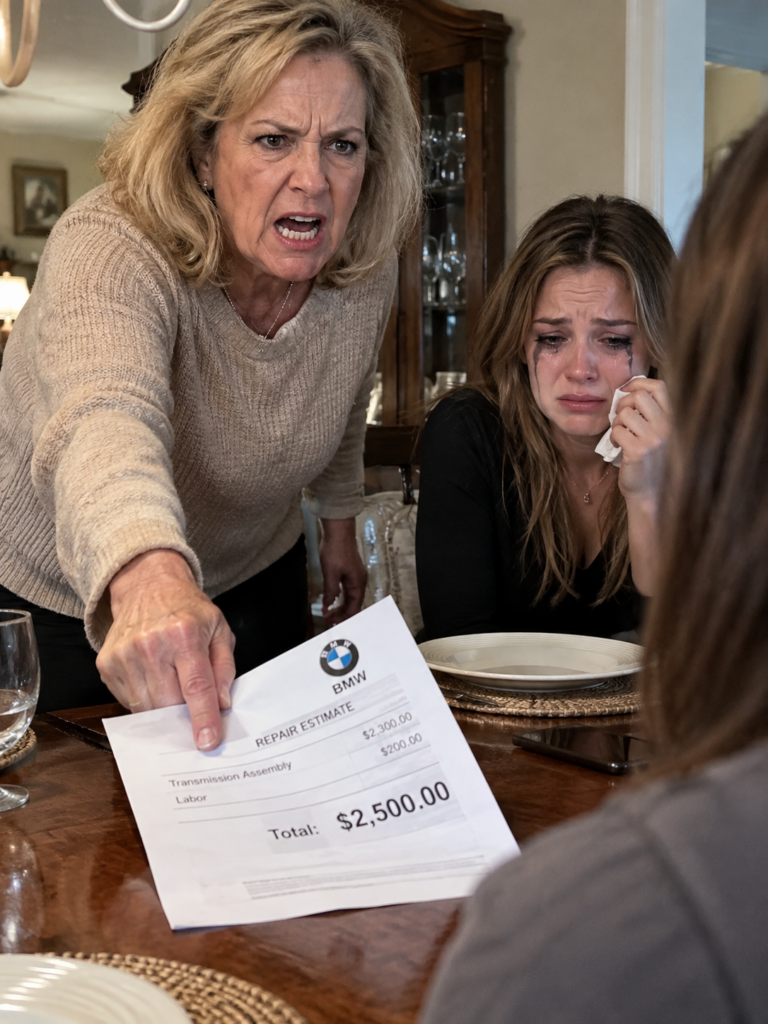
My twenty-two-year-old sister Chloe was crying across from me, mascara running down her cheeks. Beside her, my mother had one hand dramatically pressed against her chest. My father sat at the head of the table like a judge preparing to deliver a sentence.
“Your sister needs her car for her internship,” Dad said. “You make good money. She doesn’t. You’re paying the bill.”
I glanced down at the paper. BMW transmission replacement: $2,500. Then I looked at Chloe.
“You went to Miami last weekend.”
Her lips parted. “What does that have to do with anything?”
“You spent almost your entire paycheck.”
“That was already planned.”
“So was your car payment.”
Mom slammed her palm against the table. “Enough!” The silverware jumped. Several relatives at Sunday dinner stared down at their plates.
I had seen this pattern too many times. Chloe made a mistake, my parents found a reason it wasn’t really her fault, and somehow I became responsible for fixing it. When she overdrafted her checking account, I covered it. When she damaged her previous car, I helped with the deductible. When she fell behind on rent after buying concert tickets and designer shoes, I paid a month so she wouldn’t be evicted. This would have been the third rescue in eight months.
“I’m not paying it,” I said.
Mom froze. “What?”
“I said no.”
Dad leaned forward slowly, his expression shifting from irritation to disbelief. “Maya, don’t turn this into something ugly.”
“I’m not. I’m just saying no.”
Chloe cried harder. “You know I need that car.”
“You also knew that last week.”
“God, why do you always act like you’re better than me?”
“I don’t.”
“Yes, you do!”
Dad pointed at me. “She’s your sister.”
“I know exactly who she is.”
The room went silent. Mom’s face hardened. Then came the sentence that changed my life.
“This is your final choice, Maya. Either transfer the money to Chloe tonight, or pack your things and get out. If you walk through that door, consider yourself disowned. You will be dead to this family.”
There were twelve people sitting in that room. Not one defended me. Not one even looked surprised. That hurt more than the ultimatum; apparently, everyone had already accepted my role as the dependable, responsible daughter who could always be guilted into sacrificing a little more. They expected me to fold.
I pushed back my chair. The legs scraped across the hardwood.
Dad’s eyebrows rose. Mom whispered, “What are you doing?”
I stood, my hands steady. “Then I’m out.”
Chloe stopped crying, and Dad actually laughed. “You’re being dramatic.”
“No,” I said. “For the first time, I think I’m being honest.”
I walked into the hallway and grabbed my coat. Mom followed.
“You walk out now, don’t expect us to come begging.”
“I won’t.”
“You’ll regret this.”
“Maybe.”
“Maya!”
I put my hand on the doorknob. For one second, I wanted her to stop me for the right reason—not because she wanted money, but because she loved me. She didn’t. So I opened the door, let the cold night air hit my face, and left.
The Discovery
I drove for twenty minutes before realizing I had nowhere to go. I was thirty, had a good corporate technology job, and had enough emergency savings, yet I felt like a runaway teenager. My phone buzzed repeatedly—Mom, Dad, Chloe, Mom again. Then, a notification popped up from a banking app I barely remembered installing: Account activity detected.
At a red light, I opened it. The screen loaded, and my breath stopped.
$186,430.17
I stared at the number, then laughed once nervously. It had to be a mistake. I pulled into an empty pharmacy parking lot and opened the account details. It was under my full legal name, opened twelve years earlier by a trust administrator named Eleanor Whitmore—my grandmother.

Grandma Eleanor had died three years earlier. She had been the only person in my family who never treated me like an obligation machine. When I was sixteen and working weekends at a grocery store, she had told me, “Never let anyone confuse your generosity with ownership.”
I scrolled down through years of deposits, interest, and dividends, finally reaching a locked document titled: FOR MAYA — OPEN ONLY AFTER RELEASE CONDITION IS MET.
My thumb hovered, then tapped.
Maya, if you are reading this, your parents have finally forced you to leave their home over money.
My heart slammed against my ribs. The letter explained that when I was born, my grandfather had created an education and inheritance trust for me. After he died, my parents convinced Grandma they needed temporary access for tuition, medical bills, and emergencies. Instead, they financed vacations, credit cards, a kitchen remodel, Dad’s failed business, and eventually Chloe. Grandma eventually froze the trust, created a separate protected account, and set a release condition: the money would become fully available if I turned thirty-five, independently purchased a home, or if my parents attempted to force me from the family home because I refused to give them money.
Grandma had predicted this exact moment.
The Staged Conspiracy
Three weeks after that night, Chloe showed up at my friend Rachel’s apartment wearing jeans, sneakers, and swollen eyes. “I took the bus,” she whispered. “Please let me inside.”
She sat at my kitchen table and pushed a folder toward me containing bank records, loan documents, credit card statements, and a sealed envelope in Grandma’s handwriting addressed to: FOR CHLOE — WHEN YOU ARE READY TO TELL MAYA THE TRUTH.
Chloe confessed that she had known about the protected account and had sat silently at the dinner table while our parents threw me out. But the revelations in Grandma’s letter to Chloe shattered my entire reality.
Rebecca was not my mother. Rebecca was Chloe’s mother.
My parents had lied to me about my identity. The adoption documents proved that Chloe was the adopted child, while I was Linda and Thomas’s biological daughter. My parents had stolen my inheritance—which actually came from my maternal grandfather via Linda—and then invented a false adoption story to make their theft look like a rescue, ensuring I would feel eternally indebted.
Worse still, Chloe confessed the truth about the BMW.
“The transmission wasn’t broken,” she whispered. “There was no repair. The invoice was fake.”
She had needed $2,500 to cover Dad’s gambling debts, which he had forced her to help move through accounts. Dad had engineered the entire Sunday dinner confrontation, using a legal draft of Grandma’s trust he found after her death to intentionally trigger the release condition. He thought he was still listed as my emergency financial beneficiary and planned to pressure me into handing over the cash.
The Final Inheritance
When I called my attorney, Danielle, to recount the chaos, she dropped an even bigger bomb.
“Maya, your grandmother left one final instruction. The $186,430 was never the full inheritance. That account was a test.”
The rest of the fortune was tied up in the ownership documents of the house my parents currently lived in. Grandma had purchased their mortgage from the lender eleven years ago through a holding company after my father defaulted, meaning my parents had been paying rent to a company I legally owned.
“As of the moment your father deliberately triggered the trust clause for financial gain, all remaining controlling assets transferred to you,” Danielle explained. “Between the investment portfolio and the property interest, it’s just over $1.8 million. And your parents’ house is fully paid off.”
Three weeks later, I returned to that house. My parents waited in the dining room. Dad appeared exhausted; Mom looked frightened; Chloe sat near the window beside me. I placed the deed and a new document on the table.
“You’re evicting your own parents?” Dad stammered.
“No,” I replied quietly. “I sold the house this morning. But I purchased a small condo nearby in Mom’s name only.”
Mom stared at me in shock. “What?”
“You’ll have somewhere to live,” I said. “Because your gambling debts aren’t becoming her homelessness.”
Dad went pale, and Mom slowly turned toward him, finally confronting the man she realized she never truly knew.
Moving Forward
A year later, Chloe stood barefoot in my backyard helping hang string lights for a summer dinner. She had sold the BMW, bought a used Honda, started therapy, and completed her internship without anyone rescuing her. Mom lived in the condo and was divorcing Dad, with whom I maintained no relationship.
As the sun set behind my little craftsman house, Chloe handed me an envelope from Grandma’s final files. Inside was a single handwritten note:
Maya,
If you are reading this from a home that feels like yours, then the money did what I hoped it would do. But I need you to understand something. The inheritance was never the gift. The gift was the moment you finally learned that love requiring you to abandon yourself is not love. You did not become free when the account opened. You became free when you said, «Then I’m leaving.»
I pressed the note against my chest. Behind me, Chloe called out, “Are you going to help with these lights or just stand there crying?”
“Go hang the lights,” I laughed, wiping my eyes.
For years, my family had convinced me that being needed meant being loved. Now I knew better. Sometimes the most expensive thing you can give someone isn’t money—it’s unlimited permission to keep hurting you. And sometimes the most valuable thing you can ever say is one simple sentence: Then I’m leaving.
What boundaries have you had to set to protect your own peace and well-being?