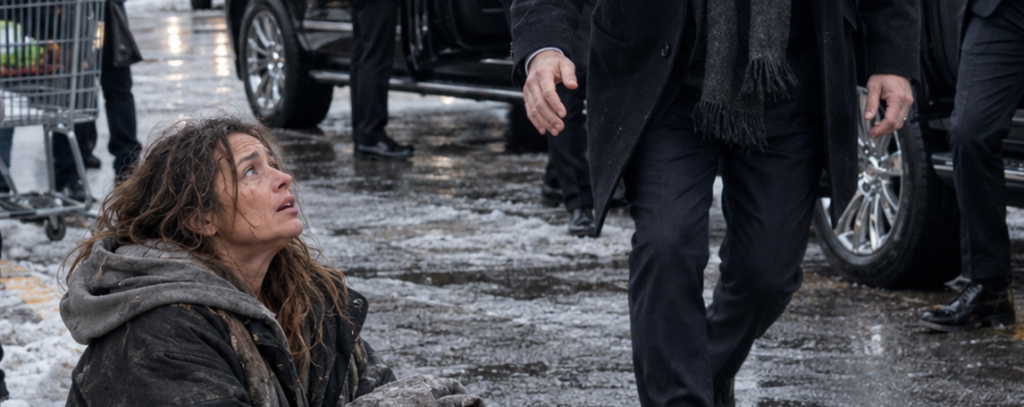
Vincent Moretti stopped several feet away from me.
For one strange second, none of us moved.
Not Vincent.
Not the men standing behind him.
Not me.
Only Noah seemed untouched by the tension surrounding us. He stood between his father and me with the empty sandwich wrapper still clutched in one hand.

“Dad,” he said again.
The word was clearer this time.
Vincent inhaled sharply. His eyes closed for half a second, as though hearing that single word had struck some place inside him too deep for anyone else to see.
Then he lowered himself onto one knee.
“Noah.”
His voice was quiet. Careful. He didn’t rush toward his son. He didn’t grab him. He simply held out his hands.
Noah stared at him. Then he walked forward.
Vincent gathered him against his chest. The man I had first assumed was dangerous bowed his head against his little boy’s hair, and for several moments the parking lot seemed to disappear around them.
I looked away. Some things felt too private to witness.
When I glanced back, one of the suited men had turned toward the store entrance and was speaking into a phone. Another was watching me with open curiosity.
Vincent finally stood, keeping one hand on Noah’s shoulder.
“Are you hurt?” he asked.
Noah shook his head.
“Did anyone frighten you?”
Another shake.
Vincent’s eyes moved to me. His expression was controlled again, but not cold.
“Were you with him the entire time?”
“Not the entire time,” I said. “I found him sitting here maybe twenty minutes ago.”
Noah corrected me in a tiny voice.
“Twenty-seven.”
Vincent froze. So did everyone else.
I looked down at Noah.
“You were counting?”
He nodded.
Something passed across Vincent’s face. Wonder. Pain. Hope. All tangled together.
A woman hurried out of the nearest SUV. She looked to be in her early sixties, with silver-streaked dark hair and the worried expression of someone who had spent the last hour imagining every terrible possibility.
“Oh, thank goodness.”
She rushed toward Noah, then stopped herself before touching him.
“Noah?”
He looked at her.
“I’m okay, Rosa.”
Rosa covered her mouth. Her eyes filled instantly.
Vincent looked away again. Apparently I was the only person present who didn’t understand the full importance of what was happening.
Rosa whispered, “He spoke.”
Vincent nodded once.
“He spoke.”
The words seemed impossible for him to say normally.
I shifted my weight. The cold was starting to work through my shoes again. Whatever strange moment I had become part of clearly belonged to this family. Noah was safe. That was all I had wanted.
I bent to pick up my backpack.
“I should go.”
Noah’s hand immediately closed around my sleeve.
“No.”
I stopped. His grip tightened.
Vincent noticed.
“So,” he said carefully, “you’re Maya.”
I blinked.
“How do you know my name?”
Noah answered.
“She told me.”
Vincent’s eyes flickered toward his son. I could almost see him storing every word Noah spoke like something priceless. Then he looked at me.
“My name is Vincent Moretti.”
“I gathered.”
One of the men behind him almost smiled. Vincent didn’t.
“You know who I am?”
“Not really. Your name sounds familiar.”
For some reason, that surprised him. I had spent the last several months worrying about where I would sleep, whether shelters had open beds, which laundromats stayed open late, and how long I could make a pair of socks last before washing them in a gas station sink. Powerful businessmen did not rank high on my list of concerns.
Rosa stepped closer.
“You gave Noah something to eat?”
“It was just a sandwich.”
Vincent looked at the wrapper.
“Your sandwich?”
I shrugged.
“He was hungry.”
“And you?”
I didn’t answer. His gaze dropped to my backpack. Then to my worn shoes. Then to the coat I had bought from a thrift store three winters earlier.
I hated that moment. I knew what he saw. Most people looked at someone like me and immediately began assembling a story. Addiction. Bad choices. Irresponsibility. Danger. Failure.
The truth was far less dramatic. I had once had an apartment. A job. A coffee maker that rattled whenever it brewed. A plant I kept forgetting to water. Then the small medical billing company I worked for closed unexpectedly. I fell behind on rent. My car needed repairs I couldn’t afford. My mother became ill in another state, and what little savings I had vanished in bus tickets and medication she couldn’t cover. After she died, I returned to find my apartment gone and most of my belongings boxed in a storage unit I later lost.
No villain. No single catastrophe. Just a series of ordinary losses arriving too close together.
Vincent seemed to understand enough not to ask. Instead he said, “Come with us.”
I stiffened.
“That sounds less like an invitation than you probably intended.”
For the first time, a faint expression almost resembling embarrassment crossed his face. Rosa actually smiled.
Vincent tried again.
“Please come with us.”
“Why?”
“Because it’s freezing.”
“I’m used to it.”
“You shouldn’t have to be.”
The answer irritated me more than it should have. People with money often said things like that. As though noticing hardship and solving hardship were the same thing.
“I appreciate the concern, but Noah is safe. That’s what matters.”
I tried to leave again. Noah still hadn’t released my sleeve.
“Maya.”
I looked down. His blue eyes were solemn.
“You said you wouldn’t leave.”
“I said I wouldn’t leave until someone came for you.”
He considered that. Then he looked at his father.
“Can she come home?”
Vincent seemed genuinely uncertain how to answer. Rosa rescued him.
“She could come for supper.”
Noah brightened slightly. Vincent looked at me.
“Dinner.”
I almost laughed. I hadn’t eaten since yesterday, and now a wealthy stranger was inviting me to dinner because his son had decided I belonged there.
“No conditions?” I asked.
“No conditions.”
“No photographers?”
His eyebrows lifted.
“Why would there be photographers?”
“I don’t know. Rich people do strange things.”
The man standing nearest Vincent coughed into his fist, definitely hiding a laugh. Vincent glanced at him.
“Daniel.”
“Sorry.”
Vincent turned back to me.
“No photographers.”
“And afterward?”
“We’ll take you wherever you want to go.”
That was the problem. I didn’t have anywhere I wanted to go. Still, the smell drifting from the grocery store bakery was making my stomach hurt. I looked at Noah. He was waiting.
“All right,” I said. “Dinner.”
Noah smiled. It was small. But Vincent saw it. And when I looked at him, something in his guarded expression had softened.
The Moretti home wasn’t what I expected. I had imagined iron gates, marble statues, perhaps an enormous staircase designed specifically for dramatic entrances.
There was a gate. And the house was certainly large. But it was warmer than I anticipated. Brick instead of stone. Lights glowing in the windows. A wreath on the front door that looked slightly crooked. Someone had left a child’s red bicycle leaning beside the garage.
Inside, the air smelled faintly of cinnamon and wood smoke.
Noah removed his coat and shoes before Rosa could remind him. Then he turned to me.
“You can put yours there.”
I hesitated. My shoes looked terrible beside his polished sneakers. Rosa noticed.
“You can leave them on if you prefer.”
“No, it’s okay.”
She brought me slippers. Not new ones from a box. Ordinary house slippers. Something about that made me relax more than luxury ever could.
Dinner was already being prepared. Apparently the household had been expecting Noah home nearly two hours earlier. I learned that his driver had taken him to a speech therapy appointment. Afterward, while Rosa stepped inside a pharmacy to pick up a prescription and the driver moved the car closer to the curb, Noah had wandered toward a nearby holiday display.
A delivery van blocked the adults’ view for less than a minute. By the time they reached the sidewalk, he was gone. He had walked nearly three blocks before reaching the grocery store.
No one said the story accusingly. Rosa blamed herself anyway.
“I should have held his hand.”
“You went into a pharmacy,” I said. “You didn’t abandon him.”
Her mouth tightened.
“You don’t understand Mr. Noah. He never wanders.”
Noah was seated at the kitchen island drawing circles on a piece of paper.
“He followed the music,” he said.
Vincent turned sharply.
“What music?”
Noah stopped drawing. Silence returned. No one pushed him. That, I noticed immediately. Whatever mistakes this family had made, they had learned not to force the child into speech.
Vincent pulled out a chair.
“Whenever you’re ready.”
Noah glanced toward me.
“The bell song.”
I knew it. A man outside the grocery store had been ringing a small brass bell while collecting donations beside a speaker playing Christmas music.
“You heard bells?” I asked.
Noah nodded.
“Mom liked them.”
Rosa looked down. Vincent stared at the kitchen counter. Noah continued drawing.
I had seen grief before. It had lived in my mother’s house after my father died. It had lived inside me after my mother followed him eight years later. Grief rarely announced itself loudly. Mostly it rearranged ordinary rooms. A chair no one sat in. A mug no one used. A song nobody played anymore.
“What was your mom’s name?” I asked.
Vincent looked at me, but Noah answered.
“Elena.”
He reached into his coat pocket and removed the photograph I had seen earlier. This time he handed it to me.
The woman in the picture was beautiful, but not in the polished way magazine photographs were beautiful. Her dark hair was tied back. She was laughing. Noah, much younger, sat on her lap. Behind them stood Vincent. He looked almost like a different man. Younger. Less careful. Happy.
“She liked bells?” I asked.
Noah nodded.
“Every Christmas.”
Vincent cleared his throat.
“Dinner’s ready.”
I pretended not to notice.
We ate in the kitchen instead of the formal dining room. Roast chicken. Potatoes. Green beans. Warm rolls. Nothing elaborate. I tried to eat slowly. The body remembers hunger even when pride tries to hide it.
I was halfway through my first plate when Rosa quietly set another roll beside me. She didn’t ask. I appreciated that.
Noah sat next to me. Across the table, Vincent barely touched his food. He kept watching his son. Not constantly. But often enough for me to notice. Each time Noah spoke, Vincent’s fingers stopped moving.
“Do you like carrots?” Noah asked me.
“Yes.”
“I don’t.”
“You ate three.”
“I was testing them.”
I nodded seriously.
“Important research.”
Noah smiled again. Vincent’s fork stopped. Rosa turned away, pretending to adjust something near the stove.
Daniel—the man from the parking lot—had joined us after changing out of his dark overcoat. I discovered he wasn’t security. He was Vincent’s cousin and had worked as the Moretti family’s attorney for almost fifteen years.
“You thought we were kidnappers,” Daniel said.
“You arrived in three black SUVs.”
“Fair.”
Vincent gave him a look.
“What?”
Daniel lifted both hands.
“She has a point.”
The dinner felt almost normal after that. Almost.
Then Noah said, “Maya sleeps outside.”
My fork stopped. Vincent’s eyes moved to me.
“So much for subtlety,” I muttered.
Noah frowned.
“Did I do something wrong?”
“No.”
I immediately softened my voice.
“You didn’t.”
Vincent leaned back.
“Where are you staying?”
“I manage.”
“That wasn’t my question.”
I met his eyes.
“That’s the answer I’m giving.”
He didn’t seem accustomed to people refusing him information. But he surprised me by nodding.
“All right.”
Rosa brought out apple pie. I nearly cried. Not because of the pie itself. Because it was warm. Because someone had placed whipped cream beside it. Because for months food had been something I calculated, stretched, rationed, or searched for. Suddenly it was simply dessert.
Noah ate only the crust.
“You’re wasting the best part,” I told him.
“The apples are too soft.”
“They’re supposed to be soft.”
“That seems suspicious.”
Daniel laughed. Vincent almost did. Then Noah looked at his father.
“Can Maya sleep here?”
Every adult at the table became still. I stared at my plate.
“Noah—”
“You said she doesn’t have somewhere.”
“That doesn’t mean—”
“There are twelve bedrooms.”
Daniel coughed again. Vincent rubbed a hand over his face.
“Why do you know how many bedrooms we have?”
“I counted.”
“Of course you did.”
For the first time, Vincent laughed. It was quiet. Brief. But real. Noah looked pleased with himself.
I should have refused immediately. Instead I felt warmth climbing behind my eyes. Twelve bedrooms. I had slept in a bus station three nights earlier. Life could be absurd.
Vincent looked at me.
“One night.”
“I don’t want charity.”
“Then don’t call it charity.”
“What should I call it?”
He thought for a moment.
“Helping my son feel secure after a difficult day.”
That was clever. Maybe too clever. My throat tightened.
“Really?”
“Really.”
It wasn’t rescue. It wasn’t charity. It was a job. I started the following Monday. That mattered.
Nothing transformed overnight. I didn’t suddenly become part of the Moretti family. Vincent did not hand me keys to a house. Noah did not start talking constantly. Life moved in smaller increments.
I worked. I saved. I filled out housing applications. Noah attended therapy. Some days he spoke. Other days he didn’t. But he began using his voice more often when nobody made a celebration out of it.
I saw him twice a week. Usually at Harbor House. Vincent had begun volunteering there after discovering, apparently to his embarrassment, that writing checks was not the same as understanding the work.
Noah helped stock the children’s reading room. Rosa organized donated clothing. Daniel taught a monthly class on tenant rights. Even Vincent carried boxes. Badly.
“You hold them from the bottom,” I told him one afternoon.
“I own construction companies.”
“That makes this worse.”
Noah giggled. Vincent looked offended.
“I’m being bullied in a nonprofit.”
“You’ll recover.”
The strange thing was how normal he became. The city might speak carefully about Vincent Moretti. I learned that some of the reputation came from his father, Antonio, who had built the company aggressively decades earlier. Vincent had inherited both the business and the mythology around the family name.
But the man I came to know worried about his son eating enough vegetables. He forgot passwords. He drank terrible coffee. He carried Elena’s old grocery list folded inside his wallet.
I discovered that by accident. We were leaving Harbor House one evening when several papers fell from his coat pocket. I bent to help. One was yellowed and creased.
Milk.
Eggs.
Cinnamon.
Blueberries.
Bell batteries.
I paused.
“Bell batteries?”
Vincent took the paper from me.
“Elena decorated the house with these ridiculous little electric bells every Christmas.”
He smiled at the memory.
“She bought them from a small shop in Westbridge. Noah loved them.”
“Do you still have them?”
His smile faded.
“I don’t know.”
That night, the bells stayed in my thoughts. So did Noah’s words. The bell song. Mom liked them.
Three days later, Rosa called me. Her voice was unusual.
“Maya, could you come to the house?”
“Is Noah okay?”
“He’s fine.”
She hesitated.
“We found something.”
When I arrived, Vincent was in Elena’s old study. I had never been inside. The room had remained mostly untouched. Books. Paintings. A sewing basket near the window. Several framed photographs.
Noah sat cross-legged on the rug. In front of him was a cardboard Christmas box. Rosa had apparently gone looking for the electric bells after our conversation. Inside the box were decorations, ribbons, old cards, and a small wooden music box shaped like a church.
Noah was staring at it. Vincent stood near the desk.
“He says it belonged to Elena.”
I sat beside Noah.
“It plays the bell song?”
He nodded.
Rosa wound the key. A delicate melody filled the room. I recognized it immediately. It was the same tune playing outside the grocery store the day I found Noah.
Noah reached into the box. Beneath the music box was a sealed envelope. On the front, written in careful handwriting, were four words: For Noah, when ready.
Vincent stared at it.
“I’ve never seen that before.”
Rosa shook her head.
“Neither have I.”
Noah touched the envelope but didn’t open it. Instead he looked at his father.
“Mom told me.”
Vincent lowered himself beside him.
“Told you what?”
Noah swallowed. His voice became smaller.
“The last night.”
“What did she tell you?”
Noah looked toward me. I understood immediately.
“You don’t have to say anything you don’t want to,” I told him.
He nodded. Then, after a long silence, he whispered:
“She said Dad would forget the promise.”
Vincent went completely still.
“What promise?”
Noah looked at the envelope.
“I don’t remember.”
He pushed it toward his father. Vincent didn’t take it.
“This is yours.”
Noah shook his head.
“Together.”
Vincent finally picked it up. His fingers trembled slightly. But before opening it, he noticed something written in tiny letters along the bottom corner.
A name.
Not Vincent’s. Not Noah’s. Not Rosa’s.
Mine.
Maya Ellis.
I stared at it.
“That’s impossible.”
Vincent looked at me.
“Your last name is Ellis?”
“Yes.”
Rosa sat down slowly. Noah watched all of us.
I took the envelope. The handwriting was definitely the same as the writing on the front—For Noah, when ready—and below it, faded but unmistakable: Ask Maya Ellis about the blue house.
My hands turned cold.
Vincent spoke softly.
“You knew Elena?”
“No.”
I looked at the photograph on the desk. At the smiling woman I had never met.
“I swear I never knew your wife.”
Yet I knew one thing Elena Moretti apparently expected me to recognize.
The blue house.
Because seventeen years earlier, before I ever became homeless, before Vincent Moretti had ever heard my name, before Noah was born—
I had lived in one.
And suddenly the question was no longer why Noah had spoken to me. It was how his mother had known exactly who I was.