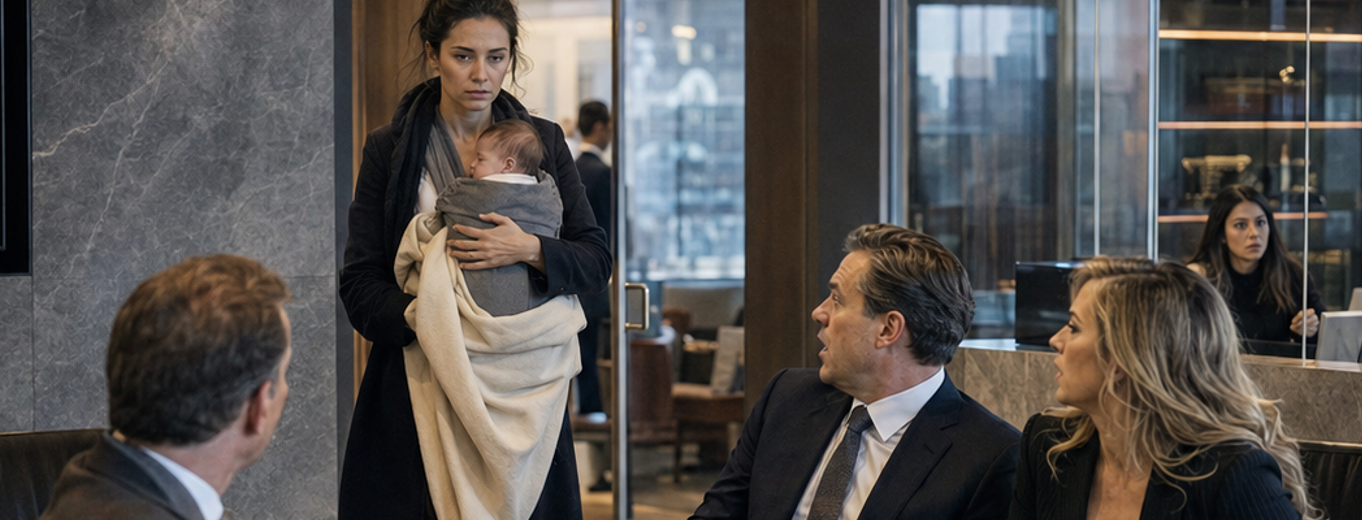
“No,” Vanessa whispered.
Grant turned toward her so fast the leather back of his chair let out a squeak. “What did you say?”
Vanessa didn’t answer. She was staring straight at Noah. Not the carrier. Not the blanket. At Noah.
Our son had wiggled one tiny fist free and turned his face toward the window light. Eleven floors below, Manhattan was rolling through an ordinary Tuesday—taxis braking, delivery vans squeezing around corners, commuters rushing down the sidewalk with coffee in hand.
Inside the room, time stopped.
Vanessa leaned in. “There,” she whispered.
I followed her gaze. A small patch of dark hair had shifted above Noah’s left ear. Right in front of it was the faint, pale brown mark I’d spotted the morning after he was born. It looked almost like a comma. The pediatrician had brushed it off as nothing—just a harmless birthmark.
Grant squeezed his eyes shut.
In that split second, I knew it wasn’t nothing.
I locked eyes with him. “What is it?”

He opened his eyes. “Claire—”
“No,” I kept my voice flat. “You don’t get to say my name like that answers anything.”
My attorney, Martin Bell, looked back and forth between us. Grant’s lawyer, a silver-haired woman named Helen Price, slowly snapped her folder shut.
Vanessa kept her eyes glued to the baby. “I’ve seen that mark before.”
Grant’s face hardened. “Vanessa.”
“Don’t.”
For the first time since I’d learned her name—and unfortunately, I’d known she existed for nearly five months—Vanessa Hart didn’t sound cool and polished. She sounded exhausted.
She looked at Grant. “You told me she knew.”
The room felt like it was closing in. I felt Noah’s steady breathing against my chest.
“Knew what?” I demanded.
Grant shoved his chair back. “I think we should take this private.”
Martin jumped in. “My client will decide that.”
Grant glanced at him, then back at me. There was a time when a look from my husband could shift the gravity in a room. I’d watched senior partners back down because Grant raised an eyebrow; I’d seen grown men nervously straighten their ties before stepping into his office.
Right now, he just looked like an ordinary guy in an expensive suit who had officially run out of hiding spots.
I reached under Noah’s blanket and rubbed his tiny, socked foot. “Tell me.”
Grant stared out the window. Seconds dragged by.
Then Vanessa spoke up. “There’s another child.”
I had braced myself for almost anything. A financial scandal. A medical crisis. Another affair. Some buried corporate mess wrapped up in NDAs and legal red tape.
I definitely hadn’t expected those three words.
My mouth went bone dry. Grant sat completely frozen.
Vanessa went on, speaking a bit more carefully now. “A girl.”
I stared at Grant. “How old?”
His answer took a beat. “Twelve.”
The number hit hard.
We had been married eight years. Together for ten. That girl had existed before I ever came into the picture. Which somehow made the truth both easier and worse. Easier because he hadn’t blown up a second family during our marriage—and worse because for ten whole years, he had looked me in the eye every single day and decided I didn’t deserve to know she was out there.
“You have a daughter,” I said.
“Yes.” The word was barely a whisper.
“What’s her name?”
Grant’s shoulders dropped. “Margot.”
Something shifted in his voice when he said it. It was the first thing he’d uttered all morning without calculating the angle.
Margot. Not a liability. Not a headache. Just a name he’d clearly spoken inside his own head a thousand times.
Vanessa folded her hands. “She has that exact same mark. Right there.” She tapped the space in front of her own left ear. “And Grant has it, too.”
I looked at my husband. Instinctively, his fingers brushed against his hairline. I’d seen that faint brown mark before—hundreds of times. When his hair was wet on vacation. On lazy Sunday mornings. Once, when he fell asleep beside me on a flight to Rome and I traced it with my fingertip. When I asked him about it back then, he told me his father had one, too. That was the end of the conversation.
I looked back down at Noah. Suddenly, that little birthmark felt like a secret code everyone in the room except me had been taught to read.
Martin broke the silence. “Claire, do you want a break?”
“No.”
Grant looked at me. “You just had a baby. You shouldn’t have to—”
I almost laughed. Not because anything was funny, but because even now, sitting in the absolute wreckage of his lies, he was still trying to manage what I could handle.
“I gave birth eleven days ago, Grant. I didn’t lose my hearing.”
His expression wavered. “I didn’t mean—”
“I know exactly what you meant.”
Noah let out another little coo. I instinctively cupped the back of his head, grounding myself.
Vanessa looked away, and for the first time, I noticed how uncomfortable she looked. That caught me off guard. The Vanessa I’d built up in my head over the last few months was confident, ruthless, and eager to step right into the life I was leaving behind.
Turns out, I’d built her out of scraps: a restaurant receipt, three late-night text pings, an anonymous photo of Grant and Vanessa leaving a Boston hotel, and finally, Grant admitting there was someone else. I’d never actually asked what he told her.
Now, I had to know. “How do you even know about Margot?”
Vanessa looked at Grant. He didn’t try to stop her this time.
“I met her once,” Vanessa said.
My fingers tightened on Noah’s blanket. “When?”
“Three years ago.”
“While Grant and I were married?”
“Yes.” She didn’t flinch.
“Why?”
Grant answered. “Because Margot’s mother needed help setting up a trust.”
I looked back at him. “You’re telling me your mistress met your daughter because she was doing legal work for you?”
Vanessa’s cheeks flushed. “I wasn’t his mistress back then.”
The room went dead silent again.
I studied her. “When did it start?”
“Four months ago.”
Grant shot her a sharp look. She completely ignored him.
“After you’d already filed for separation,” Vanessa added, looking right at me.
I turned back to Grant. I had filed for a legal separation five months earlier—not because I knew about Vanessa, but because our marriage had quietly turned into a beautifully decorated empty house. We still did the dinners. We still smiled for the holiday cards. We still coordinated our calendars. But Grant had spent two years slowly disappearing into his work, answering my questions with half-truths and treating any attempt at intimacy like an inconvenience.
I figured he had just fallen out of love with me. Eventually, I stopped begging him to prove me wrong.
Vanessa came into the picture after that. It didn’t excuse him, but it completely rearranged the timeline I thought I knew.
“Why did you let me believe otherwise?” I asked him.
Grant rubbed his thumb along the edge of the table. “You saw the photograph.”
“And I asked you straight out if you were having an affair.”
“Yes.”
“You told me, ‘There is someone else.’”
His eyes locked onto mine. “There was.”
“But not before I left.”
“No.”
A hollow, bitter ache washed over me. “So even the truth you handed me was rigged.”
“I know.”
Vanessa shoved her chair back again. “This is why I shouldn’t be here.”
Grant looked up. “You insisted.”
“Yeah,” she said, her voice tight, “because you told me today was going to be final.” She looked controlled, but there was real panic underneath. “You told me Claire wanted the divorce wrapped up before the baby arrived.”
I snapped my head back to him. “What?”
Vanessa held my gaze. “He told me you weren’t pregnant.”
Grant shot to his feet. “Vanessa.”
She stood up, too. “No. I’m done translating your silence into something noble.”
I watched them. There was no romantic loyalty left between them—just the jarring realization that the same man had lied to both of us, giving us entirely different realities.
Vanessa grabbed her designer bag. “For the record, Claire, I only knew about Margot because I handled a trust file for Grant years ago. I genuinely thought you knew about her. And until you walked through that door today, I honestly believed there was no baby.”
Grant’s jaw clenched hard. “I was going to tell you.”
“When?” Vanessa shot back.
He didn’t have an answer. She gave him one last, long look, then turned to me. “I’m sorry.”
I didn’t know what to do with her apology. I certainly wasn’t ready to forgive her, and I wasn’t entirely sure how to divvy up the blame. So, I just gave a stiff nod.
Vanessa walked out. The glass door clicked shut behind her with a soft whoosh. No dramatic exit, no shouting match, no slammed door—just the quiet departure of a woman realizing her future was built on quicksand.
I looked back at Grant. “Where is Margot?”
His face softened instantly. “With her grandparents.”
“And her mother?”
His gaze dropped to the floor. “Anna passed away eight months ago.”
The sharp edge of my anger paused. “I’m sorry.”
It slipped out automatically—not for Grant, but for a twelve-year-old girl I had never even met.
Grant nodded. “She’d been sick for a while.”
“Does Margot live around here?”
“Outside Boston.”
“Do you see her?”
His hesitation answered for me. “Not enough.”
I carefully leaned back in my chair. Noah had drifted back to sleep. “Start at the beginning.”
Helen Price gave Grant a look, and he finally sat back down. For the first time all morning, the divorce documents sat completely ignored.
Grant folded his hands on the table. “I met Anna in college.” His voice sounded different now—less like a cutthroat private equity shark, and more like a man reading from a chapter of his life he’d kept sealed so long that breaking the spine hurt. “We were twenty-one. Together for about a year, then we split up. I moved to New York; she went to grad school in Boston. She found out she was pregnant after we were already done.”
“And you knew?”
“From day one.”
I looked away, the Manhattan skyline blurring for a second. “What happened?”
“I asked her to marry me.”
That surprised me. “She said no?”
“Because we weren’t in love anymore.” A bitter, humorless smile touched his lips. “Anna was always way more grounded than I was.”
He cleared his throat. “She wanted to raise Margot near her parents in Boston. She wanted privacy. My father was just starting to groom me to take over Ashford Capital, and the family name was already pulling too much media attention.” His face hardened. “My father immediately wanted to throw lawyers at it.”
“Of course he did.”
Grant nodded. “He treated it like a PR crisis.”
“And you?”
“I fought him.”
That answer came fast. I studied him closely. “You expect me to believe that?”
“No,” he said, his honesty catching me off guard. “I expect you to look at the receipts.” He glanced at Martin. “There’s a paper trail. Letters, agreements, proof of every single payment, school tuition, medical bills, a trust fund set up in Margot’s name. None of it was hidden from the IRS or the legal team.”
“Just from your wife.”
“Yes.” That was the one part he didn’t even try to sugarcoat.
“Did Anna ask you to keep Margot a secret?”
“In the beginning, yes.”
“And later?”
Grant stared down at his hands. “Later… I just stopped checking to see if that was still what Anna wanted.”
There it was. No grand conspiracy. No blackmail. No Hollywood plot twist to let him off the hook. Just plain, ordinary cowardice. The kind that quietly festers when you put off a hard conversation for a day, then a week, until entire years have slipped away.
“Why?” My voice cracked slightly.
Grant met my eyes. “Because by then, I had met you. And every month I went without telling you just made the next month that much harder.”
“That’s not an excuse.”
“No,” he swallowed hard. “It’s an admission.”
For months, I had prepped myself for a fight. I expected Grant to argue, spin the narrative, and turn our divorce into a brutal battle of leverage. Instead, he just looked older and heavier with every sentence.
“I told myself I was protecting Anna’s privacy,” Grant muttered. “Then I told myself I was protecting Margot. Eventually, I just convinced myself the right time would magically show up.”
“And it never did.”
“No.”
“You married me.”
“Yes.”
“You stood in front of two hundred people and swore up and down there were no secrets between us.”
His eyes dropped. “Yes.”
I looked down at Noah. In that quiet moment, something clicked into place that I had been too blind to see during the final year of our marriage. Secrets carry weight. Even when they aren’t malicious. Even when they start out as someone else’s boundary. Grant had brought one into our marriage and spent eight years building thick concrete walls around it. Maybe that’s why he checked out. Maybe not. But whatever his reasons, I had lived right alongside those walls without ever knowing what they were hiding.
I turned to Martin. “I want to pause the meeting.”
Grant’s head snapped up.
Martin nodded immediately. “Done.”
“I’m not dropping the petition,” I added.
“Understood.”
“I just need some space.”
“Take all the time you need.”
Grant’s face was back to being a blank slate, but his hands gave him away. They were trembling. I had never, not once, seen Grant Ashford’s hands shake.
I stood up carefully. He immediately made a move to stand with me.
“Don’t,” I said.
He froze.
“I can handle my son.” The words came out sharper than I intended.
Pain flashed across his face—not anger, just pure hurt. I almost felt bad.
Almost.
Then he asked quietly, “Can I see him?”
The question caught me off guard. Not ‘Can I hold him?’ Not ‘Give him here.’ Just ‘See him.’
I looked down. Noah was sound asleep, completely oblivious to the fact that a room full of adults had just blown up his family tree. I stepped around the table. Grant stayed glued to his spot. When I was close enough, I peeled back the edge of the blanket.
Noah’s face came into view. Grant stared at him, looking like he’d forgotten how to breathe.
“He has your mouth,” Grant whispered.
I almost smiled. “He has gas.”
Grant let out a sound that was dangerously close to a laugh. It lasted barely a second, but it was the first real, human sound I’d heard out of him in months.
Then Noah fluttered his eyes open. Newborn eyes—dark, unfocused, and intensely solemn.
Grant’s expression completely melted. Something ancient and heavily guarded broke behind his eyes.
“Hey there,” he whispered.
Noah blinked. Grant’s fingers twitched, hovering just inches away before pulling back. He looked up at me, asking silently.
I hesitated, then nodded.
He gently pressed one finger against Noah’s tiny hand. Instantly, Noah’s little fingers curled around it with a tight grip.
I looked down at them. I had watched my husband negotiate billion-dollar buyouts without blinking an eye. I had stood beside his father’s grave and watched him stay dry-eyed through the entire eulogy. But a single tiny baby hand wrapped around his finger nearly completely undid him.
I was the first to look away.
Two days later, a courier dropped a heavy box off at my apartment.
It wasn’t from Grant. It was from Helen Price.
Inside were copies of everything Grant had referenced: Anna’s old letters, trust records, photographs, school report cards, and a brief note from Helen:
Grant has authorized full disclosure. These are copies; the originals are safely locked down. He requested that you only read what you feel comfortable reading.
I almost slammed the lid back down. Noah was fast asleep in his bassinet by the window. Out in the kitchen, my mom, Eleanor, was busy making soup—ignoring the fact that my fridge was already packed tight enough to survive a natural disaster.
She walked into the living room holding two bowls. “What’s that?”
“Grant’s past life.”
She set the bowls down. “Heavy box.”
“Apparently.”
Mom sat down next to me. She’d never been a fan of Grant treating emotional check-ins like quarterly profit reports, but she’d also never pushed me to pull the plug on the marriage. When I first told her we were separating, she only said one thing: ‘Make sure you’re leaving the marriage you actually have, not the one you’re afraid you have.’
At the time, I found the advice annoying. Now, it echoed in my head.
I opened the first manila folder. The oldest letter was thirteen years old.
Grant,
I’m not changing my mind about marriage. A kid deserves parents who actually choose each other, not two terrified twenty-one-year-olds trying to slap a broken relationship back together out of sheer obligation.
I want you in her life, but we need to build something calm. No press. No Ashford family circus. No pretending we’re something we aren’t.
—Anna
I read it twice.
The following letters tracked the years. Photos of a dark-haired little girl holding a red balloon. Margot at three splashing in yellow rain boots. Margot at six missing both front teeth. Margot at eight sitting next to Grant on a park bench, both of them holding ice cream cones.
My chest tightened.
“You really had no idea?” Mom asked softly.
“None.”
I flipped the page. School art projects. Birthday cards. A homemade card written in lopsided crayon lettering: THANK YOU FOR THE TELESCOPE, DAD.
I stopped breathing.
Dad. Not Grant. Dad.
My anger shifted again. He hadn’t abandoned her. But he had sliced his life into watertight compartments. Maybe he thought that was the responsible way to handle it. Maybe everyone had just played along for years.
Until Anna got sick.
Near the bottom of the box was a letter dated eighteen months ago. The handwriting was noticeably shakier.
Grant,
We need to stop pretending our old agreement still makes sense. Margot is old enough now to realize you have another life entirely. She asked me straight out if your wife knows about her.
I told her I assumed you’d told her. From your silence on the phone just now, I realize I was wrong.
Tell Claire. Not because I have any right to make demands on your marriage, but because Margot is starting to view secrecy as shame. I never wanted that for her. Neither should you.
—Anna
My stomach churned.
Eighteen months ago. Grant had been explicitly told to tell me. And he chose not to.
Mom read my face. “What does it say?”
“He had a chance.” I handed her the letter. “He had plenty of chances, actually. But this one came with direct instructions.”
She read it quietly, then folded it up. “That doesn’t erase the rest of it.”
“No,” I said. “It just makes it so much worse.”
She placed the letter back in the box. “What are you going to do?”
“I honestly don’t know.”
That was the weirdest part. For months, I had a bulletproof game plan: divorce Grant, carve out a peaceful life, and raise Noah without constantly wondering if his father wished he was somewhere else. But that certainty was built on a story that turned out to be half-false.
Grant lied. That was still a fact. But other things were true, too. Vanessa came into the picture after we split, not before. Margot wasn’t the product of a secret affair during our marriage. And the cold distance I had written off as pure indifference might have been a lot more complicated. Not right. Just complicated.
At the very bottom of the box was a plain white envelope with my name scrawled across the front: Claire.
It wasn’t Grant’s handwriting. It was Anna’s.
I froze.
Mom noticed. “What is it?”
“I think this is for me.”
The envelope had never been sealed. Inside were four pages of crisp paper.
Dear Claire,
If you’re reading this, it means Grant finally found the backbone I’ve been bugging him to grow for years.
I don’t know you, which feels weird because I’ve known about you for a long time. Margot knows about you, too. She actually saw your picture in Grant’s wallet once and asked if you were a movie star. I couldn’t help but smile.
I need you to understand something—though it probably won’t make what Grant did any easier to swallow. The secrecy started with me. When Margot was born, I wanted total distance from the Ashford family circus and the media microscope that came with it. Grant respected that boundary, even when his father threw a fit.
For a long time, our arrangement worked. But rules made for a baby don’t really work for a preteen. Margot has heavy questions now. She deserves honest answers. And so do you.
Grant loves his daughter. Imperfectly, cautiously, and sometimes from way too far away—but he loves her. I think part of the reason he got so dangerously good at keeping separate lives is because the world kept rewarding him for it. His father praised his silence. The corporate world praised his discretion. Even I praised his silence when Margot was born.
That doesn’t excuse what he hid from you. It just explains where he picked up the bad habit.
There was another paragraph further down.
I hope he tells you before this letter ever has to be opened. If he didn’t, I’m sorry. Not on his behalf—on mine. Because at some point, I realized that guarding our privacy had morphed into protecting a toxic secret, and those are two entirely different things.
I read that sentence three times. Mom sat quietly beside me, waiting.
Then I reached the final page. A line near the bottom made me sit bolt upright.
Margot talks about meeting you someday. Grant always claimed the timing was ‘complicated.’ I suspect ‘complicated’ is just the code word frightened adults use when kids are asking entirely simple questions.
She knows you’re his wife. She knows he loves you. And recently, she told me something else.
She said Grant showed her the ultrasound picture you sent him last winter.
My breath completely hitched.
I read the sentence again.
Ultrasound picture. Last winter.
Long before our separation. Long before Grant claimed he’d never seen the image I left sitting on his desk. Long before he swore he’d been too buried in work to attend my early prenatal appointments.
There was one final line scrawled at the very bottom:
Margot said he told her she might finally be getting a baby brother.
I lowered the letter. The apartment was deafeningly quiet.
Mom looked at me, panic in her eyes. “Claire? What is it?”
I couldn’t talk.
For months, I had convinced myself that Grant only found out about my pregnancy after I walked out. That was the story he fed his legal team. That was what he let Vanessa believe. That was what he implied during our brief, ice-cold interactions.
But Anna’s letter had been written months before Noah was even born. And according to her, Grant didn’t just know about the baby—he had shared the ultrasound with his daughter.
I looked over at the bassinet. Noah was sleeping peacefully under the afternoon sun.
Then I picked up my phone.
There was only one person left who could explain why my husband had spent years hiding one child from me—and apparently hiding the second child from everyone else.
I dialed Grant’s number.
He answered on the very first ring. “Claire?”
I clutched Anna’s letter in my trembling hand. “You knew.”
Total silence on the line.
“You knew about Noah before I ever walked out.”
Another heavy, agonizing pause.
Then, Grant gave me the four words that blew the entire foundation apart:
“Yes. But not the way you think.”
“Yes. But not how.”
I stood beside Noah’s bassinet with Anna’s letter in my hand. “What does that mean?”
Grant exhaled slowly on the other end of the line. “Where are you?”
“Home.”
“Is someone with you?”
“My mother.”
“Good.”
I closed my eyes. “Stop managing the environment and answer the question.”
“You’re right.” A brief pause. “I knew you were pregnant before you told me.”
I sat down. My mother watched from across the room without interrupting. “How?”
“Your appointment reminder.”
For several seconds, I just stared at the wall. “My what?”
“You left your tablet in the library one night. A reminder popped up on the screen.”
I remembered that evening. December. Snow driving against the windows. Grant had come home unusually early, but he was stuck taking calls from London. I had booked the first doctor’s appointment privately because I wanted absolute confirmation before telling him, having already peed on three positive sticks. I’d pictured surprising him at Christmas. Instead, everything between us had unraveled so fast that the moment never happened.
“You saw the reminder,” I said.
“Yes.”
“And said nothing.”
“Yes.”
“Why?”
His voice dropped low. “Because I thought you were going to tell me.”
“I tried.”
“I know.”
“No, Grant. You don’t get to say you know. I came into your office the next morning.”
“I remember.”
“You were leaving for Chicago.”
“I remember.”
“I asked if we could grab dinner when you got back.”
His tone flattened. “And I canceled.”
“You canceled four times.”
“I know.”
There was no defense left in him. It almost made it harder. I looked down at Anna’s letter. “How did you get the ultrasound?”
“You left a copy on my desk.”
“You swore to me you never saw it.”
“I lied.”
The plainness of the admission hurt worse than an excuse would have. “Why?”
“Because by then, I knew you were walking out.”
I shut my eyes. “That doesn’t make any sense.”
“It made sense to me at the time.”
“Explain it.”
He was silent for a beat. “I had spent months trying to figure out how to tell you about Margot.”
I glanced at the letter. “Anna was leaning on you.”
“Yes.”
“And instead of just telling me, you shut down.”
“Yes.”
“Why?”
“Because every version of that conversation started with me admitting I’d lied to your face for eight years.”
There it was again. That same ordinary cowardice.
“I knew how it would look,” he went on. “I knew what it was.”
“And then you found out I was pregnant.”
“Yes.”
“What crossed your mind?”
His voice shifted. For the first time, I heard a trace of the man I actually married—not the cold executive, not the defendant in a divorce—just Grant.
“I thought it was the best thing that had happened to me in years.”
My eyes stung. I hated that the words mattered to me. I hated that a part of me had spent months waiting to hear them.
“Then why did you act like you didn’t care?”
“Because I panicked.”
“Over a baby?”
“Over everything.” His words spilled out faster now, as if telling the truth scared him, but stopping scared him more. “I had a daughter you didn’t know about. Anna was sick. Margot was asking hard questions. My dad’s old estate rules were flaring up because Margot’s legal existence tangled up certain trusts. And suddenly, you were pregnant.”
He paused. “I knew I had to tell you everything.”
“Except you didn’t.”
“No.”
“Instead, you buried yourself in work.”
“Yes.”
I let out a dry, humorless laugh. “Of course you did.”
“I know.”
Something shifted inside me. For years, I’d written off Grant’s workaholic habits as pure discipline. Then I thought it was selfishness. Now I saw it for what it really was: work was the only place where he understood the rules. The math balanced. The contracts laid out the liabilities. Problems came with deadlines and teams.
Family didn’t. Love didn’t. So whenever life spun out of his control, Grant retreated to the one place he could still pull the levers.
It didn’t excuse him. But finally, the pattern made sense.
“Why did you show Margot the ultrasound?”
His answer came instantly. “Because she was terrified.”
“Of what?”
“Anna.”
I looked back at the letter. Grant spoke carefully. “Anna’s treatments weren’t working. Margot understood a lot more than the adults realized. She asked me what would happen if her mother wasn’t around someday.”
My throat tightened. “I told her she’d always have family.”
“And you showed her Noah.”
“Yes.”
“You told her she might have a brother.”
“Yes.”
“But you couldn’t tell me I might have a stepdaughter.”
“No.”
I rubbed my forehead. “That is so completely backwards I don’t even know what to do with it.”
“I know.”
“Stop saying that.”
A faint pause. “Alright.”
My mother raised an eyebrow from across the living room. Despite myself, I almost cracked a smile. Then I asked the question that had been eating at me since the conference room.
“Does Margot know about the divorce?”
“Yes.”
“Does she know about Vanessa?”
“No.”
“Good.” The word slipped out before I could filter it. Whatever mess existed between Grant and Vanessa had no business anywhere near a twelve-year-old girl’s life.
“Have you seen Margot since Anna died?”
“Every other weekend.”
That surprised me. “You said it wasn’t enough.”
“It isn’t.”
“Does she want more time?”
“Yes.”
“Then why doesn’t she live with you?”
“Her grandparents have been her anchor almost her whole life.”
At least that sounded rational. “They raised her day-to-day. Her school is there. Her friends are there. Uprooting her right after Anna died would’ve been about what I wanted, not what Margot needed.”
I leaned back. It was easily the most emotionally aware thing I had ever heard my husband say.
“Who are you, and what did you do with Grant Ashford?”
Silence on the line, followed by a soft, genuine laugh. “I deserved that.”
“Yeah, you did.”
Mom was openly eavesdropping now. I turned slightly away from her.
“Claire?”
“What?”
“I want to meet Noah properly.”
My chest tightened. “I know.”
“I’m not asking for today.”
“Good.”
“And I’m not asking you to walk back the divorce, either.”
I hesitated. “We still need to talk about that.”
“I know.”
I almost corrected him, then stopped myself. “Not today.”
“Alright.”
I looked down at Anna’s letter. “There’s one more thing.”
“What is it?”
“I want to meet Margot.”
The silence stretched so long I pulled the phone away to check if the call had dropped.
“Grant?”
“I’m here.”
“Well?” He sounded completely rattled.
“You want to meet her?”
“Yes.”
“Why?”
The question annoyed me. “Because she’s Noah’s sister.”
Grant went quiet.
“And because apparently she’s spent years knowing who I am, while I had no clue she even existed.” I softened my tone a bit. “I don’t want some dramatic, made-for-TV family reunion. I don’t want anyone forcing her to carry adult baggage. But if she’s open to meeting me, I want her to have that choice.”
Grant’s voice was rough when he finally answered. “She is.”
We waited three weeks. That was my call. Noah needed a routine. I needed sleep. And Margot deserved a lot more prep work than a bunch of stressed adults gathering in a room to hand her their complicated history.
Grant talked to her grandparents first, then to Margot herself. After that, her grandfather called me directly.
His name was Daniel Whitmore. He had the calm, steady voice of a retired schoolteacher—which, as it turned out, is exactly what he was.
“I just wanted to call and thank you,” he said.
“For what?”
“For putting Margot’s feelings ahead of the adults’.”
I looked across the apartment. Noah was snoozing in his portable bassinet while Mom folded impossibly tiny onesies. “I’m learning.”
“Aren’t we all.”
We set it up: lunch at a quiet spot just outside Boston. Neutral ground. Grant would be there, along with Daniel and his wife, Susan. No press, no lawyers, and zero talk about the divorce unless Margot brought it up.
Grant got to the restaurant ahead of me. When I walked in carrying the baby carrier, he stood up instantly.
He looked different. Not flashy—he was still wearing a suit that could fund a small vacation—but the heavy, defensive armor around him looked a little cracked.
He walked over, stopping at a respectful distance. “Hey.”
“Hey.”
His eyes instantly dropped to Noah. Our son was awake, staring with intense, solemn fascination at a brass light fixture overhead.
“He’s getting bigger.”
“That tends to happen with babies.”
Grant cracked a small smile. “Can I hold him?”
I’d already let him twice: once at my place with Mom hovering, and once at the pediatrician’s office, where Grant had absorbed an hour of sleep schedules and feeding data like he was studying for the bar exam.
This time, I just handed him over.
Grant settled Noah against his chest. He was still a little stiff, but he was careful. More importantly, he stopped looking at me for instructions every three seconds.
“You’ve been practicing.”
“I read three books.”
“Of course you did.”
“And I watched a video.”
“Just one?”
“Twelve.”
I couldn’t help the smile.
The front door chimed, and Grant stopped breathing. A girl walked in, flanked by an older couple. Margot.
The first thing I noticed wasn’t the birthmark. It was Grant. She had his exact habit of scanning a room before walking all the way in, cataloging every detail. Dark hair, gray-green eyes, and a naturally guarded expression. She was wearing faded jeans, white sneakers, and a navy sweater with a tiny moon embroidered on the shoulder.
Grant shifted Noah carefully. Margot spotted the baby, and her whole face lit up.
“Is that him?”
Grant smiled. “That’s him.”
She stepped forward, then caught sight of me. Her excitement instantly dialed down into teenage shyness. “Hi.”
I smiled back. “Hi, Margot.”
She looked back at Noah. “He’s really tiny.”
“He’s convinced he runs the place.”
That earned a quick, quiet laugh. Susan and Daniel introduced themselves, and we all sat down. For the first twenty minutes, we stuck to safe topics: school, favorite books, Boston traffic, and whether the restaurant’s grilled cheese lived up to Daniel’s hype.
Margot relaxed by degrees. She had a dry, understated sense of humor. She loved astronomy, hated mushrooms with a passion, and had recently picked up the cello—admitting she was “not yet a gift to the orchestra.”
Then Noah started fussing. Grant looked down. “Do you want to hold him?”
Margot nodded eagerly. Grant slid his chair closer, showing her how to support the tiny head. Noah blinked his dark eyes open.
Margot stared down at him. “Hi.”
He blinked back.
“I’m your sister.”
Grant looked away for a second. I pretended not to notice him blink hard against sudden moisture.
Margot kept talking. “I have a telescope.”
Noah let out a tiny yawn.
“That means you can use it when you’re bigger.” Another yawn. “I think he likes me.”
“He’s just overwhelmed by your stellar conversational skills,” I teased.
Margot grinned.
And just like that, my son met his sister. No fireworks. No dramatic tears or heavy speeches. Just a telescope, two yawns, and grilled cheese. It was perfect.
Vanessa called the following week. I almost ignored it, but morbid curiosity won out.
“Hello?”
“Claire.”
“Vanessa.”
“I’ll keep it brief.” She sounded completely different—calmer, stripped of the polished edge. “I broke things off with Grant.”
I looked out the window. “That’s between you and him.”
“I know.” A pause. “I wanted to apologize the right way.”
“You already gave a speech.”
“No. I said I was sorry in a law office while trying to make a fast exit.” Fair point. She went on, “I believed whatever story was easiest for me to swallow.”
That earned my focus. “What story?”
“That your marriage had been emotionally dead for years. That you didn’t want kids. That you and Grant were just cleaning up paperwork on a finished chapter.”
I closed my eyes. The bit about children still stung. “Grant told you I didn’t want kids?”
“Not in those exact words.” Of course he didn’t.
“He said you’d mutually decided against building a family.”
“That’s not quite the same thing.”
“I realize that now.”
I waited.
“He never explicitly lied and said you hated babies. I just simplified the narrative because it justified what I wanted to see.”
There was a brutal honesty to that. “Why are you telling me all this?”
“Because I spent three months acting like you were just some bitter wife who refused to accept the inevitable.”
“And now?”
“Now I realize I didn’t know a damn thing about your marriage.”
I looked over at Noah. “That makes two of us.”
Vanessa let out a quiet, humorless breath, then turned serious again. “I cared about Grant.”
“Past tense?”
“Yeah.”
“What changed?”
“He couldn’t trust me with the truth.” The irony was so thick neither of us had to spell it out. She continued, “And I realized I was nagging him to be a better man while enabling the exact behavior I claimed to hate.”
“Which behavior?”
“Compartmentalizing.” That word again.
“Work in one box. Margot in another. You in another. Me tucked away somewhere else. He really believed if he built thick enough walls, nothing would ever crash together.”
“Except it all crashed together at once.”
“Exactly.”
We sat in silence for a second. Then Vanessa added, “For whatever it’s worth, I hope he figures it out.”
I surprised myself by answering, “So do I.”
Not because I was rushing to fix my marriage. But because Grant was Noah’s father. And Margot’s father. Whatever the future held for us, their lives would be infinitely better if he learned how to drop the smoke screen before life forced his hand.
The divorce proceedings stayed in limbo. Months slipped by. Summer rolled in, then crisp autumn air.
Grant did something entirely out of character: he stopped fighting for control.
When I asked for a predictable parenting schedule, he agreed that Noah’s stability mattered more than his own convenience. When Margot wanted to fly into New York, he worked it around her school calendar instead of calling an emergency board meeting. When I told him to stop showing up with a mountain of expensive baby gadgets every time he visited, he looked genuinely baffled.
“He likes the robotic mobile.”
“He’s four months old, Grant.”
“He tracked it with his eyes.”
“He also stared at a white wall for twenty minutes.”
Grant eyed the high-tech mobile like it had betrayed him. “So the wall won?”
“The wall completely destroyed you.”
He laughed. That happened a lot more these days.
He’d started seeing a therapist. He didn’t make a big announcement about it; I only found out because one evening, while we were mapping out Thanksgiving logistics, he muttered, “My therapist points out that I lean on logistics to avoid dealing with actual emotions.”
I stared at him. “You talked to a therapist about your feelings?”
“Apparently.”
“On purpose?”
“Don’t make this harder than it already is.”
I laughed so hard I nearly woke the baby.
But the real shifts were the quiet ones. He started answering questions straight up—sometimes painfully so. When I asked if he’d actually loved Vanessa, he said, “I cared about her. But I also used that relationship as an escape hatch so I wouldn’t have to face the wreckage of ours.”
When I asked if he really wanted the divorce, he admitted, “I convinced myself I did because facing the fact that you might leave me felt too terrifying.”
And when I asked why he’d never fought for us back then, he sat in silence for a long time before saying, “Because every model of love I grew up with taught me that needing someone gave them leverage over you.”
I thought of his father, Richard Ashford—a man who treated affection like a liability and privacy like a weapon.
“And you actually believed that?”
“I did.”
“Do you still?”
Grant looked over at Noah. “No.”
It wasn’t a grand, cinematic declaration. Which made it entirely believable.
The turning point didn’t happen during a dramatic midnight talk; it happened on a painfully ordinary Sunday.
Margot was in town. Somehow, she and my mother had formed an unholy alliance fueled by baking, space documentaries, and a shared conviction that Grant needed to log off his work laptop. Noah was six months old now, completely obsessed with anything Margot did. She’d shake a rattle, and he’d react like she was headlining Madison Square Garden.
I walked into the kitchen and found Grant scrubbing baby bottles at the sink. Margot sat at the breakfast bar wrestling with middle-school math homework, while Mom rolled out pie dough. Noah sat in his high chair, rhythmically slamming both hands onto the plastic tray.
Nobody looked like they belonged in a glossy magazine. Grant had flour dusted across one forearm; Margot was groaning about fractions; Mom was lecturing her on why fractions were invented solely to test family loyalty.
Noah let out a happy squeal.
I stopped in the doorway. This wasn’t the pristine, curated family I’d envisioned when I married Grant. It was messier. Louder. Built entirely out of botched plans, second chances, and people who had walked into each other’s lives completely out of order.
But it was real.
Margot looked up and spotted me. “Claire?”
“Yeah?”
“Dad says he can help me with this word problem.”
Grant glanced over his shoulder. “I can.”
“He explains algebra like he’s doing a hostile corporate takeover.”
“I do not.”
“You literally told me I needed to ‘identify the underlying asset.’”
Mom burst out laughing. Grant looked genuinely offended. “The variable represents—”
“Stop,” I cut in.
He blinked at me. “What?”
“You are officially banned from sixth-grade homework.”
“That feels overly punitive.”
“It’s for the child’s mental health.”
Margot pointed a pencil at me. “See? She gets it.”
Grant muttered something about math literacy under his breath and went back to the bottles. I walked over and leaned against the counter next to him.
“What?” he asked, side-eying me.
“Nothing.”
Except it wasn’t nothing. For the first time in my life, I could look down the road and picture a future that didn’t have to mirror the past.
That evening, after Margot and my mother headed out, Grant lingered by the front door. Noah was down for the night, and the apartment was dead silent.
“We have mediation on Thursday,” he said quietly.
“I know.”
“Our lawyers want to lock down the property settlement.”
“I know.”
He gave a slow nod, turning his hand on the doorknob.
“Grant.”
He stopped.
I’d rehearsed the words in my head a dozen times. They still made my stomach drop. “I don’t want to finalize the divorce on Thursday.”
He froze, staring at me.
I instantly held up a hand. “That doesn’t mean everything is magically fixed.”
“I know.”
“It doesn’t mean we just slide right back into being married the way we were.”
“I don’t want that trash either.”
I frowned. “That came out wrong.”
“No,” Grant said, taking a step closer, though keeping his distance. “I don’t want the marriage we had.” His voice dropped. “I want a shot at building one where you actually know who I am.”
My throat felt tight. “That’s going to be harder.”
“I know.”
“And a hell of a lot slower.”
“Yes.”
“And for the record, I’m still pissed off.”
“You have every right to be.”
“I don’t need your permission to hold a grudge.”
A tiny, self-deprecating smile touched his lips. “Walked right into that one.”
“You sure did.”
Silence settled between us again. Not the suffocating, avoidant silence of our past. This one felt like a choice.
“Why now?” he asked softly.
I glanced toward Noah’s room, then back at the framed snapshot on the bookshelf—Margot holding her baby brother while wearing ridiculous paper crowns Mom had bought for no reason.
“Because I finally figured out the difference between forgiving what broke us and pretending it never happened.”
Grant’s expression softened. “I don’t want you to pretend.”
“I know.”
“And if you decide six months from now that you’re done—”
“I know.”
He stopped himself. I gave him a small, wry smile. “Look at you, actually listening.”
“I’m trying.”
“That’s the point.”
His eyes locked onto mine. Not because he’d magically turned into a saint overnight. Not because fatherhood had cured him of all his flaws. Not because the other woman had simply vanished from the timeline.
Because he was showing up. Every day. Without demanding a gold star.
I reached out and took his hand. Grant looked down, our fingers intertwining, then back up at my face.
“Can I ask you something?”
“Shoot.”
“Are we starting over?”
I thought about it for a second. “No.”
His shoulders slumped just a fraction. I gave his hand a reassuring squeeze.
“We know entirely too much to just start over.”
He waited.
“We start from right here.”
A year later, Margot stood out in the backyard, holding Noah by both hands as he took three wildly unstable steps across the grass.
Grant hovered three feet away like a heavily stressed air-traffic controller. “Don’t hover, let him balance.”
“He’s gonna face-plant.”
“He’s walking, Grant.”
“He appears to be falling with extreme velocity.”
Margot rolled her eyes heavenward. “Dad.”
“What?”
“You make everything a crisis.”
“I am safeguarding his skull.”
“From plush grass?”
Noah abruptly let go of one of her hands. Grant lurched forward. I caught him firmly by the sleeve. “Let him go.”
Noah took one step. Then a second. Then he sat straight down on his diaper, staring at the turf like physics had personally betrayed him.
Margot cheered. Noah giggled. Grant let out a massive sigh.
“You survived,” I told him.
“Barely.”
Margot hauled her little brother back up to his feet. The faint, comma-shaped birthmarks beside their ears caught the late-afternoon sun.
Family punctuation, Daniel had called them. Maybe he was right.
A comma isn’t a hard stop. It’s a breath. A place where one part of the story hooks into whatever comes next.
Grant and I hadn’t scrapped the divorce on a whim; we put it on ice, and six months later, we jointly tossed the petition in the shredder. There was no second wedding, no white dress, no flashy vow renewal for Instagram. We just made our promises the quiet way:
He’d stop censoring reality to protect my feelings. I’d stop reading between the lines when I could just ask a direct question. We’d tell Margot and Noah the unfiltered truth about their family as they grew up, making sure neither child ever felt like they belonged to a redacted chapter. And we’d accept that love doesn’t magically erase the wreckage of bad choices—it just gives you a reason to clean up the mess together.
Vanessa eventually relocated to Washington DC. She sent Margot a polite birthday card—they’d stayed on decent terms from their pre-affair working days—but she cleared it with me first. I told her yes. It surprised both of us.
Some stories don’t need a villain to reach a conclusion. Sometimes people just hit a wall, look around at the fire they helped start, and decide to walk away and do better next time.
Anna stayed woven into the fabric of our lives, too. Framed photos of her sat proudly in Margot’s room, and every Mother’s Day, we drove out to the botanical garden where her parents had planted white roses in her memory. I never tried to take her place. There was no need. Families are big enough to hold the people who came before.
That might have been the hardest lesson Grant and I had to learn.
One evening, after everyone had cleared out, I found him sitting alone on the back porch steps. Noah was asleep upstairs. Margot was crashing at her grandparents’ place for the night. The house was wonderfully, deafeningly quiet.
I sat down next to him on the wood step. “What’s on your mind?”
Grant stared out over the dark lawn. “Just thinking that I came dangerously close to blowing all of this up.”
I waited.
He turned his head to look at me. “Because I kept waiting for the mythical ‘right time’ to finally tell the truth.”
“There’s no such thing.”
“Yeah. I know that now.”
I bumped my shoulder against his. He smiled, a slow, easy thing.
“Do you ever think back to that morning?”
“At the lawyer’s office?”
“Yeah.”
“Sometimes.”
“What sticks out?”
I thought about it. Not Vanessa’s panicked face. Not the heavy legal folders. Not even Grant turning ghost-white when he saw the carrier.
“I remember how tiny he was.”
Grant’s smile widened. “He was terrifyingly small.”
“He was completely normal.”
“That is too small for human consumption.”
I laughed. Then his expression turned reflective.
“I remember looking at you and thinking you were the strongest person I’d ever seen.”
I shook my head. “I was terrified out of my mind.”
“I know.”
“You couldn’t have known back then.”
“No,” he corrected softly. “I know it now.”
And that made all the difference.
We sat side by side under the evening sky. After a beat, Grant reached up and absently rubbed the faint mark near his hairline.
“Margot swears Noah’s mark is darker than hers.”
“She’s probably making that up to win an argument.”
“Mine was way darker when I was a kid.”
“And your dad’s?”
Grant nodded. Then he gave a quiet, wry smile. “He used to lecture me about how it was a proud Ashford trait.”
I looked sideways at him. “And now?”
Grant thought about it for a long second. “Now I think it just belongs to whoever wears it.”
It sounded simple, almost insignificant. But I knew what he meant. For most of his life, he’d operated under the assumption that family was something handed down to you like an heirloom—a last name, a bank account, an unspoken set of expectations scripted by the generation before.
But our messy, cobbled-together family didn’t fit into any of those neat boxes. A daughter born before our vows. A son born while everything was crashing down. Grandparents who opened their hearts. A birth mother whose final letters blew open a closed door. A husband who had to learn the hard way that privacy and deception are two entirely different animals. A wife who had to figure out that forgiveness isn’t weakness—it’s just the freedom to choose your footing without letting old pain make your decisions for you.
I had walked into a high-rise Manhattan office believing my life was burning to the ground.
In a lot of ways, it was. The marriage I thought I had was dead. The man I thought I knew had never really existed.
But endings aren’t always just empty space. Sometimes they burn away enough dead weight to let the actual truth breathe. And truth, I discovered, is rarely neat or pretty.
Grant had loved me and lied to me. Anna had guarded her privacy and accidentally helped build a secret that hurt us all. Vanessa had rationalized a situation she knew was wrong. I had tuned out the warning signs because digging deeper hurt too much.
None of us came out of it with clean hands. But none of us had to stay defined by our worst moments, either.
Upstairs, Noah gave a faint squawk.
Grant was on his feet before I could even blink. “My watch.”
“You did the last wakeup call.”
“I’m keeping score.”
“You can let me handle—”
He cut me off with a wave of his hand. “Nope. I’ve memorized the rotation.”
I laughed, shaking my head. “Of course you have.”
He pushed the back door open, then paused, looking back over his shoulder.
“Claire?”
“Yeah?”
“Thanks.”
“For what?”
Grant glanced up toward the stairs leading to our son, then down the hall toward Margot’s framed art projects, before locking eyes with me.
“For not letting me keep hiding from my own life.”
I looked at the man I once vowed I’d never trust again. Trust hadn’t magically reappeared overnight; it had been rebuilt in hundreds of tiny, unglamorous moments. Questions answered honestly. Promises kept without being chased. Brutal conversations that didn’t get swept under the rug. School plays attended. Midnight feedings split down the middle. Apologies given without demanding instant absolution.
And truths spoken out loud before someone else had to dig them up.
“You did the work,” I told him.
Grant gave a quiet nod, then disappeared upstairs to our son.
I stayed out on the porch a little longer. A year ago, I might have thought the ultimate revenge would be watching Grant suffer enough to finally get it.
I’d been dead wrong.
The real ending was much quieter than that. He got it because he stayed. Because he listened. Because he actually changed. And because I finally learned I didn’t have to choose between carrying the truth and choosing hope.
Inside the house, Noah’s fussing tapered off. A second later, I heard Grant murmuring low, soothing nonsense to him, followed by a bright burst of baby laughter.
I stood up and walked toward the sound.
Not toward the life I’d drawn up on paper. Not toward the ghost of the marriage we’d lost.
Toward the real family we’d finally learned how to tell the truth about.
And for the first time in as long as I could remember, there wasn’t a single locked door left between us.