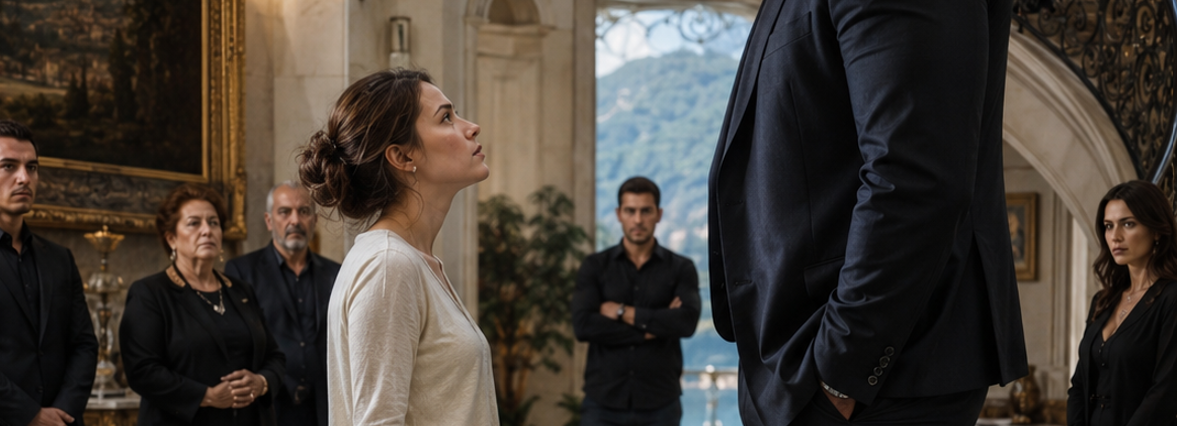
Elena’s fingers closed lightly around my wrist.
«Before you say yes,» she whispered, «there’s something about this marriage you need to know. Something my brother doesn’t know I know.»
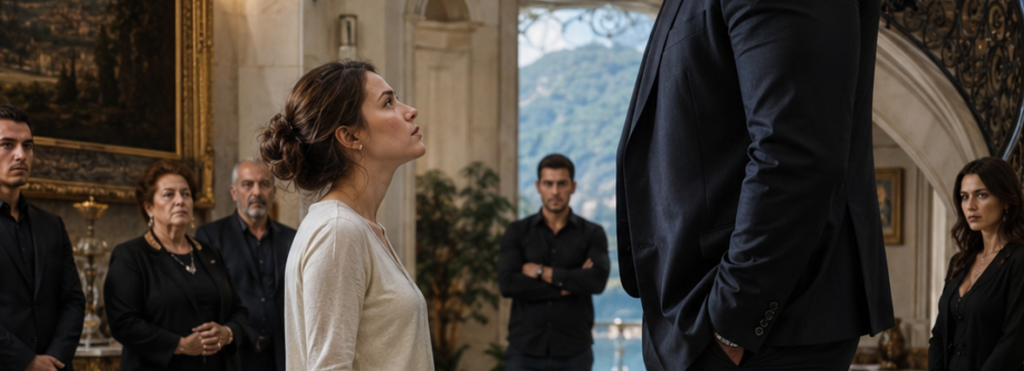
For three seconds, the foyer seemed to lose all sound: the priest waiting somewhere deeper inside the house; Marco standing near the entrance with the expression of a man professionally trained not to notice anything; Luca Moretti towering a few feet away, watching me with those guarded dark eyes; and Elena beside me, her face composed except for the unmistakable urgency in her voice.
I swallowed hard. «What kind of something?»
Her gaze flicked toward Luca. «Not here.»
That was easily the least comforting answer available. Luca noticed, of course. A man who looked like him probably spent his entire life picking up on the half-second hesitation before someone spoke, the sideways glances exchanged when they thought he couldn’t see, and the way a room’s energy shifted just by his walking into it. His expression settled—not angry, which would have been easier to read, but worse: resigned.
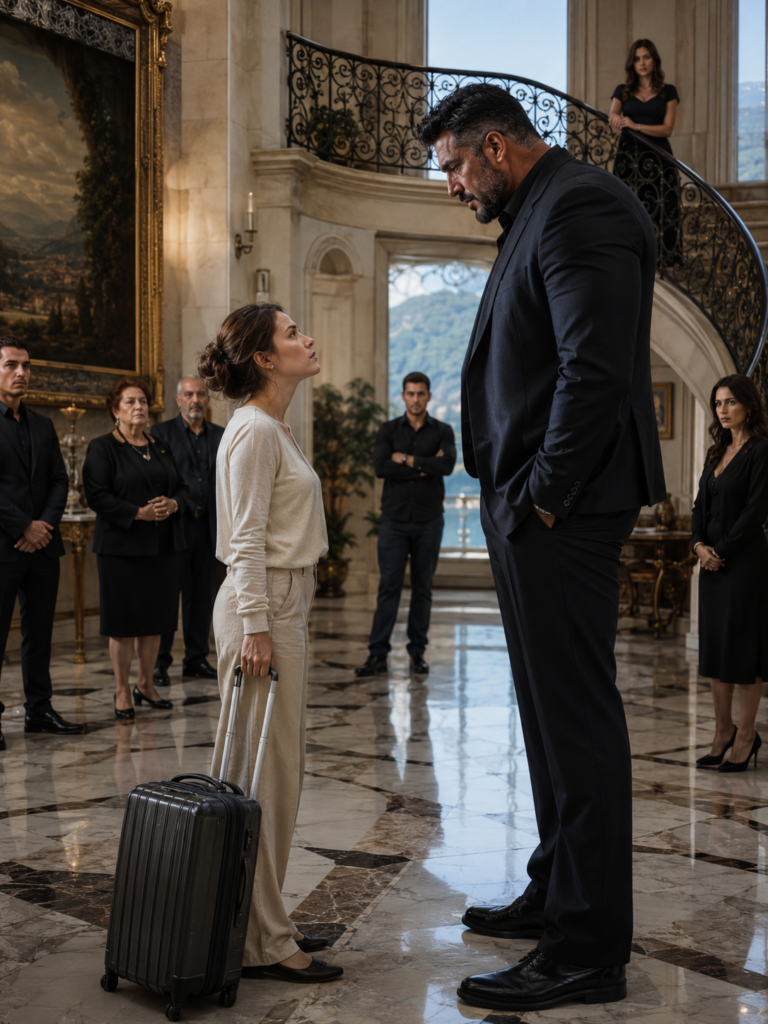
«If you’ve changed your mind,» he said quietly, «you don’t need to explain.»
I looked at him. There it was again, that expectation. A door preparing to close before anyone had even touched the handle.
«I haven’t changed my mind.»
Elena gave me a sharp glance.
I added quickly, «I also haven’t made it yet.»
Something almost like amusement flickered across Luca’s face. «That seems reasonable.»
«I would like…» My voice caught. Apparently, rehearsing speeches for forty minutes in a car had been entirely useless. «I’d like until tomorrow.»
Marco glanced toward Luca, Elena went still, and Luca simply studied me.
«To decide?» he asked.
«To understand what I’m deciding.»
His eyes moved once toward his sister. Elena didn’t look away; there was history in that glance, years of it. Finally, Luca nodded. «Tomorrow.»
That easily. No argument. No reminder of my father’s debt. No mention of obligations or promises. He turned toward Marco. «Tell Father Matteo we apologize.»
«Of course,» Marco said.
«And arrange dinner for four.»
Elena raised an eyebrow. «Four?»
«You started this conversation,» Luca said. «You can finish it at the table.»
He looked back at me. «You’ve traveled a long way. Elena can show you your room.»
«I’m not being locked in it, am I?»
Marco made a choking noise that might have been a laugh pretending to be a cough. Luca stared at me before the corner of his mouth twitched upward. «No.»
«Good. Because I’m surprisingly resourceful around windows.»
«I’ll alert security.» There was dry humor in his voice now.
I hadn’t expected that. I hadn’t expected anything about him, really. That was the whole problem. I had arrived carrying a picture my father had built with careful sentences and uncomfortable pauses: Luca Moretti, head of the family, a man people obeyed and other families treated carefully. A man five women had apparently met with the possibility of marriage and declined. My father hadn’t said much about those women, and even less about why they had turned him down. I had filled in the blanks myself, and now I wondered how many of those blanks were entirely wrong.
Elena led me upstairs to a room that overlooked Lake Como. Calling it a room was ridiculous; my entire apartment back home could have fit inside it with enough space left over for an argument about rent. Tall windows opened toward the mountains, a small sitting area faced a stone fireplace, and pale curtains shifted in the breeze from a balcony overlooking gardens cut into the slope below. My suitcase had already appeared at the foot of the bed.
«I assume you have very efficient ghosts,» I said.
«Marco.»
«Less interesting.»
Elena shut the door, and the humor immediately disappeared from her face. I sat on the edge of the bed. «All right.»
She remained standing. «Our father died two years ago.»
«I knew that.»
«Did your father tell you he and Vittorio Moretti had been business partners?»
I frowned. «He said they knew each other.»
«They knew each other for almost twenty-five years.» That was not the same thing. «My father never mentioned that.»
«I suspected he hadn’t.» Elena walked toward the window. «Our family owns hotels, shipping companies, agricultural estates, and other things.» There was a deliberate pause around those last two words.
I knew what the Moretti name represented—everybody did. But reputations lasted longer than the people who created them, and families could carry old stories like inherited furniture nobody knew where to put.
«Twenty years ago,» Elena continued, «our father began moving most of the family’s legitimate businesses into separate companies. Your parents helped with one of them.»
«My parents owned a bakery.»
«Your mother understood food better than half the consultants my father hired.»
That sounded like Mom. Margaret Bennett had never met a consultant she couldn’t intimidate with butter.
«She developed pastry programs for three Moretti hotels,» Elena said. «Chicago, New York, and Florence.»
I stared at her. «My mother worked for your family?»
«With them. She refused to work for anyone.» That sounded even more like Mom.
«And my father?»
«He handled expansion. Later, he borrowed money from Moretti Hospitality to expand Bennett Bakery into wholesale distribution.»
That part I knew—not the Moretti connection, but the expansion. I had been twenty-one when Dad leased the warehouse, twenty-three when everything began going wrong. Too many stores, too many contracts, refrigerated trucks we couldn’t afford, and a supermarket agreement that collapsed after six months. Then Mom became ill. The business had shrunk around us while medical appointments and unpaid invoices piled up on the kitchen table. Dad had always told me the Moretti loan was the thing that remained, the debt he could never escape.
«How much?» I asked.
«Elena.»
Luca’s voice came from the doorway. Neither of us had heard it open. He stood there without his suit jacket now, white shirt sleeves rolled once at his forearms. Somehow he seemed even larger without the formality of the jacket, but his expression was directed squarely at his sister.
«What are you telling her?»
«The truth.»
«Which truth?»
Elena folded her arms. «That Daniel Bennett’s loan may already have been settled.»
I stopped breathing for a second. Luca didn’t move. «What?»
«I found one of Papa’s old restructuring files.»
«When?»
«Last month.»
«And you didn’t tell me?»
«I wasn’t sure what I had.»
His jaw tightened—not with fury, but with hurt. It was quieter than anger and somehow more revealing. «You were sure enough to tell Sophia.»
«She was about to marry you tonight.»
The words landed heavily between them. Luca looked at me, and I tried to absorb what I had just heard. «My father’s debt is paid?»
Elena shook her head. «I don’t know.»
«That sounded suspiciously like you knew.»
«I know the original loan documents were marked restructured three years before Vittorio died. There should be a settlement agreement. I haven’t found the signed copy.»
Luca stepped into the room. «You searched Papa’s private files?»
«I was looking for the Florence foundation records.»
«And found Bennett?»
«Yes.»
«Why didn’t you bring it to Francesca?»
«Because if I was wrong, I didn’t want another accounting mess landing on your desk when you were preparing for this.»
He gave her a look that made Elena sigh. «And because I thought you would say exactly what you’re saying now.»
«I haven’t said anything.»
«You do a remarkable amount of speaking with your face.»
I looked between them. For one ridiculous moment, I felt like a preschool teacher interrupting an argument between two unusually well-dressed giants. I stood up.
«Can we start from the part where I flew across an ocean because my father told me he owed your family enough money that marrying you would settle it?»
Luca’s expression changed. «He told you that?»
«Yes.»
«I was told the marriage was his proposal.»
I stared at him. «What?»
«Your father contacted Francesca six months ago.»
«My father said your family approached him.»
«No.» One small word, and a whole new problem.
Elena lowered herself into the chair near the window. «Oh.»
I looked at her. «What does ‘oh’ mean?»
«It means dinner is going to be more interesting than I expected.»
«I don’t want interesting. I want boring. I suddenly have a profound appreciation for boring.»
Luca rubbed a hand over his jaw. «My understanding was that your father wanted the two families connected again, and that the debt would be absorbed into a new hospitality agreement after the marriage.»
«He told me you demanded the marriage.»
«I demanded nothing.» There was no raised voice, but something in him went very still. «💍 I asked Francesca three times whether you had agreed freely.»
My stomach dropped. «And she said?»
«That your father had your consent.»
I closed my eyes. Dad. Not again. Not another one of his carefully edited truths. «May I call him?»
Luca looked almost offended by the question. «You don’t need my permission.»
«I know.»
«Do you?» That stopped me. His voice had softened. I opened my eyes to find Luca watching me with a seriousness that made my chest ache unexpectedly. «You came here believing I expected obedience from you.»
I hesitated. «Yes.»
«And now?»
«I’ve known you approximately twelve minutes.»
«Twenty-three.»
«You counted?»
«No.»
Marco’s voice drifted from the hallway. «Twenty-three.»
Elena covered her mouth, and I laughed before I could stop myself. Luca turned his head toward the door. «Marco.»
«I was told dinner for four.»
«You were not told to stand outside listening.»
«I wasn’t standing. I was walking very slowly.»
Even Luca laughed then—barely, but I saw it. A real smile changed him in a way I wasn’t prepared for. He still looked formidable, just humanly formidable.
When everyone finally left, I called my father. He answered on the second ring.
«Soph?»
«Hi, Dad.»
«You arrived?»
«Yes.»
«How is the house?»
«Large.»
«And Moretti?»
«Also large.»
Silence hung on the line. I sat near the window while Lake Como stretched below me, blue-gray beneath the evening light. «Dad, Elena says the loan may have been restructured.»
Nothing.
«Dad?»
«I didn’t want you dragged into that.»
I stared at the phone. «You arranged my marriage.»
«That isn’t what I—»
«You told me Luca Moretti expected me to marry him because you owed his family money.»
«I told you it would settle things.»
«That is not the same sentence.»
He exhaled. My father had a particular silence when he was ashamed, one I had known since childhood. It usually came after bounced checks, missed school events, or promises about the bakery that didn’t work out.
«I thought it would,» he said.
«Thought what would?»
«Settle everything.»
«You proposed it?»
A long pause. «Yes.»
The word hurt more than I expected. «Why?»
«I was trying to give you something secure.»
«I had something secure.»
«The bakery is barely surviving.»
«It’s mine.»
«And I watched your mother work herself exhausted trying to save it.»
His voice cracked around her name, stopping both of us dead in our tracks. Mom had been gone four years; grief had stopped being a storm and become regular weather, though sometimes it arrived without warning.
«Dad,» I said more quietly, «why didn’t you tell me you knew the Morettis this well?»
«I didn’t want that part of our life following you.»
«What part?»
Another silence. «I’ll explain when you come home.»
«No.»
«Sophia.»
«You sent me to Italy to marry a man I’d never met. We are past the stage where explanations get scheduled for later.»
He breathed out slowly. «There are things about your mother I should have told you.»
My fingers tightened around the phone. «What things?»
A knock sounded at my door, and Elena leaned inside. «Francesca is here.»
I nodded. «Dad, I have to go.»
«Soph—»
«I’m not marrying anyone tonight.»
«I understand.»
«And tomorrow depends on the truth.»
Another pause. Then my father said something I hadn’t expected: «It should.»
Dinner took place in a smaller dining room—which apparently meant a table for twelve instead of thirty. Francesca Conti sat at Luca’s right, in her early fifties with silver threaded through her black hair and reading glasses balanced low on her nose. She looked like a woman who could find a missing clause at forty paces.
«I was told there was confusion,» she said.
«There is an entire festival of confusion,» I replied.
Marco coughed into his napkin, and Francesca almost smiled. Luca explained what Elena had found, and Francesca listened without interrupting before opening a leather case.
«I brought copies of every document my office received from Daniel Bennett.» She slid a folder toward me.
The first letter had my father’s signature; the second outlined the proposal. Not a demand, not even a condition of debt repayment, but a formal proposal. Daniel Bennett wished to reopen discussions between the Bennett and Moretti families regarding commercial cooperation and, should both parties wish it, a marital union between Luca Moretti and Sophia Bennett.
I read the paragraph twice. My father had transformed should both parties wish it into this is the only way. I looked up at Luca.
«You received this?»
«Yes.»
«And you agreed?»
His fingers rested beside his wineglass. «Eventually.»
«Why?»
Elena suddenly became fascinated with her plate, while Marco discovered the ceiling. I waited until Luca met my eyes.
«Because I was tired of meeting women who arrived already afraid of me.» The answer was quiet. «I thought an arrangement might be simpler.»
That made me sad in a way I couldn’t explain—not because arranged marriages were inherently tragic, but because he had said simpler. Not better, not happier. Simpler.
«You met five women?»
His eyes narrowed. «Who told you that?»
«Your face.»
Elena laughed, though Luca ignored her. «Yes.»
«What happened?»
«Sophia,» Elena murmured.
«No. It’s all right.» Luca looked down at his hands. «The first barely spoke through dinner. The second told her father afterward that she could never sleep beside someone my size.»
Heat crawled up my neck on behalf of a woman I had never met. «That’s awful.»
«The third liked me until she learned I would not transfer controlling shares of a company into her family. The fourth decided she preferred my cousin.»
Marco suddenly drank a great deal of water.
«And the fifth?»
Luca paused. «She was kind.»
Something about the way he said it made me listen harder. «She told me she could accept the family, the house, the public attention. But she wanted children, and she was afraid they would inherit my height.»
I stared at him. «That’s ridiculous.»
«Genetics would disagree.»
«That isn’t what I meant.» His eyes lifted, and I felt strangely angry for him—not furious, just irritated at the quiet accumulation of small cruelties people could justify because they were spoken politely.
«So you decided arranged marriage number six was easier?»
His mouth tilted. «Something like that.»
«Very romantic.»
«I wasn’t expecting romance.»
«Clearly.»
That earned me another almost-smile.
Francesca cleared her throat. «I hate to interrupt this exceptionally productive courtship, but Elena may be correct.»
Every face turned toward her. She had opened another file. «The Bennett debt appears in the Moretti Hospitality ledger until three years ago. Then the principal balance becomes zero.»
My heart jumped. «Paid?»
«I don’t know.» She pointed to a line. «Transferred.»
«To where?»
«That is the question.»
The answer required access to archive records stored in Vittorio Moretti’s old study. Luca had avoided the room since his father died, admitting this only after Elena unlocked the door.
«I thought you worked in here,» I said.
«Never.»
The study smelled faintly of cedar and old paper. Books covered two walls, and a heavy desk faced windows looking down toward the lake. Nothing had been preserved like a museum; it simply looked unused.
Elena went directly to a cabinet. «Papa kept personal agreements separately.»
«You knew that?» Luca asked.
«I helped organize them after Mama died.»
His face softened at the mention of their mother. For the next hour, we opened files: Bennett Bakery, Chicago expansion, hospitality consulting, catering contracts. Names I knew, and names I didn’t.
Then I found something completely unrelated to numbers. A photograph slipped from between two folders and landed face down on the rug. I picked it up. A young man stood beside a huge birthday cake—maybe eighteen, already broad-shouldered and taller than everyone around him, but unmistakably Luca. Behind the cake stood a woman with flour on her black dress.
I knew that smile. «Mom.»
My voice came out barely above a whisper.
Luca looked over. He froze. «That was your mother?»
I handed him the photograph. «You knew her?»
«No.» He stared at it. «I remember the cake.»
Of course he did. It was enormous—three tiers covered in chocolate curls and small golden sugar leaves. At the bottom, piped in icing, were the words: BUON COMPLEANNO, LUCA.
«I was eighteen,» he said slowly. «My father said a friend from America made it.»
I sat down. «My mother was here.»
Elena looked over my shoulder. «She visited several times.»
«Nobody told me.»
Luca turned the photograph over. There was handwriting on the back—not my mother’s, but a man’s: Vittorio Moretti. Margaret says children should never be made responsible for their parents’ bargains. Underneath it was a date from eighteen years ago.
Nobody spoke. Elena moved suddenly toward the cabinet. «I remember that phrase.»
She pulled out another file, then another, until finally she found a cream envelope sealed inside a transparent archive sleeve. Across the front were two names: Vittorio Moretti and Margaret Bennett.
My hands went cold. Francesca carefully opened the sleeve. Inside were four pages: the first concerned the hotel pastry contract, the second discussed expansion rights, the third dealt with loans, and the fourth was handwritten. Francesca read it once silently, then looked at Luca.
«What?» he asked quietly.
Francesca gave him the page. I watched his eyes move across it, his expression shifting from confusion to disbelief, and then to something almost wounded.
«What does it say?» I asked.
He handed the paper to me. The handwriting was Vittorio’s:
Margaret,
Daniel will always try to save everyone himself. You know this.
If the bakery expansion fails, I will restructure the debt against future hospitality revenues. Neither Sophia nor Luca will be asked to carry it.
You have my word.
Our children will not become payment for our choices.
Below that was my mother’s handwriting: Good. Because if either of us ever suggests marrying them off to fix our bookkeeping, I reserve the right to come back and haunt you.
Despite everything, I laughed—a broken little laugh. «That’s Mom.»
Elena smiled. Luca didn’t. He was staring at the final line, a handwritten notation beneath both signatures: Debt conversion executed. See Bennett-Moretti Revenue Agreement.
Francesca read it twice. «This means the original loan was not supposed to be outstanding.»
«So my father doesn’t owe Luca anything?» I whispered.
«Not under the original note.»
Luca pushed his chair back. «No.»
We looked at him. His expression had become very calm. «I want the full account reviewed.»
Francesca nodded. «Immediately.»
«And no one contacts Daniel demanding payment.»
«I wouldn’t.»
«I know.» He looked at me, embarrassment clear in his eyes, maybe even shame, though none of this was his fault. «You came here because you believed you were paying your father’s debt.»
«Yes.»
«I agreed to meet you because I believed you wanted this arrangement.»
«Yes.»
«So neither of us knew what the other had actually been told.»
«No.»
He nodded once. «Then there will be no ceremony tomorrow.»
The words should have been a relief. Instead, something unexpected happened—my heart sank just a little. Which was absurd. I barely knew him. I had spent one evening at his house, fallen into his shirt, insulted his romantic abilities, and uncovered a family accounting problem. And yet—
«Unless,» he added, «someday you decide there should be one.»
My eyes lifted. No expectation. No bargain. No debt. Just a choice.
«That sounded dangerously close to flirting.»
«I’m told I’m inexperienced.»
«Five failed prospects would support that.»
Elena groaned. «Please don’t encourage her.»
Marco looked at Luca. «I like her.»
«You weren’t asked.»
«I’ve served you for fourteen years. I stopped waiting to be asked around year three.»
For the first time since I’d arrived, the room felt almost warm—not safe because the mysteries were solved, because they weren’t, but safe because nobody was pretending anymore.
Later that night, unable to sleep, I wandered downstairs. The kitchen lights were on, and Luca stood at the counter. He had abandoned the suit entirely, wearing dark trousers and a white shirt with the sleeves rolled higher, staring at a bowl as though it had personally offended him.
«What are you doing?»
He glanced up. «Making coffee.»
«That is a mixing bowl.»
«I had not begun.»
«Good recovery.»
I opened cupboards until I found flour.
«What are you doing?» he asked.
«Baking.»
«At midnight?»
«My business model depends on it.»
He watched as I found lemons, sugar, eggs, and olive oil. The kitchen staff had apparently gone to bed, though everything was perfectly arranged. I began measuring ingredients, and Luca leaned against the counter.
«You’re not angry.»
«Oh, I’m angry.»
«At your father?»
«Mostly.»
«At me?»
I considered it. «No.»
«You could be.»
«For what?»
«Agreeing to marry someone you didn’t know.»
I cracked an egg. «So did I.»
«You thought you had no choice.»
«That’s what I need to figure out.»
He was silent while I mixed batter. A few minutes later, I handed him a whisk. He looked at it, then at me.
«This seems unwise.»
«You run a multinational hotel group.»
«Yes.»
«You can whisk eggs.»
«That conclusion is not supported by evidence.»
«Try.»
He did, far too carefully. I stared. «You’re afraid of the bowl.»
«I am not.»
«You look terrified.»
«I was told bakers are territorial.»
«We are.»
He whisked faster, and some batter splashed his sleeve. I laughed. Luca looked at the yellow streak, then at me, and started laughing too—not the restrained almost-laugh from earlier, but a real one, low and surprised, as though he hadn’t expected the sound from himself.
Something inside me shifted. Not love—nothing that dramatic—but recognition, perhaps. A person becoming visible where an expectation had been.
We put the cake in the oven, and while it baked, we sat at the enormous kitchen table.
«Why did you really agree?» I asked.
He knew what I meant. «Not because it was simple.» He considered his answer. «My father believed marriage should strengthen a family.»
«Business?»
«Not only business.» He looked toward the dark windows. «My parents were arranged.»
I blinked. «They loved each other?»
«Eventually.»
«Eventually sounds promising.»
«It took my mother approximately six months to stop calling him an arrogant peacock.»
I smiled. «And then?»
«Then she spent thirty-four years proving she was correct.»
I laughed, and his face softened. «I suppose I thought perhaps affection could come afterward.»
«And now?»
«Now I think affection should have the dignity of arriving before paperwork.»
That was such a carefully Luca sentence that I smiled again.
The timer sounded, and I stood up. He did too. I stepped around the chair, caught my foot on his shoe, and my balance vanished. Again. His hands caught my waist. Again.
Only this time, I didn’t grab his shirt. I landed against his chest. He went still, and so did I. He was warm, solid, and very, very close. His hands remained at my waist only long enough to make certain I was steady before he released me.
«You do fall often.»
«I warned you.»
«You did.»
Neither of us moved. His eyes dropped briefly toward my mouth, then returned to mine. No pressure. No assumption. Just a question he didn’t ask.
I stepped back. «Cake.»
«Of course.»
«Very important.»
«Extremely.»
Neither of us mentioned the moment again.
The next morning, Francesca arrived before breakfast carrying another file, her expression telling me she had found something. We met in the small library, with Luca standing beside the fireplace, Elena sitting near me, and Marco remaining by the doors. Francesca placed the file on the table.
«I found the revenue agreement.»
My pulse climbed. «And?»
«The Bennett loan was converted into a percentage of future revenues from three Moretti hotels using Margaret Bennett’s pastry programs.»
«So the debt was settled?»
«Yes.»
Relief nearly took the strength out of me. My father was free. I was free. But Francesca did not look relieved.
«What?» Luca asked.
«There is another document.» She pulled out a second page. «This one is much newer.»
«How new?»
«Six months.» The exact same month my father had contacted her.
She slid it toward me. I recognized Dad’s signature immediately. There were no threats, no debt, no marriage condition. Instead, it was an application to transfer ownership of Bennett Bakery.
I stared at the name of the proposed recipient. Not Luca. Not Moretti Hospitality.
Me.
«He was giving me the bakery?»
Francesca nodded. «Completely.»
«Why?»
«There’s a letter attached.»
My hands shook as I opened it:
Soph,
If you are reading this, then I finally failed at keeping one secret too many.
The bakery was always meant to be yours.
The debt was never the reason I contacted Luca Moretti.
I did it because of something your mother asked me to do before she died.
I stopped reading. The room became impossibly quiet. Luca moved closer but did not touch me, and I looked at the remaining lines—there were only three:
I should have told you years ago.
Ask Luca about the summer Margaret Bennett spent at Villa Moretti.
Then ask him why Vittorio kept Room 214 empty for eighteen years.
I lifted my head. Luca’s face had gone completely still.
«Room 214?» Elena whispered.
Luca stared at the letter, then at me. «I know that room.»
«Why was it kept empty?»
He shook his head. «I don’t know.»
But Elena was no longer looking at either of us. She was looking toward the hallway, her face having lost its color.
«I do,» she said.
And suddenly the question was no longer why my father had wanted me to marry Luca Moretti. It was what our parents had begun in this house eighteen years ago—and why they had spent the rest of their lives making sure neither of us knew.